
CO-NELEMixing & Granulation
Precision-engineered batching plants and forced-action mixing systems developed for high-volume concrete manufacturing, refractory castables, and ultra-high-performance applications.
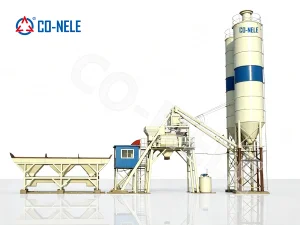
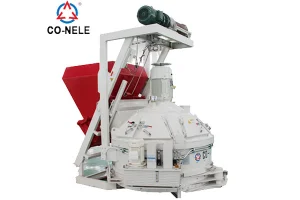
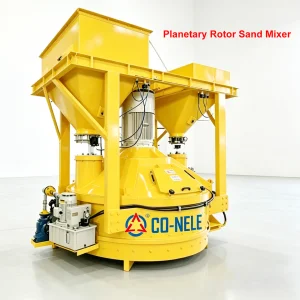
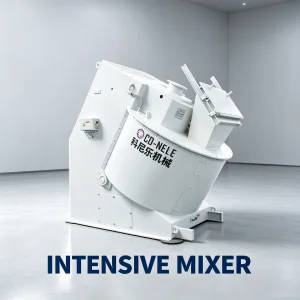
Evaluating operational throughput, volumetric dosing accuracy, and mechanical efficiency standards across modern commercial readymix and high-precision precast manufacturing facilities.
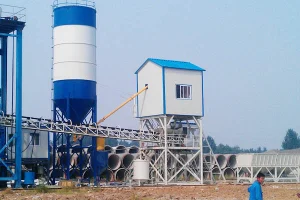
Modern industrial concrete production demands exact volumetric yield calculations rather than theoretical nominal mixer ratings. Engineering a batching plant's true output requires analyzing aggregate charge times, cement aeration velocity, fluid dosing rates, and discharge gate pneumatic clearance dynamics. A plant rated at nominal 120 m³/h capacity must achieve consistent 60-second batch cycles with less than 2.5 seconds of gate latency to maintain effective real-world throughput.
Global procurement teams evaluating Chinese machinery manufacturers prioritize power consumption per cubic meter mixed (kWh/m³), wear liner longevity under high-abrasion basalt aggregate friction, and gearbox thermal endurance. High-performance plants incorporate hardened alloy liners (HB500+) and automated central lubrication circuits to extend wear blade operational lifespans past 120,000 continuous mixing cycles without structural deformation.
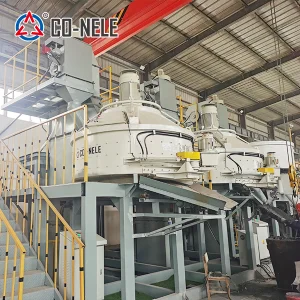
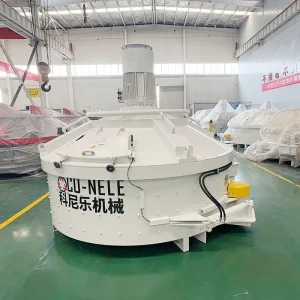
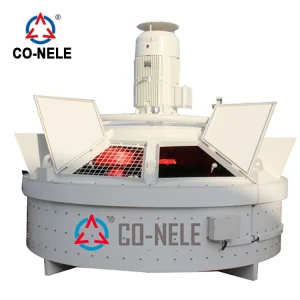
Achieving uniform binder dispersion in Ultra-High-Performance Concrete (UHPC) and self-compacting recipes requires micro-shear energy dissipation. Vertical planetary counter-current mixing mechanisms deliver complex non-repeating flow trajectories, ensuring zero dead zones and reducing the coefficient of variation (CV) of compressive strength across cured batches to under 3.5%.
| Plant Series / Model | Theoretical Capacity | Effective Output (30s Mix) | Mixer Configuration | Aggregate Bin Storage | Discharge Clearance |
|---|---|---|---|---|---|
| HZS25 / Compact | 25 m³/h | 18 - 21 m³/h | JS500 Twin Shaft / CMP500 Planetary | 3 x 10 m³ (Skip Hopper) | 3.8 Meters |
| HZS50 / Modular | 50 m³/h | 40 - 44 m³/h | JS1000 Twin Shaft / CMP1000 Planetary | 4 x 15 m³ (Skip / Belt) | 4.0 Meters |
| HZS75 / Mobile | 75 m³/h | 58 - 65 m³/h | JS1500 Twin Shaft Compulsory | 4 x 20 m³ (Inclined Belt) | 4.1 Meters |
| HZS120 / Commercial | 120 m³/h | 95 - 105 m³/h | JS2000 Twin Shaft Compulsory | 4 x 30 m³ (Chevron Belt) | 4.2 Meters |
| HZS180 / Infrastructure | 180 m³/h | 145 - 160 m³/h | JS3000 Heavy Duty Twin Shaft | 4 x 45 m³ (Dual Belt Feed) | 4.2 Meters |
| HZS240 / Mega-Plant | 240 m³/h | 195 - 215 m³/h | JS4000 High-Torque Compulsory | 5 x 50 m³ (Enclosed Tower) | 4.5 Meters |
A systematic calculation framework for EPC contractors, ready-mix suppliers, and precast concrete plants to size mixing capacity based on project logistics and mix specifications.
Plant specifiers frequently miscalculate capacity by assuming theoretical output equals daily truck-loading throughput. Theoretical capacity represents continuous dry-run mixing cycles under zero material latency. To determine required plant capacity for commercial readymix operations, apply the standard Operational Efficiency Factor (OEF):
For an HZS120 plant (120 m³/h theoretical), practical sustained output ranges between 80 m³/h and 98 m³/h under standard suburban ready-mix truck dispatch logistics.
Optimizing plant capacity requires dissecting the complete mixing timeline per batch. Reductions in individual phase durations aggregate to substantial daily volumetric gains:
Multi-loadcell aggregate batching with high-speed micro-pulse dosing accuracy within ±1% limits.
Synchronized belt or skip hoist elevation feeding materials into the pressurized mixing chamber.
Planetary counter-current or twin-shaft turbulent mixing achieving complete micro-homogeneity.
Variable hydraulic gate opening preventing concrete segregation into waiting transit mixers or hoppers.
Analyzing fluid dynamics, shear rates, drive train stress, and mechanical wear mechanisms inside modern heavy-duty industrial concrete mixers.
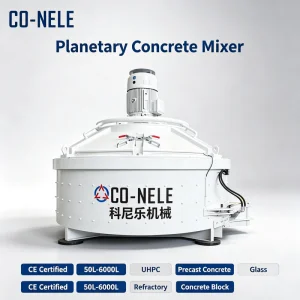
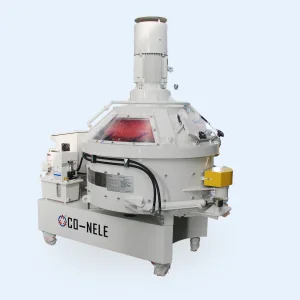
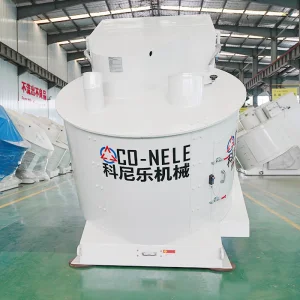
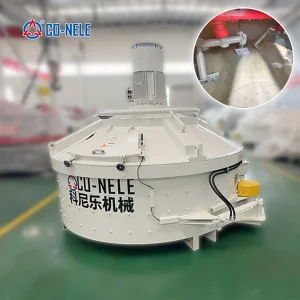
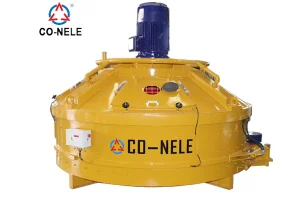
Planetary concrete mixers feature a vertical main drive shaft connected to rotating mixer stars that orbit around the central axis while revolving rapidly around their own pivots. This dual-kinematic rotation forces the mixing blades through complex, non-overlapping geometric paths.
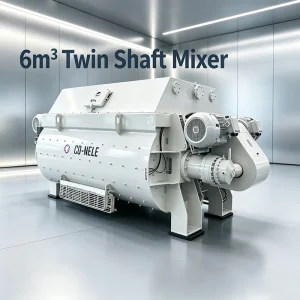
Twin-shaft compulsory concrete mixers utilize dual horizontal shafts fitted with counter-rotating helical mixing paddles. The overlapping paddle radius creates a intense horizontal and axial counter-current flow pattern, generating a weightless turbulent boiling zone in the center of the mixing trough.
From ultra-dense refractory linings in steel mills to high-volume highway infrastructure paving, plant configurations are customized to match material rheology.
Precast component production (hollow-core slabs, utility culverts, wall panels, and pavers) demands zero batch-to-batch color or moisture deviation. Incorporating CMP Planetary mixers with moisture-sensing probes ensures precise slump control, smooth demolding surface finishes, and accelerated early compressive strength development for fast mold turnover.
UHPC formulations contain low water-binder ratios (<0.20), high silica fume concentrations, and micro-steel fiber reinforcement. Specialized UHPC mixers feature high-power electric motors, reinforced planetary arms, and thermal monitoring to prevent premature hydration while maintaining high shear stress to completely coat micro-fibers without clumping.
Processing dense refractory castables for metallurgical furnaces requires heavy-duty intensive mixing technology. Specialized refractory mixers incorporate thick Ni-Hard pan liners, tungsten carbide coated paddles, and dust-tight seals to withstand continuous abrasion from corundum, silicon carbide, and bauxite aggregates.
Integrating real-time microwave sensors, cloud telemetry, automated aggregate moisture compensation, and environmental dust containment into modern batching infrastructure.
Water-cement ratio consistency represents the primary variable governing concrete structural integrity. Modern Chinese batching plants integrate high-frequency digital microwave moisture sensors inside aggregate storage bins and mixing pans. Reading sand moisture 25 times per second, the automated control system dynamically calculates real-time aggregate surface water weight and adjusts mixing water trim valves within ±0.5 liters accuracy before batch discharge.
Environmental compliance regulations in Western Europe and North America necessitate fully enclosed batching plant architectures. Advanced dust suppression technology incorporates pulse-jet negative pressure baghouse filters on cement silos and mixing tower enclosures, capturing 99.9% of airborne particulates down to 1 micron. Integrated filter cake recovery systems return captured dust directly back into the weigh batcher, eliminating plant waste streams.
Examining geographic procurement preferences, climate adaptation requirements, and project execution trends across key global industrial markets.
High ambient temperatures (>45°C) require concrete plants equipped with chilled water mixing systems, liquid nitrogen dosing manifolds, and insulated aggregate storage bins. High-capacity HZS180 and HZS240 plants deployed in Saudi Arabia and the UAE feature heavy-duty dust seals, dual-chiller lines, and high-volume cement silo configurations to maintain continuous pour schedules for commercial skyscraper foundations and port installations.
US and Canadian contractors prioritize compliance with ASTM C94, NRMCA certification requirements, and OSHA electrical standards. Chinese exports to North America utilize UL-listed Siemens PLC control panels, Eaton electrical switchgear, heavy-duty structural steel frame designs, and quick-connect modular wiring harnesses to facilitate rapid site assembly and municipal inspector approvals.
Transportation infrastructure growth in Indonesia, Vietnam, and the Philippines drives demand for highly mobile, foundationless concrete batching plants. Mobile series plants mounted on heavy-duty tri-axle trailer chassis allow contractors to relocate batching equipment between highway segments within 48 hours, reducing concrete transit times over challenging rural terrain.
Rigorous international engineering compliance ensures smooth integration into global job sites while satisfying local environmental and electrical mandates.
Leading Chinese machinery manufacturers engineer batching plants to satisfy stringent international structural, mechanical, and electrical codes:
Operational continuity requires proactive lifecycle management and rapid spare parts availability:
Direct technical answers provided by senior concrete plant design engineers regarding mixer selection, wear longevity, and site installation economics.
Base your choice on concrete formulation rheology and intended output. Select a vertical planetary counter-current mixer for dry-cast concrete, block manufacturing, architectural precast, colored mixes, and Ultra-High-Performance Concrete (UHPC) where micro-homogeneity (<5% CV) is required. Select a compulsory twin-shaft mixer for high-throughput commercial ready-mix plants (>60 m³/h output) producing wet concrete recipes with aggregates up to 80mm.
Under standard aggregate mixing conditions (limestone/gravel under 20mm), high-chrome alloy wear parts (cast iron with 20-26% Chromium, hardness >60 HRC) last between 100,000 and 150,000 mixing cycles. When mixing highly abrasive quartz aggregates, silica fume, or refractory castables, wear part lifespan typically ranges between 40,000 and 70,000 batches. All liners feature standardized bolt-on designs for fast field replacement.
Foundationless batching plants utilize integrated heavy-duty steel base frames that sit directly on compacted soil or simple flat concrete slabs, eliminating deep concrete footings and ground excavation. They require up to 80% less civil preparation work and can be fully erected or disassembled within 3 to 5 days using standard cranes, making them ideal for leased land or mobile infrastructure contracts.
All motor drives, electrical control cabinets, and pneumatic solenoid valves are fully customizable to match local grid standards across the globe. Standard configurations include 380V/50Hz, 415V/50Hz, 440V/60Hz, 460V/60Hz, and 220V/60Hz (3-Phase). Electrical cabinets feature dual-voltage transformer circuits and tropicalized IP65 enclosure protection for extreme environmental resistance.
Yes. Plant control systems are built on open architecture industrial PLC platforms (Siemens S7-1200/1500 or Schneider Modicon) communicating over standard Industrial Ethernet (PROFINET, Modbus TCP, Ethernet/IP). Control software integrates seamlessly with external aggregate radial stackers, automated silo level radar sensors, ERP dispatching software, and central laboratory quality databases.
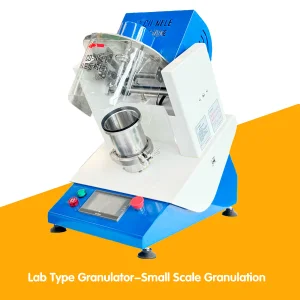
Manufacturers operate fully equipped industrial mixing laboratories housing 5L to 75L pilot-scale intensive and planetary mixers. Clients can ship 20-50 kg raw powder and aggregate samples to test mixing time, power torque curves, liquid binder dispersion, granule bulk density, and final cured strength before committing to full-scale production line orders.
Explore our full line of specialized planetary mixers, twin-shaft concrete batching systems, sand mixers, and granulators designed for demanding industrial duty.
Consult with our senior application engineers to calculate precise batching plant dimensions, select forced-action planetary or twin-shaft mixers, and receive custom CAD site layout proposals tailored to your project requirements.
Request Engineering Proposal