
CO-NELEMixing & Granulation
Precision-engineered intensive mixers, planetary batching systems, and laboratory granulators tailored for refractory castables, advanced ceramics, and dense aggregate formulations.
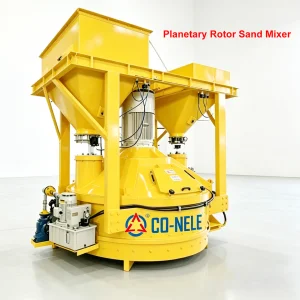
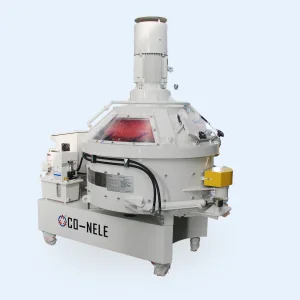
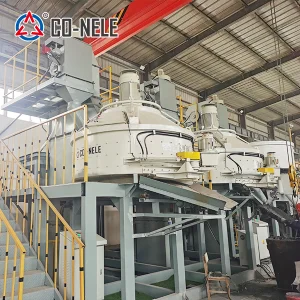
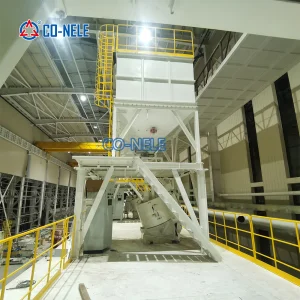
In modern high-temperature industrial applications—ranging from blast furnace hearths and ladles in steelmaking to rotary clinker kilns in cement production—the thermal, mechanical, and chemical longevity of linings relies entirely on the structural homogeneity of the refractory matrix. As global refractory technology shifts rapidly from traditional fired bricks toward unshaped monolithics, Low-Cement Castables (LCC), Ultra-Low Cement Castables (ULCC), and No-Cement Self-Flowing Castables (NCC), the operational requirements placed on industrial mixing machinery have scaled exponentially.
Traditional gravity-fed or horizontal free-fall pan mixers are fundamentally incapable of processing high-density monolithic refractories. These complex formulations contain micro-silica, ultrafine alumina powders (sub-micron particle size), metallic fibers, and chemical deflocculants. Without intense forced mechanical energy, fine powders agglomerate into dry micro-balls, while coarse dense aggregates (such as tabular alumina, fused white corundum, or silicon carbide) suffer severe gravity-induced segregation. China high-capacity refractory mixer machinery designed by CO-NELE integrates vertical-shaft counter-current planetary drives and inclined intensive mixing mechanics, establishing a micro-homogeneity benchmark with a Coefficient of Variation (CV) under 3%.
High-shear rotor mechanics shatter electrostatic agglomerates in micro-silica and active alumina, guaranteeing 100% hydration and additive activation within 60 to 90 seconds of wet mixing.
Counter-current mixing blades combine vertical lifting action with horizontal radial acceleration, forcing ultra-dense aggregates and light liquids into continuous dynamic intersection.
Energy transmission efficiency reaches 92%, mitigating unwanted frictional heating of temperature-sensitive binder systems and extending the working life window of castables on site.
Global refractory manufacturing is undergoing structural consolidation and technological upgrading driven by stringent environmental regulations, raw material cost pressures, and the global transition to low-carbon industrial processes (such as Direct Reduced Iron via Hydrogen in steelmaking). Buyers across Western Europe, North America, the Middle East, and Southeast Asia are shifting procurement strategies from simple equipment purchasing to long-term operational partnerships with authoritative original equipment manufacturers (OEMs).
| Macro Industry Driver | Traditional Mixing Setup | Next-Gen High-Capacity Refractory Mixer | Industrial Operational Impact |
|---|---|---|---|
| Decarbonization & EAF Steelmaking | Standard horizontal twin-shaft or gravity pan mixers | Vertical Planetary / Inclined Intensive Mixers | Enables production of complex synthetic MgO-C and Al2O3-SiC-C castables with minimal binder content. |
| Refractory Matrix Micro-Dispersion | Manual liquid dosing, extended 5-min cycle times | Automated PLC liquid injection & high-shear rotor dosing | Reduces mixing cycle times by 60%, achieving CV < 3% for ultra-fine micro-silica powders. |
| Tribological & Wear Cost Control | Generic AR400 or cast iron wear plates | Diamond-grade Carbide Tiles & High-Chrome Ni-Hard Liners | Extends liner service life from 20,000 batches to over 150,000 batches under corundum abrasion. |
| Smart Plant Automation & Data Tracking | Stand-alone analog relay operation | SCADA / Siemens S7-1500 PLC with IoT Rheology Sensing | Full digital trace-ability per batch, real-time power curve monitoring for moisture control. |
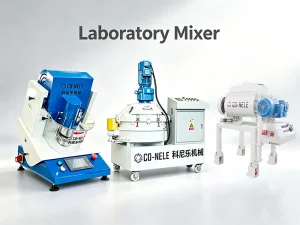
As a leading China capacity refractory mixer manufacturer, CO-NELE has addressed these global shifts by developing scalable mixing platforms ranging from 150-liter laboratory R&D units to 4,000-liter continuous industrial production lines. Equipment design integrates severe duty-cycle gearboxes capable of surviving instantaneous thermal shock and high torque loads associated with dense castable formulations.
The mechanical superiority of modern refractory mixers stems from sophisticated kinematic drive geometry. In contrast to conventional single-axis rotation, CO-NELE machinery employs a multi-axial planetary counter-current mixing system and inclined high-shear rotor technology.
The mixing stars revolve around the central axis of the mixing pan while simultaneously rotating rapidly on their own axes in opposite directions. The overlapping swept paths ensure that within one rotation cycle of the main drive, every square millimeter of the pan floor and wall is swept by heavy-duty tungsten carbide mixing blades.
The heart of the refractory mixer is its proprietary, co-axial planetary reducer gearbox. Engineered specifically to withstand high torque spikes and heavy structural shock loads when initiating wet mixing of ultra-dense formulations. The gearbox uses forced oil-lubrication cooling and dual viton shaft seals to eliminate oil leakage risks completely.
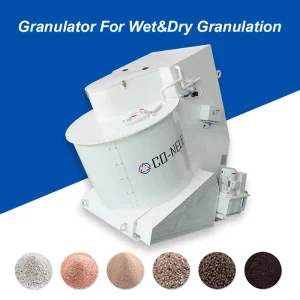
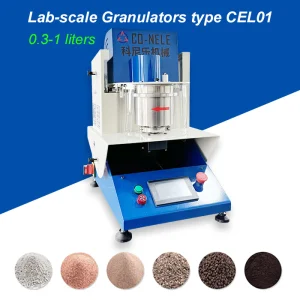
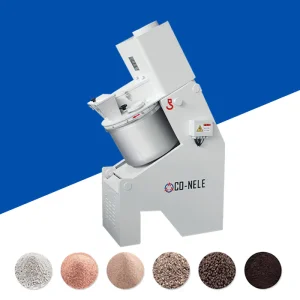
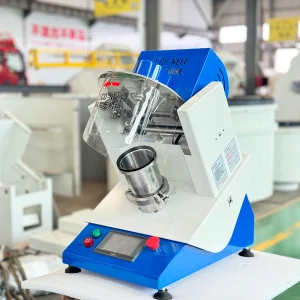
For synthetic raw material preparation, proppants, and pressed refractory brick powders, CO-NELE intensive mixers feature an inclined rotating pan coupled with an independently driven high-speed rotor. This configuration converts raw powders into spherical granules with up to 95% targeted size distribution without thermal drying.
For engineering procurement managers and technical directors at global refractory manufacturing enterprises, initial capital expenditure (CAPEX) represents less than 15% of the total 10-year lifecycle cost of an industrial mixer. The vast majority of expenditure is consumed by operational costs (OPEX)—including power usage, wear-part replacement, unscheduled downtime, and batch quality reject rates.
Refractory ingredients like fused alumina and silicon carbide reach 8.5 to 9 on the Mohs hardness scale. Standard steel pan liners wear through in weeks. CO-NELE equips mixers with interchangeable, bolt-on liners made of Chrome-Nickel alloy (Ni-Hard 4, hardness > 60 HRC) or specialized ceramic tile linings, extending replacement intervals dramatically.
Pneumatically or hydraulically operated dual-door discharge gates are curve-matched to the pan floor perimeter. The dynamic scraping action of the floor mixing blade sweeps the discharge zone, clearing batch materials in under 12 seconds with less than 0.1% residue remaining.
High-efficiency IE3/IE4 premium motors combined with high-torque gearboxes deliver maximum kinetic energy directly into the mixing pan. Energy usage per metric ton of processed refractory is reduced by 18% to 25% compared to legacy horizontal mixers.
CO-NELE high-capacity refractory mixer machines are deployed across diverse heavy industry supply chains globally. Each sector presents distinct recipe demands, material bulk densities, and thermal requirements:
Specialized mixing systems for Blast Furnace Main Trough Castables, Ladle Working Layer Monolithics, Tundish Coatings, and RH Degasser Snorkel Refractories. Precision dispersion of organic fibers and anti-explosion agents ensures void-free, spall-resistant linings.
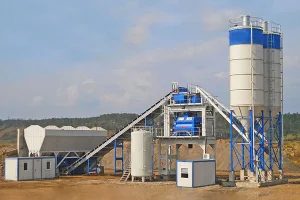
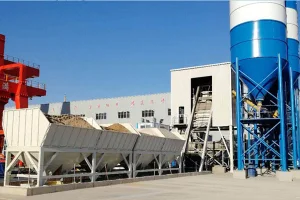
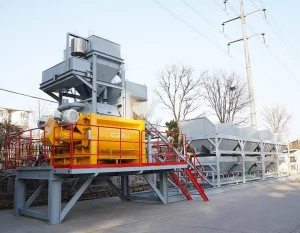
High-output batching plants and refractory mixers for Preheater Cyclone Linings, Kiln Hood Castables, and Cooler Grate Liners. Engineered to process high-alkali resistant and silicon-carbide reinforced formulations with consistent moisture dispersion.
Contamination-free mixing solutions for Aluminum Melting Furnace Castables, Anode Baking Refractories, and Glass Tank Regenerator Checker Bricks. Optional stainless steel linings or non-metallic polyurethane wear parts prevent iron contamination.
Heavy-duty mixing lines for Fluidized Bed Catalytic Cracking (FCCU) anti-erosion linings, municipal waste incinerator linings, and boiler tube protection castables requiring extreme abrasion resistance at elevated temperatures.
Because refractory mixing involves processing hard synthetic aggregates under intensive mechanical force, wear engineering is at the forefront of CO-NELE research and development. Our machines incorporate layered tribological protection systems:
Mixing pan floor and wall liners are constructed from high-chromium cast iron alloys (26% Cr, hardness ≥ 62 HRC). Modular design allows localized replacement of high-wear zones (such as outer wall radii) without discarding intact floor panels.
Mixing blades feature vacuum-brazed Tungsten Carbide (WC) tiles along leading edge profiles, combined with hard-facing weld overlays on upper blade surfaces. This dual-protection approach yields 4x to 6x longer service life than standard tool steel blades.
A Siemens PLC-controlled central lubrication unit delivers precise micro-doses of grease to rotor bearings, shaft seals, and discharge gate hinges at pre-programmed batch intervals, preventing dust ingress and premature bearing failure.
As an established OEM exporting to over 80 countries, CO-NELE adheres strictly to international industrial standards. Machinery destined for the European Union, North America, the Middle East, or Asia undergoes rigorous quality control testing prior to dispatch.
All mixing equipment complies with EU Machinery Directive 2006/42/EC, Low Voltage Directive 2014/35/EU, and ISO 9001 quality management benchmarks. Optional ATEX explosion-proof configurations are available for dusty chemical environments.
Control cabinets are custom-built to match regional power standards—including 220V, 380V, 415V, 440V, 480V, and 690V at 50Hz or 60Hz. Standard integration of Schneider, Siemens, and ABB electrical components ensures easy off-the-shelf local spare parts sourcing.
Equipped with secure IoT cloud gateways, our technical support team can perform remote PLC diagnostics, program updates, and operational troubleshooting worldwide. Factory-trained field engineers provide physical installation, commissioning, and staff training on site.
Looking ahead to 2030, the refractory mixing process is evolving from fixed-time batch cycles to real-time, dynamic rheological sensing. CO-NELE is pioneering smart mixing platforms that integrate Artificial Intelligence and inline physical sensors to transform factory automation:
By analyzing real-time high-frequency torque data from the planetary gearbox, the control system calculates changes in batch viscosity and yield stress, automatically adjusting liquid additive dosing to achieve target slump without manual intervention.
High-speed ceramic microwave sensors mounted directly in the mixing pan floor measure real-time moisture content within the batch 25 times per second, guaranteeing sub-0.1% water control for low-cement castable formulations.
Next-generation intensive granulating mixers combine mechanical pelletizing with waste-heat drying air loops, allowing refractory producers to form micro-pellets with zero direct carbon emissions.
Detailed answers compiled by CO-NELE senior application engineers to assist purchasing directors and process engineers in equipment selection:
Explore CO-NELE’s full range of concrete batching plants, mobile mixing stations, high-shear granulators, and lab-scale intensive equipment.
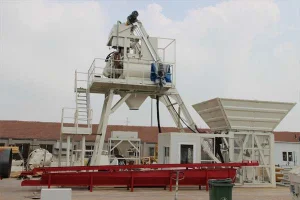
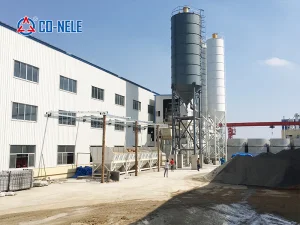
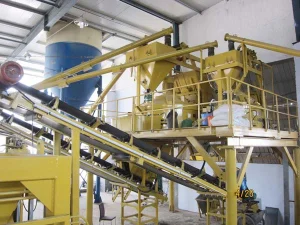
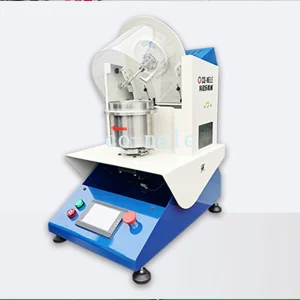
Whether you are designing a new unshaped refractory production facility, upgrading an existing concrete block batching plant, or developing proprietary ceramic granulations, CO-NELE application engineers provide full process calculations, layout drawings, and trial testing.