
CO-NELEMixing & Granulation
Explore our top-tier manufacturing lines certified for high-homogeneity precast, permeable paving, and infrastructure projects worldwide.
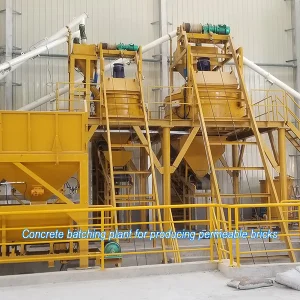
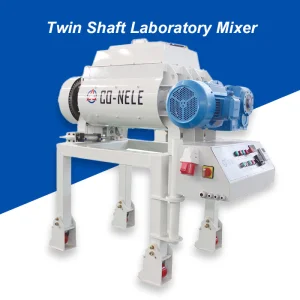
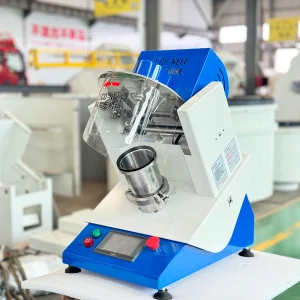
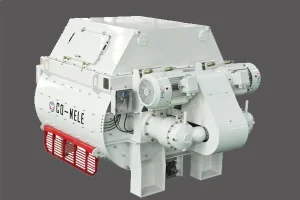
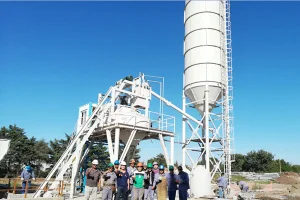
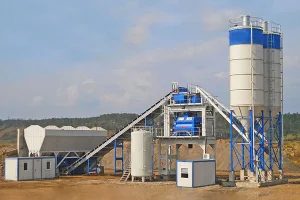
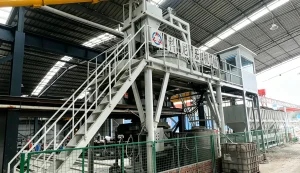
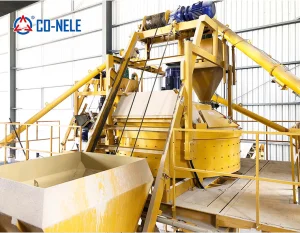
In modern industrial civil engineering, high-performance infrastructure, and structural precast production, the selection of mixing equipment dictates operational profitability, material integrity, and structural longevity. A Wet Mix Concrete Plant (also known as a central mix concrete plant) differs fundamentally from dry batching systems by fully homogenizing aggregates, cementitious binders, water, and chemical admixtures inside a compulsory central mixer before discharging the slurry into transit mixers or concrete pumps.
The global demand for wet mix plants is experiencing rapid growth, driven by stringent EN 206 and ASTM C94 quality mandates across major infrastructure projects worldwide. Dry mix systems, which rely on the transit mixer drum to combine dry materials with water en route, introduce substantial variance in water-cement ratio ($w/c$), slump stability, and air entrainment. Conversely, wet mix plants utilize vertical planetary mixers or twin-shaft forced mixers to guarantee micro-homogeneity, yielding a Coefficient of Variation ($CV$) under 5% across complex batch recipes.
As municipal construction specifications tighten around carbon emissions and resource usage, China's concrete machinery sector—led by engineering innovators such as QINGDAO CO-NELE MACHINERY CO., LTD.—has emerged as a primary exporter of advanced batching systems. Chinese manufacturers have closed the gap with legacy European equipment makers by offering state-of-the-art planetary gearing, integrated microwave moisture tracking, fully enclosed zero-emission dust management, and custom plant modularity at a competitive total cost of ownership (TCO).
Unlike assemblers who buy third-party commercial gearboxes, premier Chinese manufacturers design and cast heavy-duty planetary reducers in-house. This ensures optimized torque output under zero-slump and ultra-high-performance concrete (UHPC) shear stress.
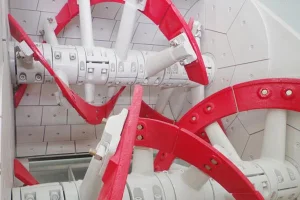
Pan liners and mixing blades utilize high-chromium Ni-Hard alloy casting ($>26\% \text{ Cr}$), extending service operational lifespans past 120,000 batches on abrasive aggregates, drastically lowering maintenance downtime.
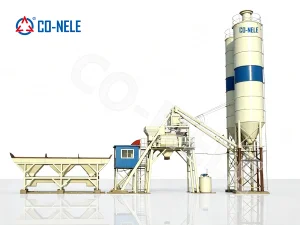
Factory-preassembled structural modules allow foundationless or quick-bolt installation. Modular designs reduce on-site civil works by 60%, enabling fast deployment for highway, tunnel, and dam construction sites.
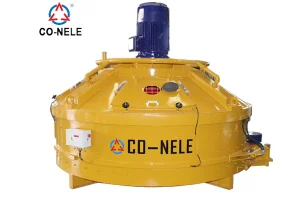
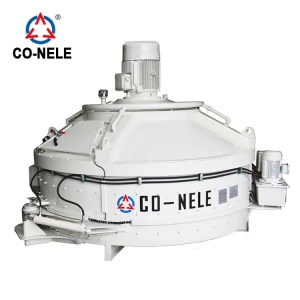
Chinese wet mix concrete batching plants typically offer two core compulsory mixing configurations. For high-volume readymix ($>90\text{ m}^3/\text{h}$), twin-shaft horizontal compulsory mixers supply rapid horizontal cut-and-shear flow. For precast, block production, architectural facing concrete, and specialized formulas (UHPC, GFRC, refractory castables), vertical-shaft planetary counter-current mixers are specified due to their multi-dimensional orbital stroke that leaves zero dead zones.
Select the optimal mixing architecture based on your application's target strength, slump, and daily output needs.
| Plant Parameter | Stationary Ready-Mix Line (Twin-Shaft) | Precast & Permeable Brick Plant (Planetary) | Mobile / Compact Foundationless Unit |
|---|---|---|---|
| Target Capacity Range | 90 m³/h – 240 m³/h | 25 m³/h – 120 m³/h | 25 m³/h – 60 m³/h |
| Mixer Core Type | Double Shaft Compulsory Mixer (CHS Series) | Planetary Counter-Current Mixer (CMPS / CMP) | Compact Twin Shaft or Planetary Unit |
| Discharge Homogeneity | CV < 5% in 35 seconds | CV < 2% in 45-60 seconds (Zero Dead Zone) | CV < 5% in 40 seconds |
| Concrete Application | Commercial Wet Concrete, Pavements, Foundations | Permeable Bricks, Concrete Pipes, Precast Wall Panels, UHPC | Remote Roads, Temporary Dams, Short-Term Site Contracts |
| Dosing Accuracy | Aggregate ±2%, Cement/Water ±1%, Admixture ±0.8% | Aggregate ±1%, Cement/Water ±0.5%, Admixture ±0.5% | Aggregate ±2%, Cement/Water ±1% |
| Installation Footprint | Large (Civil Foundations + High Tower Silos) | Medium (Factory Floor Integrated / Overhead) | Ultra-Compact (Wheel Mounted / Level Pad Slab) |
Modern wet mix concrete batching plants rely on industrial automation to meet precise structural engineering standards. In high-specification manufacturing, a variation of even 1% in moisture content can alter water-cement ratios enough to reduce compressive strength, ruin color uniformity in architectural panels, or produce honeycombing in structural precast columns.
Leading Chinese wet mix concrete plants embed high-frequency microwave moisture sensors inside aggregate batching bins and underneath the planetary mixing pan liner. These sensors measure real-time dielectric constants across aggregate flow, sending 100 sample readings per second to the master PLC controller.
The control hub integrates a Siemens Industrial PLC paired with interactive SCADA touchscreen interfaces. System capabilities include:
Requires low-slump, zero-slump coarse aggregate formulations. Planetary wet mix batching plants (e.g. CBP150) deliver uniform pigment distribution and precise water binder coating without clump formation.
Requires high early-strength development to speed up mold turnover cycles. Compulsory wet batching yields thorough cement activation and high density for core vibration pipe production.
Ultra-High-Performance Concrete (UHPC) contains micro-silica and steel fibers requiring intense shear mixing to disperse fibers without clumping. High-torque planetary mixers fulfill these exact mechanical shear profiles.
Infrastructure contractors demand maximum m³/h continuous volume output. Heavy twin-shaft wet mix plants (up to HZS180 / 180 m³/h) provide rapid discharge cycles with dual hydraulic gates.
The global concrete manufacturing industry is undergoing a major structural transformation driven by sustainability goals and digital intelligence. Modern Chinese wet mix concrete plant manufacturers lead this transition through three major technological trends:
To reduce carbon intensity, low-carbon mix designs incorporate high ratios of GGBS (ground granulated blast-furnace slag), fly ash, and calcined clays. Chinese wet mix plants feature pneumatic fluidization and anti-bridging powder silos designed for cohesive low-carbon powders.
Modern wet plants integrate automatic sand-gravel separators and re-use slurry water systems. Filtered slurry water is continuously monitored for solids concentration and factored into the automated batching water calculation, eliminating plant discharge.
Industrial IoT sensors placed on gearbox bearings, motor drives, and hydraulic discharge rams stream vibrational and thermal telemetry. AI analytics flag wear patterns before mechanical breakdown occurs, maximizing plant uptime.
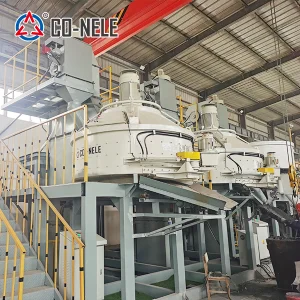
In-house gearbox machining, assembly lines, and high-performance concrete mixer testing at our Qingdao facility.
Detailed technical answers written by senior engineering leads at CO-NELE Machinery.
Explore our full line of compulsory mixers, compact batching systems, and mobile plant solutions engineered in Qingdao, China.
Contact our process engineering department today to receive a complete technical proposal, custom plant layout drawing, and factory-direct price quotation.