CO-NELEMixing & Granulation
In the modern era of high-performance civil engineering and heavy precast concrete production, forced (compulsory) mixing has superseded traditional gravity tilting drums. China has established itself as the global epicenter for advanced mixing machinery manufacturing.
Founded in 2004 in Qingdao, Shandong Province, Qingdao CO-NELE Machinery Co., Ltd. stands as a premier manufacturer of twin shaft automatic forced concrete mixers, vertical-shaft planetary mixers, and complete automated concrete batching plants. Operating across 30,000 square meters of specialized production facilities, CO-NELE combines deep mechanical engineering expertise with international quality control standards.
With over 80 granted patents, active participation in drafting National Industrial Mixing Standards, and more than 10,000 operational installations across 80+ countries, CO-NELE delivers unmatched mixing homogeneity, mechanical longevity, and operational efficiency for high-demand infrastructure projects.
Why double horizontal shaft compulsory mixing outclasses standard gravity and single-shaft systems in speed, consistency, and shear distribution.
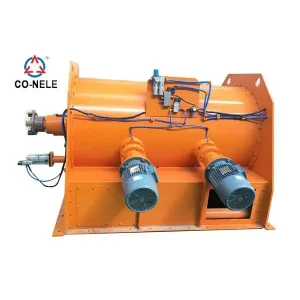
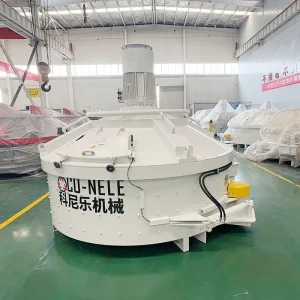
Two horizontal shafts rotate synchronously in opposite directions. Dual synchronized mixing arms equipped with staggered high-chrome paddles force material both radially and axially, generating an intense 3D turbulent boiling zone along the center overlap.
By applying mechanical shear directly to aggregate, cement powder, micro-silica, and chemical additives, compulsory twin shaft mixers achieve full macroscopic and microscopic mix uniformity (Coefficient of Variation CV < 5%) within 30 to 45 seconds.
Concrete slurries are severely abrasive. CO-NELE automatic twin shaft forced mixers feature patented multi-layer floating seal rings combined with automatic grease lubrication pumps, eliminating cement paste ingress and protecting shaft bearings.
| Mixing Criterion | CO-NELE Twin Shaft Forced Mixer | Vertical Planetary Counter-Current | Standard Gravity Tilting Drum |
|---|---|---|---|
| Primary Application | Commercial Ready-Mix, Mass Civil Infra, Wet Concrete | UHPC, Precast Blocks, Dry Cast, Refractories | Low-Grade Site Concrete, Simple Aggregate Mixes |
| Mixing Time / Batch | 30 – 45 Seconds | 60 – 90 Seconds | 120 – 180 Seconds |
| Mixing Uniformity (CV) | < 5% (Micro-Homogeneous) | < 3% (Ultra-Micro Homogeneous) | > 12% (Macro-Variable) |
| Wear Parts Lifespan | 90,000 – 150,000 Batches (High Chrome Alloy) | 40,000 – 60,000 Batches (Abrasive Rec.) | Short (Mild Steel Plates) |
| Discharge Efficiency | Dual Hydraulic Gates (Fast, Zero Segregation) | Bottom Sector Gate (Clean, Controlled) | Gravity Drum Tilt (Slow, Segregation Risk) |
How CO-NELE leverages Qingdao's industrial ecosystem to deliver superior mechanical reliability and rapid delivery timelines.
Global contractors and batching plant buyers face rising supply chain risks, erratic lead times, and inflated component costs. CO-NELE addresses these challenges through vertical integration and smart factory manufacturing in Qingdao, China.
From robot-assisted structural welding and heavy-duty CNC boring of mixer frames to proprietary planetary gear drive assembly, CO-NELE maintains complete quality supervision over every critical component. In-house dynamic load testing benches evaluate torque tolerance and temperature thresholds before any mixer leaves the assembly line.
Direct partnerships with premier steel mills ensure heavy manganese steel frames and high-chrome wear plates (Ni-Hard & Chromium Alloy HRB > 60) at stable cost structures.
All shaft ends, seal kits, paddle arms, and discharge valves are standard modular designs. Replacement parts for machines built as early as 2004 remain fully available and interchangeable.
Located minutes from Qingdao International Port, machinery is packed in ocean-safe heavy wooden frames or standard high-cube containers, speeding up global shipping routes.
Pioneering smart telemetry, green binder reduction, and automated rheology control systems for the next decade of concrete production.
Integration of smart acoustic and vibration sensors along the main bearings and gearbox housings. Real-time telemetry predicts wear liner thinning and alerts operators before mechanical failure.
Optimized paddle blade dynamic angles designed specifically for eco-friendly blended cements (fly ash, slag, calcined clay), ensuring uniform dispersion with reduced water-to-cement ratios.
Advanced hydrodynamic paddle contours that reduce electric power consumption by 15-20% per batch while generating higher localized shear forces for UHPC steel fiber dispersion.
High-frequency microwave moisture probes fitted inside the mixing pan transmit live data directly to the PLC, dynamically adjusting water injection during active mixing cycles.
Engineered mixing modules tailored to the unique physical demands of infrastructure, ready-mix supply, precast manufacturing, and special materials.
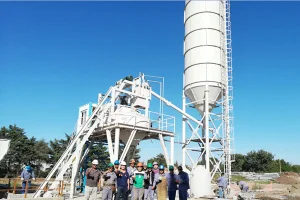
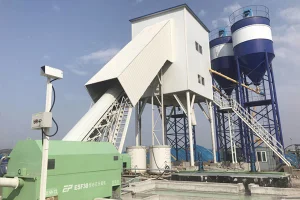
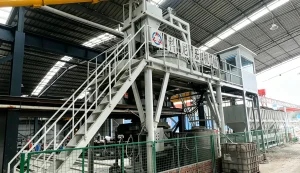
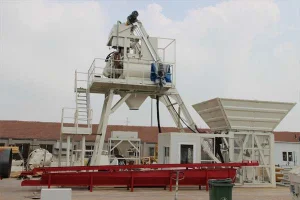
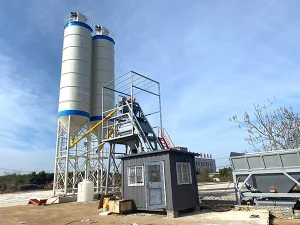
High-capacity CHS series twin shaft compulsory mixers (1.0 m³ to 6.0 m³ output per batch) integrated into HZS stationary batching plants. Ideal for highway construction, dams, airport runways, and commercial ready-mix concrete suppliers requiring high hourly throughput.
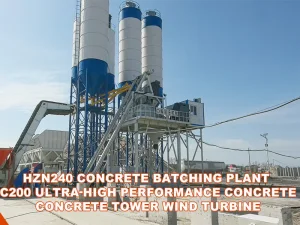
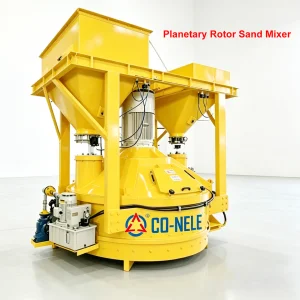
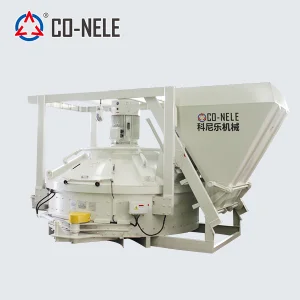
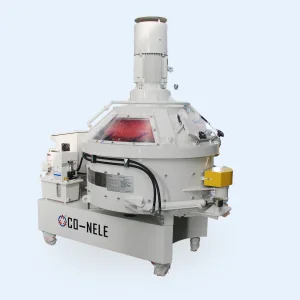
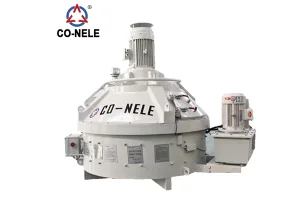
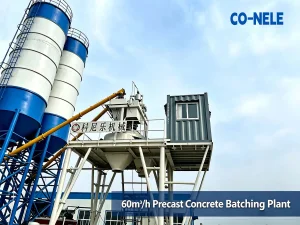
CMP planetary counter-current mixers paired with HZN precast batching plants. Essential for dry-cast paving blocks, concrete pipes, prestressed bridge girders, and architectural wall panels where surface finish and color uniformity are paramount.
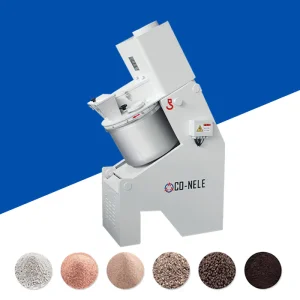
Heavy-duty reinforced planetary and intensive mixers designed for Ultra-High Performance Concrete (>150 MPa), GFRC, glass production batching, refractory castables, and abrasive ceramic sand mixing.
Evaluating purchase price against operational uptime, power consumption, and wear-part replacement costs.
When global procurement teams evaluate twin shaft automatic forced concrete mixers, initial capital expenditure (CAPEX) represents only 25-30% of the equipment's lifetime cost. Operational expenditure (OPEX)—including power efficiency, seal integrity, and wear component life—defines true profitability.
CO-NELE twin shaft mixers incorporate heavy-duty planetary gear reducers designed specifically for high-torque start-stop cycles. This direct-drive configuration minimizes mechanical power loss, yielding up to 12% savings in electrical energy per cubic meter mixed compared to standard belt-driven alternative units.
Seal failure leads to slurry contamination, bearing damage, and costly unplanned downtime. CO-NELE utilizes multi-sealed pressure systems with automated grease pumps.
Cast high-chrome alloy plates (Brinell Hardness > 600 HB) ensure prolonged operational life when mixing crushed basalt, quartzite, or recycled aggregate.
Siemens PLC controls, Schneider electric components, and dual-voltage options (220V-440V, 50/60Hz) with CE and UL compliance ensure seamless site integration.
Seamless international delivery, local electrical customization, and lifecycle engineering assistance.
Custom electrical engineering to match local regional power grids across North America (480V 60Hz), Europe (400V 50Hz), South America (220V/380V), and Southeast Asia, complete with CE documentation and schematics.
Remote engineer-led setup, video-guided mechanical commissioning, and step-by-step PLC calibration reduce installation delays and get your concrete batching line operating rapidly.
Standardized wear liners, paddle tips, seal packs, pneumatic valves, and sensor probes are held in stock for immediate dispatch via DHL/FedEx air freight or sea container shipments.
Expert technical clarity on concrete mixer selection, operational lifespans, material trials, and batching plant integration.
A twin shaft compulsory forced mixer utilizes dual horizontal synchronized shafts rotating counter-directionally to produce rapid 3D turbulence. It is optimal for high-volume ready-mix, mass infrastructure, and wet concrete above 1 m³ to 6 m³ per batch with fast 30-45 second cycle times. A planetary concrete mixer utilizes a vertical shaft with counter-current star arms, making it superior for ultra-high homogeneity dry-cast mixes, UHPC, precast block manufacturing, and color-pigmented products requiring a Coefficient of Variation (CV) below 3-5%.
Under standard operational conditions with standard aggregate mixes, CO-NELE high-chrome alloy wear liners (hardness > 60 HRC) typically deliver 90,000 to 150,000 production batches. For highly abrasive mixes, such as refractory castables or quartz-heavy UHPC, operational lifespan ranges between 40,000 and 60,000 batches. All wear parts are bolt-on and field-replaceable.
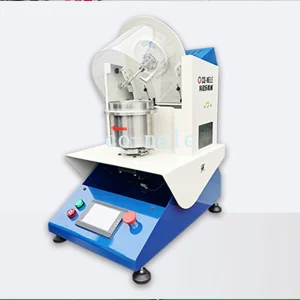
Yes. CO-NELE maintains a dedicated material testing laboratory in Qingdao equipped with lab-scale intensive and planetary mixers from 5 to 75 liters. International clients can send 10-20 kg of their aggregate, powder, or binder samples. Our engineers run trial batches, analyze particle distribution, moisture curves, mixing times, and bulk density, returning a formal test report and model sizing recommendation prior to order placement.
Every exported mixer and batching plant is shipped with a comprehensive engineering documentation package, including English operation and maintenance manuals, electrical schematics adapted to the buyer's local grid voltage, foundation anchor drawings, CE conformity declarations, ISO 9001 quality certificates, and a recommended 2-year spare-part list.
Selection depends on target hourly output and cycle logistics. Theoretical output formulas assume continuous mixing cycles. For example, an HZS60 batching plant featuring a 1.0 m³ twin shaft forced mixer running a 60-second complete cycle (loading, mixing, discharging) yields a practical output of approximately 45-50 m³/h. Our process engineers assist in balancing aggregate bin capacity, cement silo pneumatic delivery, and truck mixer dispatch rates.
Send us your raw material specifications, target concrete grades, and plant footprint. Our process engineering team in Qingdao will provide tailored dynamic mixer calculations, foundation layouts, and formal quotes within 24 hours.