CO-NELEMixing & Granulation
Explore our export-grade planetary mixers, intensive granulators, and specialized batching lines deployed in 80+ countries worldwide.
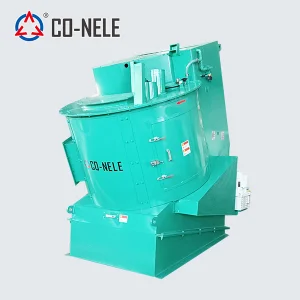
Why modern pyrometallurgical, steelmaking, and specialized precast operations are transitioning from conventional tilt-drum and horizontal twin-shaft mixers to vertical counter-current planetary systems.
Unshaped refractories—including low-cement (LCC), ultra-low cement (ULCC), and zero-cement castables (ZCC)—exhibit extreme thixotropy and high viscosity. Standard mixers introduce micro-segregation, leaving unhydrated binder pockets (silica fume/alumina) that drastically lower cold crushing strength (CCS) and thermal shock resistance in blast furnace linings.
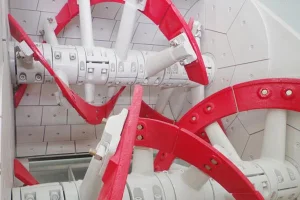
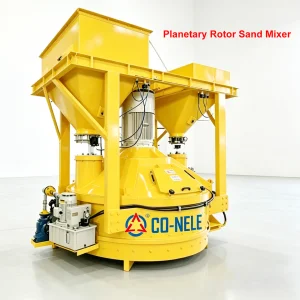
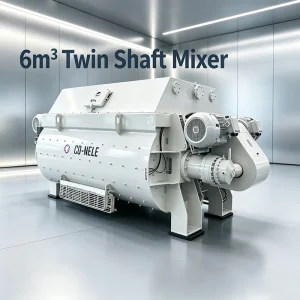
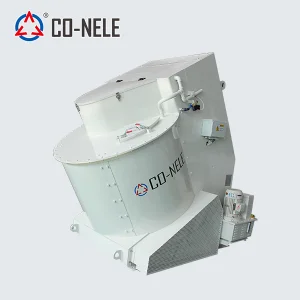
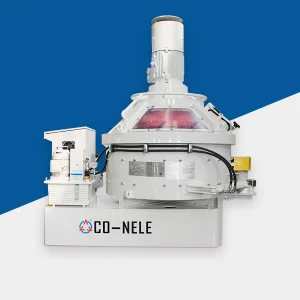
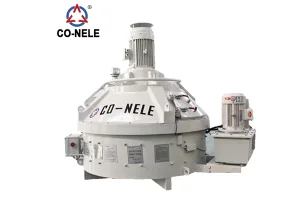
Horizontal twin-shaft mixers excel in wet ready-mix concrete above 2m³, but suffer from severe shaft-seal degradation when processing fine aggregate refractories or ultra-hard corundum/SiC particles. Vertical-shaft planetary counter-current mixing eliminates submerged shaft seals while providing 100% pan coverage every 4 planetary revolutions.
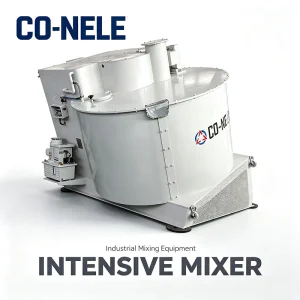
With global crude steel production demanding longer ladle lining lifecycles, refractories must achieve structural homogeneity with a coefficient of variation (CV) < 3%. Planetary counter-current mixers disperse organic/steel fibers evenly without balling, establishing a mandatory standard for modern EPC plant contractors.
China's industrial machinery ecosystem in Qingdao combines full-chain heavy manufacturing, metallurgy innovation, and uncompromised quality assurance to deliver world-class ROI.
Unlike regional assemblers who outsource critical components, leading Chinese manufacturers like CO-NELE design, cast, machine, and heat-treat planetary gearboxes in-house. By utilizing hardened alloy gear steels (20CrMnTi) subjected to carburizing and precision grinding, Chinese planetary reducers deliver high torque density, ultra-low backlashes, and zero oil-leakage over 10+ years of severe duty cycles.
Refractory aggregates (calcined bauxite, tabular alumina, silicon carbide, zirconia) rapidly erode mixing arms and pan liners. Chinese OEM factories leverage localized heavy metallurgy clusters to supply specialized wear components—such as high-chrome alloy cast iron (HB > 600), tungsten-carbide cladding, and diamond ceramic composite tiles—delivering 2x to 3x operational lifespan compared to generic European replacement parts.
European OEMs incur inflated overhead, resulting in replacement parts and capital expenditures that strain plant maintenance budgets. Chinese industrial mixer factories deliver identical or superior mixing velocity, German SEW/Siemens electrical integration, and CE/UL compliance at 40% to 60% lower total procurement cost (TCO).
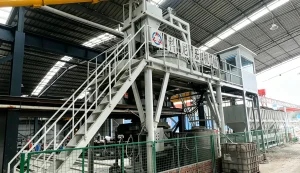
Industrial refractories require specialized batch discharge configurations: multi-gate hydraulic outlets, dust-tight sealed covers, high-pressure washing systems, and integrated moisture sensors (microwave/capacitive). Chinese factories offer agile modification turnarounds within 3 to 4 weeks, backed by complete 3D BIM foundation drawings.
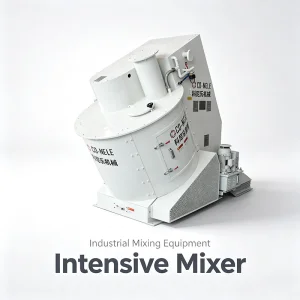
A rigorous breakdown of how planetary rotor trajectory eliminates dead zones and achieves micro-dispersion of refractory dry powders and liquid additives.
| Performance Dimension | Traditional Pan / Paddle Mixer | Horizontal Twin-Shaft Mixer | CO-NELE Planetary Counter-Current Mixer |
|---|---|---|---|
| Mixing Motion Kinematics | Single-axis rotation; material pushes outward creating centrifugal segregation. | Dual horizontal shaft shearing; central overlap zone with dead corners at end-plates. | Revolution + Rotation combined; complex counter-current star trajectory covers 100% floor area. |
| Unshaped Refractory Compatibility | Poor; struggles with dense castables & dry powders. High blade wear. | Moderate; slurry builds up on shafts; fine powders damage shaft seals. | Optimal; rapid shear breaks agglomerates, disperses micro-silica, steel & organic fibers flawlessly. |
| Shaft Seal Integrity | Submerged bottom seal prone to abrasive slurry leaks. | Submerged lateral end-seals requiring constant greasing and frequent replacement. | Top-Mounted Gearbox; zero contact between main drive seals and abrasive material zone. |
| Coefficient of Variation (CV) | CV 8% – 12% (Requires long cycle times) | CV 5% – 8% (Good for macro ready-mix) | CV < 3% (Achieved within 60 to 90 seconds of wet mixing) |
| Discharge Efficiency | Slow manual or pneumatic drop gate; residual buildup. | Hydraulic door; fast for large aggregate, prone to fine paste leakage. | Hydraulic Rotating Scraper Gate; clean, zero-residual rapid discharge. |
Coarse alumina, silica, and bauxite are charged. Mixing star arms eliminate initial size segregation.
Ultrafine silica fume, CAC cement, and nano-powders are added under dust-sealed negative pressure.
High-pressure atomized water manifolds dose exact liquid weight; microwave sensors track moisture in real-time.
High-speed planet arms shear matrix, coating aggregates evenly and dispersing metal fibers without clumping.
Hydraulic discharge gate opens; outer wall scrapers clean the pan floor cleanly in seconds.
How planetary concrete and refractory mixers solve severe operating conditions across diverse global sectors.
Scenario: Steel mills in Germany, India, and China require pre-cast monolithic ladle blocks and tundish dry mixes that withstand molten steel temperatures (>1650°C).
Solution: Planetary mixers equipped with high-chrome thick wear liners process dense magnesite, alumina-carbon, and chrome-corundum mixes, guaranteeing zero unmixed dry pockets.
Scenario: Cement operators in South America and Southeast Asia demand rapid-setting anti-stripping castables during furnace overhaul shutdowns.
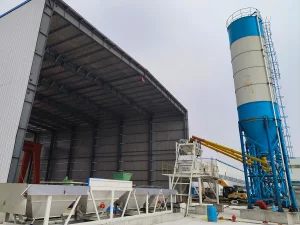
Solution: Mobile planetary batching stations allow on-site mixing of rapid-hardening alkali-resistant refractories with precise liquid dosing, reducing kiln downtime by up to 35%.
Scenario: Bridge deck expansion joint grouting and offshore wind turbine foundation grouting require fiber-reinforced UHPC exceeding 150 MPa compressive strength.
Solution: CO-NELE CMP series planetary concrete mixers deliver high shear forces needed to break down micro-silica agglomerates and cleanly coat dense steel micro-fibers without segregation.
Technological imperatives shaping the next generation of industrial mixing equipment.
Modern planetary mixers are incorporating real-time main shaft torque sensors and high-frequency microwave moisture probes. By monitoring resistance curve inflection points, the system automatically detects when optimal thixotropic fluidification occurs, automatically adjusting cycle times and cutting energy waste per batch.
As global steelmakers adopt hydrogen-based direct reduced iron (DRI) processes, refractory linings must adapt to new chemical stresses. Mixers must handle binderless and bio-resin carbon formulations, demanding nitrogen-purged explosion-proof (ATEX) mixing chambers and heated jacketed pan walls.
Transitioning from metallic high-chrome liners to modular sintered alumina ceramic mosaic tiles and silicon nitride-coated blades. This reduces iron contamination in high-purity electronic ceramics, refractory crucibles, and synthetic graphite battery anode mixing.
Essential criteria EPC contractors and plant directors must evaluate before selecting a manufacturing partner.
Direct answers from our senior engineering team on technical selection, wear life, and trial capabilities.
Review our specialized machinery catalog engineered for precast element batching, asphalt, dry mortar, and laboratory R&D.