
CO-NELEMixing & Granulation
Engineering excellence from Qingdao CO-NELE Machinery Co., Ltd. — Tailored solutions for ultra-high homogeneity, rapid batch cycles, and abrasive processing environments.
An in-depth analysis of processing mechanics, thermal lining integrity, and material dispersion demands across modern metallurgical processes.
In modern high-temperature industrial sectors—ranging from primary steelmaking blast furnaces and secondary metallurgy ladles to glass tank furnaces, cement rotary kilns, and chemical cracking towers—the operational lifespan of thermal containment depends entirely on the micro-structural integrity of the installed refractory materials. As global industrial operations push for higher thermal efficiency, lower carbon footprints, and longer campaign lives, the engineering requirements placed on refractory castables, plastic mixes, ramming mixes, and pre-fired shapes have reached unprecedented levels of complexity.
Historically, traditional horizontal pan mixers and twin-shaft forced mixers served as the industry workhorses. However, these classical mixing systems frequently exhibit fundamental physical limitations when handling modern refractory formulations, such as Low-Cement Castables (LCC), Ultra-Low Cement Castables (ULCC), No-Cement Castables (NCC), and matrixes enriched with ultrafine silica fume, micro-alumina, and metallic or organic fibers. Segregation, dead-zone agglomeration, uneven liquid distribution, and incomplete fiber dispersion lead directly to structural micro-voids, elevated porosity, and premature spalling during furnace campaigns.
This technical whitepaper details why leading international refractory manufacturers, EPC contractors, and steelmakers are replacing legacy pan designs with vertical-shaft planetary counter-current mixers. Manufactured with custom-engineered heavy-duty planetary gearboxes, high-hardness wear linings, and optimized star-arm kinematics, Chinese industrial mixer engineering—led by OEMs like Qingdao CO-NELE Machinery Co., Ltd.—has emerged as a key supplier of advanced mixing machinery worldwide.
Unlike standard concrete, refractory castables contain dense, highly abrasive aggregates (such as tabular alumina, fused brown corundum, silicon carbide, and bauxite) mixed with microscopic binder particles (<1 micron). Achieving complete wetting and deflocculation without inducing heat build-up or particle degradation requires intense kinetic energy dissipation. Planetary counter-current mixing ensures that every cubic millimeter of material undergoes continuous multidirectional shearing, eliminating density gradients and delivering 100% batch-to-batch repeatability.
Understanding the mathematical and mechanical advantages of counter-current star-arm motion over conventional mixing mechanisms.
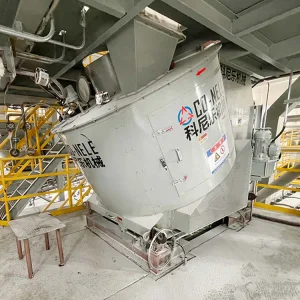
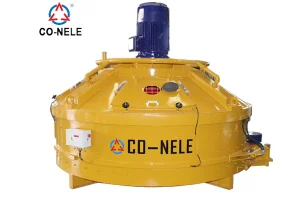
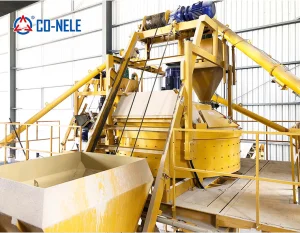
The core technological advantage of the planetary refractory mixer lies in its intricate drive geometry. The mixing arms and blades rotate around their own central axes while simultaneously revolving around the main vertical axis of the mixing pan. This complex motion path is referred to as counter-current planetary motion.
The rotational and revolutionary velocity ratios are precisely calculated so that within a single 360-degree revolution of the main rotor, the mixing blades sweep through every square centimeter of the pan floor without leaving dead zones.
Outer side scrapers continuously strip material off the inner wall and redirect it directly into the high-shear zone of the mixing stars, preventing material compaction along the pan periphery.
The opposing force fields generated by the counter-current blades shear apart clustered metallic or poly-propylenic fibers, achieving uniform matrix reinforcement without fiber balling.
Refractory aggregates such as silicon carbide, fused zirconia, and sintered corundum exhibit extreme hardness (Mohs 8–9.5). Standard steel liners wear out rapidly under high-pressure rubbing actions, leading to iron contamination of the refractory batch—a critical failure point in high-purity ceramic and electrical steel applications.
Refractory castable mixing requires high initial torque to break down stiff, dry-mixed solids before water addition. Standard commercial speed reducers often experience gear tooth pitting or shaft breakage under sudden shock loads. CO-NELE designs and manufactures dedicated planetary reducers featuring heavy-duty gear geometry, oil bath lubrication, and forced oil cooling circuits, ensuring high operational safety margins under continuous heavy-duty cycles.
Key drivers transforming global thermal material processing and the next-generation mixing technology landscape.
As the global steel industry shifts toward Direct Reduced Iron (DRI), Electric Arc Furnace (EAF) steelmaking, and hydrogen-fueled metallurgy, thermal shock profiles inside reactors are becoming more severe. Refractory formulations must adapt by incorporating higher percentages of synthetic raw materials, nanosilica, and carbon composite binders. Planetary mixers are essential for dispersing these ultrafine nano-phase additives evenly throughout the dry mix.
Modern planetary refractory mixers are no longer standalone mechanical units; they are intelligent process nodes within fully automated batching plants:
Real-time online microwave sensors embedded in the mixer base measure moisture content 50 times per second, dynamically adjusting water injection valves via PLC algorithms.
By monitoring the instantaneous power draw (kW) of the planetary gearbox motor, the control system calculates batch rheology and identifies the exact moment of peak wet-mix homogenization.
IoT-enabled vibration and thermal sensors mounted on bearing housings detect gear wear or alignment drift weeks before mechanical failure occurs.
The table below summarizes the technological evolution of Chinese planetary refractory mixing equipment from legacy mechanical setups to advanced smart mixing systems:
| Generation | Drive & Kinematics | Wear Protection | Process Control Level |
|---|---|---|---|
| Gen 1 (Legacy) | Standard pan / ribbon blades | AR400 steel plates | Manual relay controls |
| Gen 2 (Current Baseline) | Counter-current planetary gearbox | High-chrome Ni-Hard liners | Standard PLC & batching interface |
| Gen 3 (CO-NELE Next-Gen) | Dual-speed / VFD multi-axis planetary | ZTA Ceramics / Tungsten carbide | AI wattmetric rheology + IoT predictive care |
Tailored mixing systems engineered for specialized industrial processes across global installations.
Application: Mixing dense alumina-magnesia-carbon castables, tundish working linings, ladle well blocks, and tap-hole clay.
Key Benefit: High-shear dispersion breaks up fine binder agglomerates rapidly, ensuring low moisture requirement (down to 4-5%) while maintaining excellent vibration flowability during installation.
Application: Fusion-cast alumina-zirconia-silica (AZS) raw batch preparation and refractory mortars.
Key Benefit: Zero-iron ceramic linings prevent color-staining metallic impurities from entering glass-contact refractories.
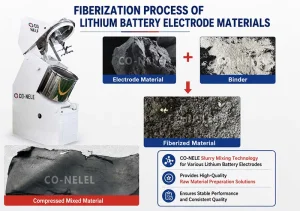
Application: Homogenization of battery cathode precursors, silicon carbide seals, and structural ceramics.
Key Benefit: Sealed gas-tight mixing tank options allow inert gas purging (argon/nitrogen) to prevent oxidation during mixing.
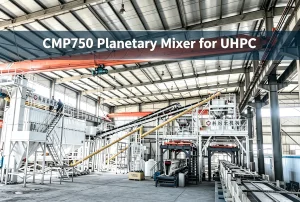
Application: Steel-fiber reinforced UHPC bridge joints, architectural precast panels, and offshore wind turbines.
Key Benefit: Superior fiber dispersion prevents micro-cracking and guarantees structural ductility exceeding 150 MPa compressive strength.
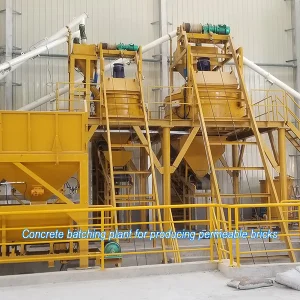
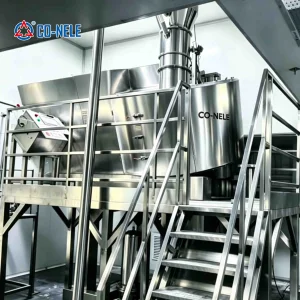
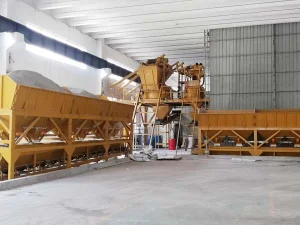
CO-NELE does not merely deliver standalone mixers. For large-scale manufacturing facilities, we engineer complete turnkey plants incorporating aggregate skip hoists or belt conveyors, multi-component powder weighing silos, liquid additive micro-dosing systems, high-pressure auto-wash systems, and fully integrated SCADA software control rooms.
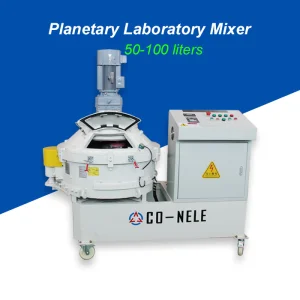
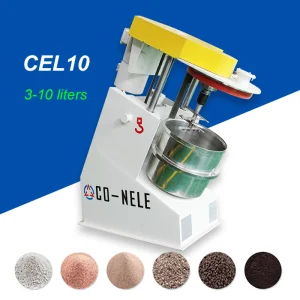
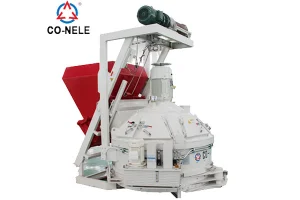
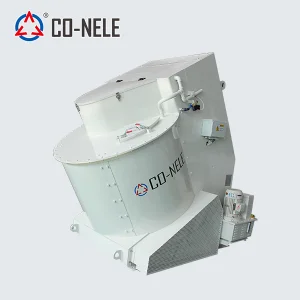
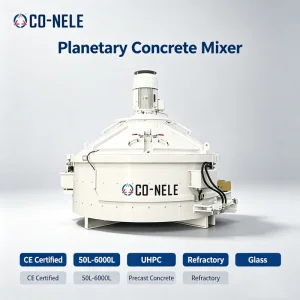
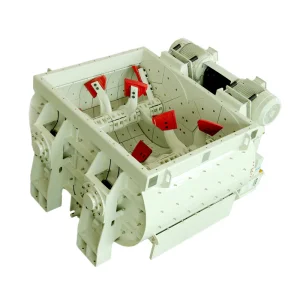
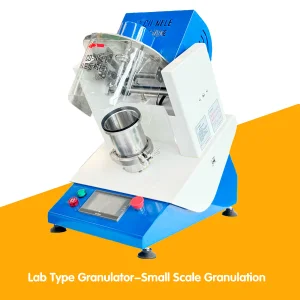
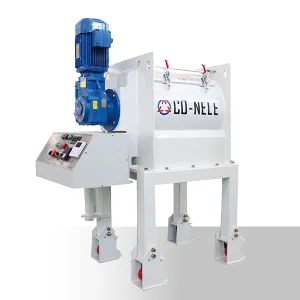
Explore our complete product portfolio engineered for dry dry-mortar, intensive granulation, laboratory formulation research, and heavy civil construction.
Engineering responses to critical technical queries evaluated during industrial mixer selection and plant integration.