CO-NELEMixing & Granulation
As high-temperature industrial sectors—including iron & steel metallurgy, cement clinker production, glass melting furnaces, and petrochemical pyrolytic reactors—push thermal efficiency boundaries, the demand for advanced monolithic refractories, low-cement castables (LCC), ultra-low cement castables (ULCC), and complex shaped refractory bricks has surged exponentially worldwide.
Modern refractory recipes incorporate ultra-fine powders like silica fume, reactive alumina, and nano-additives (< 1 µm). Achieving uniform micro-dispersion without agglomeration is the single most critical factor preventing hot-spot failure in thermal linings.
Refractory raw materials—such as fused corundum, silicon carbide (SiC), tabular alumina, and bauxite—exhibit extreme hardness (Mohs 8–9.5). Equipment must feature hardened alloy liners and custom gearbox protection to withstand intense tribological wear.
With binder costs representing up to 35% of total refractory raw material expenses, precise liquid addition and rapid energy dispersion enable manufacturers to reduce water/binder consumption by 15–20% while elevating cold crushing strength (CCS).
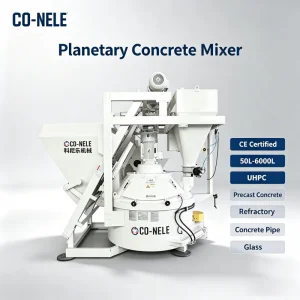
Why vertical-shaft planetary counter-current mixers have rendered traditional drum mixers, horizontal single/twin shaft mixers, and simple ribbon blenders obsolete for high-spec refractory formulations.
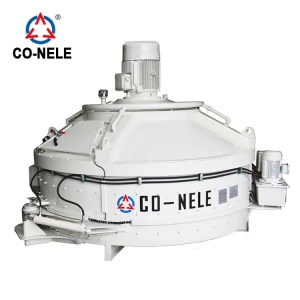
In a CO-NELE planetary mixer, the mixing star arms rotate on their own axis while simultaneously revolving around the central drive axis. The mathematical ratio between rotation and revolution ensures that within 30 to 60 seconds, every cubic millimeter of material inside the pan is swept through multiple high-shear zones.
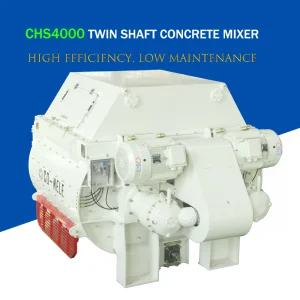
Unlike horizontal twin-shaft mixers where aggregate material can settle under shaft clearances or accumulate in corner dead-zones, the vertical planetary star trajectory covers 100% of the pan floor and sidewalls via dedicated outer scraper arms.
Refractory castables require instant dispersion of liquid additives and micro-binders. The counter-current blade interaction creates intensive velocity gradients, deagglomerating fine powders without crushing coarse aggregate grains.
| Performance Metrics | CO-NELE Planetary Mixer | Intensive Inclined Mixer | Twin Shaft Concrete Mixer | Traditional Pan Mixer |
|---|---|---|---|---|
| Mixing Homogeneity (CV) | Ultra-High (< 3%) | Extreme (< 1.5%) | Moderate (5 - 8%) | Poor (> 12%) |
| Shear Energy Input | Optimized Dynamic Shear | Very High (High RPM) | Low-Medium Impact | Low Shear Velocity |
| Wear Rate on Abrasives | Low to Medium (Protective) | High Component Wear | High Shaft Seal Wear | Extreme Pan Wear |
| Fibre & Silica Dispersion | Instantaneous, Uniform | Instantaneous | Prone to Balling | Severe Segregation |
| Power Efficiency (kWh/Ton) | High Efficiency | Higher Energy Load | Standard | Low Efficiency |
| Maintenance Downtime | Minimal (Bolt-on Liners) | Moderate Maintenance | Frequent Seal Servicing | High Repair Costs |
Refractory mixing is one of the most punishing industrial applications. High density (bulk density > 3.2 g/cm³), extreme abrasiveness, and corrosive chemical binders require robust mechanical construction.
At the core of CO-NELE’s planetary mixer is an in-house engineered planetary reducer. Unlike standard off-the-shelf commercial gearboxes, our drives are specifically rated for high thermal shocks, heavy starting loads, and torsional fatigue caused by high-density refractory castables.
We offer multiple wear protection suites: High-Chrome Cast Alloy (HBW ≥ 600), Tungsten Carbide Hardfacing, and Replaceable Ceramic Tiles (99% Alumina or SiC). Liners are segmented, precision CNC-machined, and field-replaceable with bolt-on access.
Refractory dusts—especially ultra-fine silica fume and corundum powders—are highly penetrating. CO-NELE integrates multi-stage labyrinth seals, air-purge pressurization systems, and specialized mechanical seals to protect all rotating drives from contamination.
Customized mixing configurations engineered for specialized thermal material production worldwide.
Applications: Blast furnace trough castables, steel ladle linings, tundish working linings, torpedo car repair mixes, and gunning mixes.
Applications: Aluminum melting furnace hearth linings, holding furnace castables, and non-wetting refractory formulations.
Applications: Kiln hood, nose ring, tertiary air duct castables, and AZS (Alumina-Zirconia-Silica) fused cast refractories.
Applications: FCCU reactor linings, thermal oxidizers, waste-to-energy boiler tiles, and acid-resistant mortars.
As Industry 4.0 transforms process engineering, CO-NELE is pioneering smart mixing technologies that transition refractory manufacturing from empirical guesswork to digital precision.
By measuring torque fluctuations and power draw micro-variations on the planetary drive, our smart control system calculates slurry viscosity changes in real time, automatically adjusting mixing times and water injection.
Programmable speed steps allow dry pre-mixing at medium RPM, rapid liquid dispersion at high shear RPM, and gentle final homogenization to preserve delicate lightweight insulating aggregates.
High-efficiency IE4/IE5 synchronous drive motors coupled with optimized gear ratios reduce power consumption per batch by up to 18%, supporting global decarbonization initiatives.
Detailed technical answers derived from our process engineers and field commissioning specialists to assist buying committees and plant managers.
Partner with China's leading mixing technology manufacturer. Send us your raw material specifications, capacity targets, and floor layout for a customized technical bid within 24 hours.