
CO-NELEMixing & Granulation
Explore our core series of industrial and laboratory-scale planetary, intensive, twin-shaft, and turnkey batching systems manufactured in Qingdao, China.
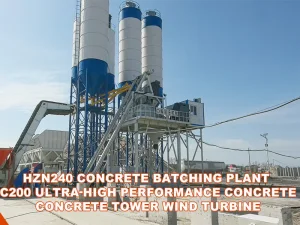
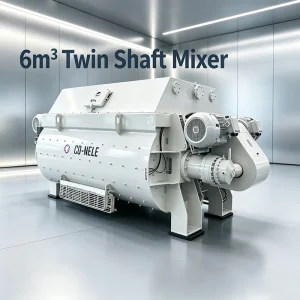
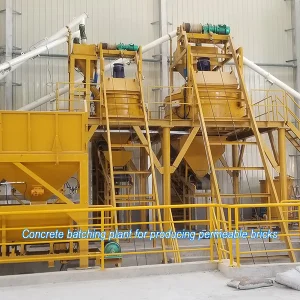
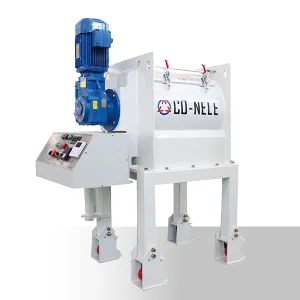
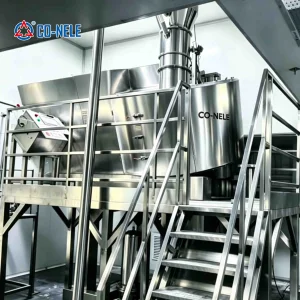
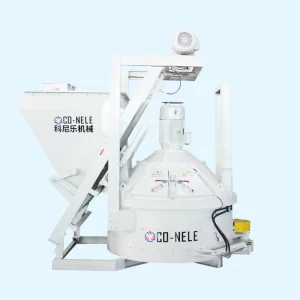
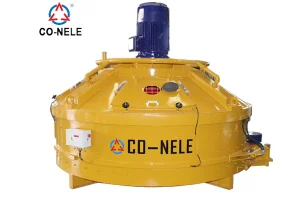
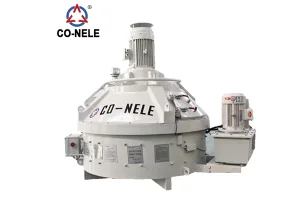
In modern advanced materials science—spanning Ultra-High-Performance Concrete (UHPC), technical ceramics, battery cathode/anode precursors, refractory castables, and specialized dry-mix formulations—the laboratory mixer is no longer a simple agitation tool. It has transitioned into the critical predictive physical simulator for industrial scale-up. As global manufacturing standards demand microscopic consistency, minimum binder consumption, and repeatable rheological parameters, sourcing from a dedicated China Laboratory Mixing Manufacturer & Factory provides a distinct competitive edge combining elite engineering precision with supply chain agility.
Historically, industrial processing plants suffered from severe "scale-up failure," where formulation recipes optimized in small laboratory stirrers degraded rapidly when introduced into full-scale 1.5m³ to 6m³ production vessels. Qingdao CO-NELE Machinery Co., Ltd. (est. 2004) has fundamentally eliminated this barrier by establishing exact geometric and kinematic symmetry between lab-scale systems (5L to 75L) and industrial-scale planetary and intensive mixers (up to 6,000L). By keeping Froude scaling numbers, tip speeds, and energy dissipation rates mathematically proportional, material scientists can transition formulas directly from initial R&D to mass batching with zero performance drop.
Achieving a Coefficient of Variation ($CV$) below 3% in multi-phase heterogeneous mixtures requires targeted energy input. CO-NELE engineers two primary laboratory and industrial mixing architectures, each engineered for distinct rheological profiles:
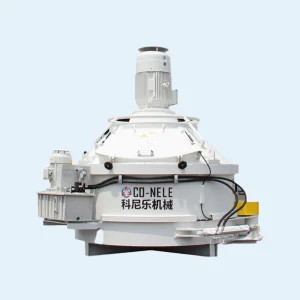
Vertical-shaft planetary mixers feature mixing arms that revolve around a central axis while simultaneously rotating at high velocity in the opposite direction. This star-arm motion completely covers the mixing pan floor every revolution without dead zones, making it the definitive standard for UHPC, GFRC, and dry-cast pavers.
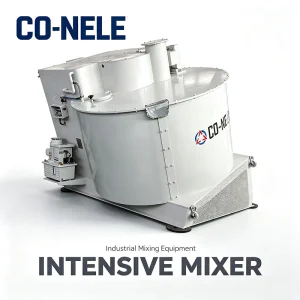
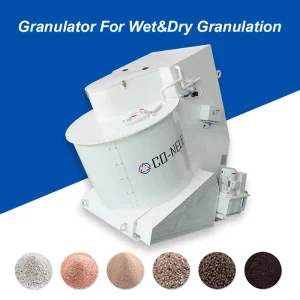
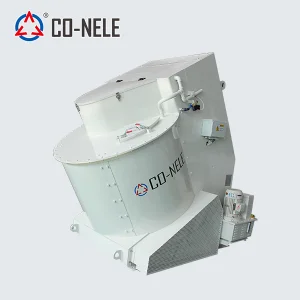
Featuring an inclined rotating mixing pan combined with a high-speed eccentric rotor, this technology separates material transport from the shearing process. The pan delivers material directly to the high-energy rotor zone, allowing rapid wetting, micro-dispersion, and controlled wet granulation (0.5mm to 8mm granules).
| Technical Parameter | Planetary Counter-Current (MP/CMP) | Inclined Intensive Granulator (CQ) | Traditional Twin-Shaft (CHS) |
|---|---|---|---|
| Primary Mechanism | 3D Counter-Current Forced Action | High-Shear Rotor + Rotating Pan | Horizontal Compulsory Shear |
| Mixing Homogeneity (CV) | < 3% (Micro-level) | < 1.5% (Ultra-fine particle) | < 5% (Macro-level) |
| Shear Energy Control | Medium to High (VFD Adjustable) | Ultra-High Variable (Up to 40 m/s tip speed) | Fixed/Medium Speed |
| Granulation Capability | Limited (Homogenization focus) | Superior (0.5mm – 8mm pelletizing) | None |
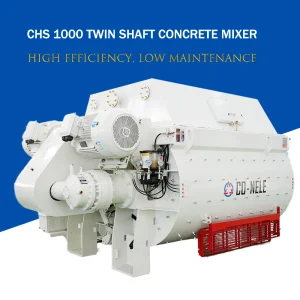
| Ideal Applications | UHPC, Precast, Refractories, Glass | Ceramics, Batteries, Abrasives, Ores | Mass Ready-Mix, Infrastructure |
The versatility of laboratory mixing systems manufactured in China is proven across diverse high-tech manufacturing sectors globally:
In the lithium-ion battery sector, cathode materials (such as NCM, LFP) require dust-free, perfectly uniform wet granulation and binder blending. Laboratory intensive mixers allow process engineers to fine-tune moisture curves, particle sphericity (>90%), and bulk density without agglomeration, ensuring uniform thermal and electrical performance in downstream sintering.
UHPC requires dispersing micro-silica fume (0.1 µm particles) into low water-to-binder matrices (w/b < 0.18) containing steel fibers up to 3% by volume. Laboratory planetary mixers such as the CDW100 and MP150 provide intense shearing force to break up silica agglomerates and distribute steel fibers evenly without balling or segregation, crucial for offshore wind turbine foundations and long-span bridge joints.
Processing alumina ($Al_2O_3$), zirconia ($ZrO_2$), synthetic diamond powders, and silicon carbide demands contamination-free environments. CO-NELE lab units incorporate wear-resistant polyurethane, ceramic, or high-chrome alloy liners, enabling precise moisture dosing and binding for dry pressing of high-density electronic ceramics.
The global industrial machinery landscape has shifted towards specialized equipment clusters. Sourcing from Qingdao, China's premier heavy machinery ecosystem, offers fundamental structural advantages:
Unlike assemblers who outsource critical components, CO-NELE designs and manufactures its proprietary planetary reducers, heavy-duty gearboxes, and mixing arm kinematics under one roof across three production bases spanning 30,000 m².
By leveraging complete domestic steel supply chains, high-precision CNC machining centers, and optimized labor efficiency, Chinese manufacturing yields premium European-grade mechanical tolerances at a significantly lower initial capital expenditure (CAPEX).
Standard laboratory units ship within 15–20 business days, while custom pilot setups integrated with automated PLC dosing, explosion-proof motors (ATEX), or thermal heating/cooling jackets are delivered in under 6 weeks.
The next decade of industrial material preparation relies on intelligence and automation. CO-NELE is actively implementing three futuristic technological pillars across its laboratory and commercial equipment lineup:
By analyzing high-frequency motor torque and current harmonic signals via VFD feedback, our laboratory mixers calculate material viscosity transitions in real-time, automatically identifying the exact point of micro-silica wetting or binder activation without stopping the batch.
Laboratory trial data from CO-NELE lab units feed directly into Discrete Element Method (DEM) software, generating customized mixing blade geometries optimized for client-specific raw material densities, grain shapes, and moisture levels.
Incorporating high-efficiency IE4/IE5 motors, energy-recovery braking systems, and automated cleaning-in-place (CIP) manifolds to reduce water and electrical consumption by up to 35% across high-volume plants.
Exporting heavy mixing machinery to over 80 countries requires robust compliance frameworks and after-sales support systems:
All laboratory and commercial mixers are built to strictly comply with CE electrical safety directives, ISO 9001:2015 quality management benchmarks, and optional ATEX explosion-proof certifications for hazardous chemical processing.
Equipped with Siemens PLC telemetry, CO-NELE engineers can remotely diagnose PLC logic, update mixing sequences, and monitor motor vibration spectra globally within a 24-to-48-hour response window.
Every gear, mixing blade, pan liner, and hydraulic seal is serialized and stocked in our Qingdao logistics hub, guaranteeing interchangeable replacement spare parts for all machines supplied since 2004.
Direct answers from our senior process engineering team regarding laboratory selection, scale-up dynamics, and global deployment.
CO-NELE laboratory mixers (such as the CDW100 or MP150) share identical geometric ratios, paddle tilt angles, and relative tip speeds with our commercial-scale planetary and intensive units. By holding linear speed ($m/s$) and power per unit volume ($kW/m^3$) constant, the binder ratio, mixing cycle time, and density achieved in a 15L lab trial directly correlate to full-scale batch outputs up to 6,000L.
For ultra-abrasive mixes, we offer replaceable high-chrome alloy liners (hardness > 60 HRC), tungsten-carbide coated mixing blades, or seamless polyurethane and ceramic linings to completely prevent metallic contamination in high-purity applications like battery powders and technical ceramics.
Yes. We encourage global customers to send 10kg to 50kg of raw materials to our testing center in Qingdao. Our process engineers conduct mixing and granulation trials, measuring granule size distribution, moisture sensitivity, bulk density, and energy consumption, returning a detailed technical report and video documentation.
We configure all control panels and motors to match destination grid voltages (220V to 480V, 50Hz or 60Hz, 3-phase). Control systems can be equipped with Siemens, Schneider, or ABB PLCs featuring multi-language touch interfaces, automated liquid dosing pumps, torque logging, and explosion-proof enclosures.
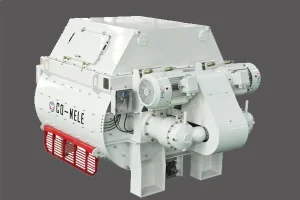
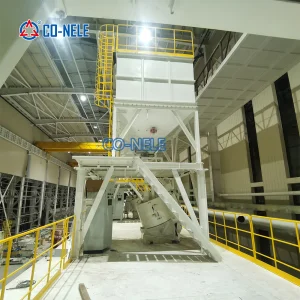
Browse additional specialized equipment solutions engineered for precast concrete, refractories, ceramics, and intensive powder granulation.
Submit your raw material specification, target capacity, or laboratory requirements. Our process engineers in Qingdao will deliver a complete technical assessment, layout blueprint, and quotation within 24 hours.