CO-NELEMixing & Granulation
Engineered forced-action mixing equipment designed for high-strength concrete, UHPC, precast elements, and continuous ready-mix production.
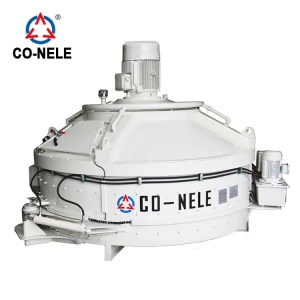
The global infrastructure ecosystem is undergoing a fundamental structural transition. Modern civil engineering contracts—spanning high-speed rail networks, deep-sea port terminals, mega-dams, and ultra-tall commercial structures—demand concrete mixtures with unprecedented compressive strength, low permeability, and tight slump tolerances. At the center of this industrial evolution is the Double Shaft Concrete Mixer (Twin-Shaft Forced Mixer), a machine architecture that has superseded traditional gravity tilting drums and vertical pan mixers in high-throughput applications.
Enterprise procurement directors across North America, Europe, the Middle East, and Southeast Asia are increasingly sourcing specialized heavy mixing machinery from premier OEMs in China. This strategic sourcing shift is driven not merely by capital expenditure efficiency, but by the substantial technical advancements engineered by top-tier Chinese manufacturers. Through advanced metallurgies, synchronized planetary drives, automated lubrication systems, and smart sensor integration, Chinese double shaft concrete mixer factories deliver industrial-grade reliability matching or exceeding European benchmarks at a optimized Total Cost of Ownership (TCO).
Information Gain Insight: Modern concrete recipes heavily incorporate Supplementary Cementitious Materials (SCMs)—such as fly ash, ground granulated blast-furnace slag (GGBS), and condensed silica fume—alongside metallic or synthetic micro-fibers. Achieving homogeneous dispersion of micro-particles (< 10 microns) within dense matrix slurries requires high-shear forced kinematics that only dual counter-rotating shaft configurations can generate within standard 30 to 60-second batch intervals.
Massive civil engineering projects demand continuous hourly discharges of 60m³/h to 240m³/h per mixing station with zero tolerance for batch-to-batch strength variance.
Transition from standard ready-mix (C30/C40) to Ultra-High-Performance Concrete (UHPC, C120+) requires intense shear dynamics to break particle agglomeration.
Global contractors maximize ROI by pairing Chinese manufacturing precision with localized spare-parts availability and low power consumption per cubic meter mixed.
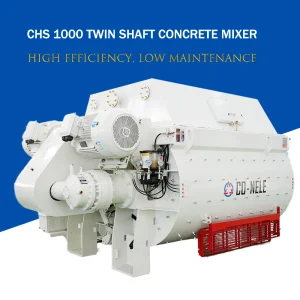
The operational superiority of a heavy-duty twin-shaft mixer lies in its fluid dynamic principle: forced counter-rotating turbulent mixing action. Unlike single-shaft or planetary mixers that move materials primarily along a two-dimensional horizontal or circular path, the double shaft mixer creates an intense three-dimensional spatial cross-stream velocity field.
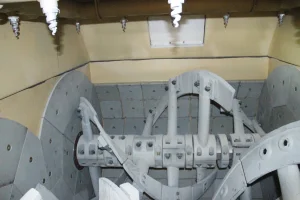
Two parallel horizontal shafts revolve in opposite directions at synchronized speeds (typically 24 to 32 RPM). Specially angled mixing paddles mounted on rigid cast-steel arms are arranged spirally along each shaft. As the arms rotate, they push material laterally outward and longitudinally along the mixer trough. Where the two counter-rotating stream paths intersect in the central zone, intense violent turbulence is generated.
Historically, shaft-end seal failure was the leading cause of downtime in compulsory concrete mixers. Fine abrasive cementitious slurry under pressure forced its way past conventional packing seals, destroying shaft bearings. Advanced Chinese double shaft mixer factories have solved this engineering bottleneck using a multi-layer composite sealing architecture:
| Sealing Layer | Mechanism / Technology | Primary Function | Service Interval |
|---|---|---|---|
| Primary Fluid Seal | Floating steel face seals / V-rings | Blocks coarse aggregate & sand particles | 50,000 Batches |
| Secondary Slurry Barrier | Pneumatic/Hydraulic purge chamber | Injects continuous high-pressure air/grease barrier | Continuous Automatic |
| Tertiary Mechanical Seal | Multi-groove skeleton lip seals | Prevents microscopic fine dust ingress | 100,000 Batches |
| External Bearing Isolation | Split housing mounted externally outside pan | Protects main bearings even during catastrophic seal fail | Lifetime Structural |
The lifespan of mixing paddles and trough liners directly governs plant profitability. Leading factories utilize high-chromium alloyed white cast irons (Ni-Hard IV and Cr26 Mo alloys) with Brinell hardness ratings exceeding HB600-650 (HRC 58-62). Liner plates are cast with uniform thickness and designed as modular, interchangeable tiles. This allows maintenance technicians to rotate tiles from high-wear impact zones (underneath aggregate charge points) to low-wear zones, extending total liner system life by up to 40%.
Choosing the correct mixing architecture based on concrete recipe, throughput demand, and operational envelope.
| Evaluation Parameter | Twin Shaft Concrete Mixer | Vertical Planetary Mixer | Continuous Drum Mixer |
|---|---|---|---|
| Primary Application | Ready-Mix (RMC), Heavy Civil, Dam RCC | Precast, UHPC, Block & Brick Production | Low-grade Paving, Base Course Stabilization |
| Homogeneity Range (CV) | ≤ 3% (Exceptional) | ≤ 2% (Ultra-Micro Homogeneous) | 8% - 15% (Moderate) |
| Discharge Velocity | Ultra-Fast (Pneumatic/Hydraulic Gate) | Moderate (Door sweep arm mechanism) | Continuous Flow (Slow batch isolation) |
| Max Aggregate Size (STD) | Up to 120 mm (Mass Concrete variants) | Up to 40 mm (Fines focused) | Up to 80 mm |
| Cycle Time (Batch) | 30 - 60 Seconds | 60 - 120 Seconds | N/A (Continuous) |
| Power Consumption / m³ | Lowest per ton mixed (High efficiency) | Higher torque load per m³ | Low power / low shear rate |
Chinese Double Shaft Concrete Mixers are deployed globally across distinct industrial sectors, each imposing unique operational demands on the mixing machine and batching plant structure.
HSR ballastless track slabs require self-compacting concrete (SCC) with absolute air-entrainment control and zero segregation. Double shaft mixers engineered with dual-speed motor drives allow slow-speed chemical admixture dispersion followed by high-shear activation, ensuring absolute compliance with international railway standards.
RCC dam projects require large volumes of zero-slump dry concrete containing crushed stone aggregates up to 80-120mm. Heavy-duty double spiral mixers (such as the CDS series) feature extra-wide shaft centers and reinforced forged steel arms capable of withstanding severe aggregate impact forces without mechanical stalling.
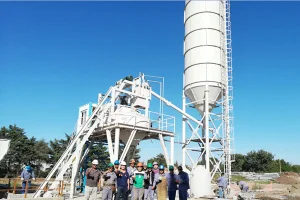
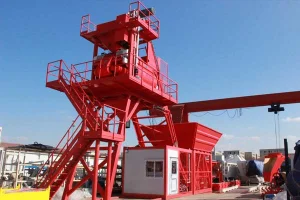
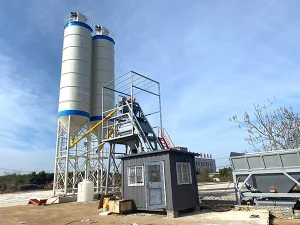
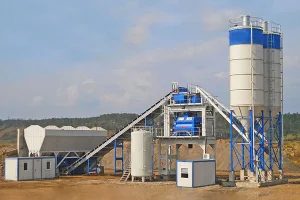
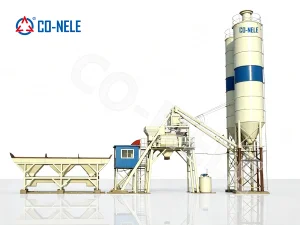
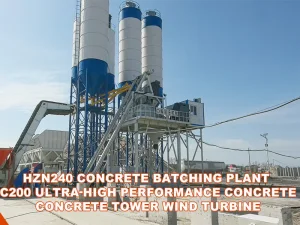
Urban plants operating HZS120 to HZS240 tower batching plants prioritize cycle-time minimization. Twin-shaft mixers integrated with wide-angle hydraulic discharge doors can dump 3m³ of fresh concrete into transit mixers in under 8 seconds, enabling plants to process over 40 truckloads per hour during peak operations.
Manufacturing precast wind turbine tower segments and marine anti-scour concrete blocks requires specialized binder activation. Mixers fitted with microwave moisture sensors and automated high-pressure ice/water dosing lines deliver exact water-cement ratios (w/c down to 0.22) with total repeatable batch precision.
The next decade of double shaft concrete mixer manufacturing in China is anchored in three core technological transformations: digital twin monitoring, eco-efficient energy recuperation, and AI-driven rheology optimization.
Integration of torque-spectral analysis directly on the main planetary gearbox shafts. By measuring micro-fluctuations in motor drive current and shaft resistance, the control system calculates concrete viscosity and yield stress in real time, automatically adjusting mixing duration to achieve exact targeted slump before discharge.
Vibration sensors, oil quality optical sensors, and acoustic emission transducers installed on main bearings and reducers continuously stream health metrics to cloud platforms. Predictive algorithms identify gear pitting or seal degradation weeks before mechanical breakdown occurs, virtually eliminating unplanned site downtime.
Advanced batching plants are integrating liquid carbon dioxide injection nozzles directly into the double shaft mixer chamber during the initial dry-mixing phase. The forced turbulence accelerates CO2 absorption into hydrated cement micro-particles, permanently trapping carbon dioxide as solid nano-calcium carbonate while boosting early compressive strength by 10-15%.
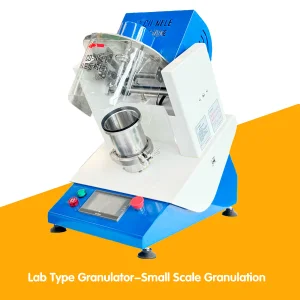
Explore customized industrial equipment, compact plants, granulators, and specialized high-torque twin shaft variants for diverse global projects.
Evaluating a Chinese double shaft concrete mixer factory requires an exhaustive verification process beyond initial price quotations. Enterprise procurement teams must audit manufacturing capabilities against international mechanical, electrical, and quality assurance standards.
The mixer trough frame must be fabricated from structural steel (Q355B or European equivalent S355JR) and subjected to stress-relief annealing after welding. This prevents structural distortion under heavy torsional loads. The main gearbox must feature heavy-duty helical gear drives with a minimum service factor (sf) ≥ 2.0 based on AGMA or ISO 6336 calculations.
Export machinery destined for Europe or North America must comply with strict international regulatory directives:
When calculating TCO over a 10-year operational horizon, capital acquisition cost represents approximately 20-25% of total lifecycle expenditure. The remaining 75-80% is governed by energy consumption, replacement wear parts, routine maintenance labor, and unscheduled downtime cost.
TCO Efficiency Tip: Standardizing on modular bolt-on wear parts and automatic centralized grease lubrication reduces routine maintenance labor by 65% while extending main seal service life by up to 2.5x compared to manual greasing protocols.
Direct technical answers from senior process engineers regarding mixer selection, operation, maintenance, and international shipping.
A twin shaft concrete mixer utilizes two horizontal counter-rotating shafts with paddles, engineered for rapid high-volume mixing (30-45 second cycle times) ideal for ready-mix concrete and mass infrastructure. A planetary mixer features a vertical shaft with counter-current rotating star arms, providing higher micro-homogeneity needed for dry-cast precast, UHPC, pigmented tiles, and refractory castables.
The shaft-end sealing system combines multi-layer mechanical floating face seals with an automated electric grease pump that continuously maintains positive internal pressure within the seal cavity. This prevents abrasive cementitious slurry from entering the seal chamber and protects the external spherical roller main bearings from contamination.
Equipped with standard Cr26 high-chromium alloy casting liners (HB600+), the liner tiles typically achieve 90,000 to 150,000 batches on standard ready-mix formulations. On highly abrasive crushed granite or quartz mixtures, lifespan ranges between 50,000 and 80,000 batches. All liners are modular and replaceable in the field.
Yes. Chinese OEMs design double shaft mixers with flexible mounting footprint options, standardized inlet chutes, and adaptable hydraulic discharge gate connections. Standard PLC control protocols (Profinet, Modbus TCP, Ethernet/IP) allow seamless integration into existing control architectures such as Command Alkon, Siemens, or custom batching software.
Mixer models up to CHS2000 (2m³ output) fit within standard 40ft High Cube (40HC) shipping containers without complete disassembly. Larger models (CHS3000 to CHS6000) are shipped as SKD (Semi-Knocked-Down) units using Flat Rack containers or break-bulk shipping, with step-by-step video commissioning and resident engineering assistance available globally.
Providing enterprise clients with continuous engineering assistance, rapid spare part dispatch, and lifecycle optimization.
Three modern manufacturing hubs spanning over 30,000 m² with in-house CNC gear machining, robotic welding stations, and load testing benches.
Direct access to process engineers and senior technicians via remote diagnostics, ensuring emergency support response within 24 hours.
100% stock availability of interchangeable high-chrome wear plates, shaft seals, mixing arms, and reducers for all batching plants and mixer models.