CO-NELEMixing & Granulation
Engineered by CO-NELE for high homogeneity, extreme durability, and maximum return on capital investment.
Understanding the shift from initial capital expenditure (CAPEX) to lifecycle operational efficiency (OPEX) in global concrete batching infrastructure.
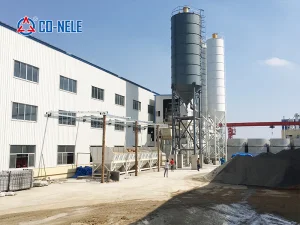
China produces over 60% of the world's concrete mixing machinery. Heavy industrial clusters in Qingdao and Shandong leverage complete upstream component ecosystems—from high-precision planetary gearboxes to wear-resistant alloy foundries—reducing equipment procurement costs by 30% to 45% relative to European equivalents without sacrificing mechanical integrity.
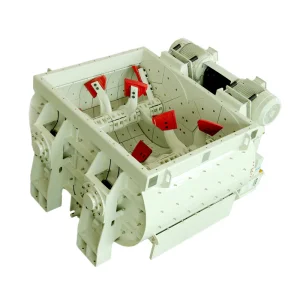
Modern batching plants have transitioned from simple tilt-drum designs to intensive planetary counter-current and twin-shaft compulsory mixers. This technical evolution ensures micro-homogeneity with a coefficient of variation CV < 5%, essential for specialized recipes like Ultra-High Performance Concrete (UHPC) and dry-cast pavers.
The true cost of a concrete mixing plant is decided over millions of cubic meters. Factors like cement dosing accuracy (±1%), wear-liner replacement intervals, power consumption per batch (kWh/m³), and automated moisture control dictate long-term operational profitability.
Direct factory purchasing metrics, hardware engineering allocation, and estimated FOB budget tiers for international contractors.
When evaluating a China Concrete Mixing Plant Cost, procurement officers must separate upfront capital expenditure (CAPEX) from lifetime operational expenditure (OPEX). A low-cost plant built with thin structural steel and inferior gearboxes quickly incurs massive losses through batch weight errors, frequent liner failures, and excessive cement consumption.
| Plant Capacity | Mixer Type & Technology | Configuration / Mobility | Estimated FOB Cost (USD) | Primary Industrial Application |
|---|---|---|---|---|
| HZS25 (25 m³/h) | Planetary / Small Twin Shaft (500L) | Compact / Skip Hoist | $18,000 – $32,000 | Small precast yards, rural road paving, bridge foundations |
| HZS50 / HZS60 (50-60 m³/h) | Planetary CMP1000 / Twin Shaft CHS1000 | Skip Hoist or Modular Compact | $38,000 – $65,000 | Commercial ready-mix, block making, medium infrastructure |
| YHZS75 (75 m³/h Mobile) | Compulsory Twin Shaft (1500L) | Fully Mobile Trailer Chassis | $55,000 – $85,000 | Highway repair, remote airfield construction, mobile contracting |
| HZS90 / HZS120 (90-120 m³/h) | Dual Twin Shaft / Large Planetary | Belt Conveyor Station | $85,000 – $140,000 | Large-scale ready-mix concrete plants, dam projects |
| HZS180 / HZS240 (180-240 m³/h) | Heavy-Duty Twin Shaft (3000/4000L) | Tower Type / Enclosed Environmental | $160,000 – $320,000+ | High-density urban commercial hubs, mega infrastructure |
| Specialized UHPC / GFRC Plant | Intensive Mixer / Counter-Current Planetary | High-Shear Precision Dosing | Custom Engineering Quotation | Architectural precast panels, nuclear power, bridge joints |
Selecting the optimal forced-action mixing mechanism based on concrete rheology, aggregate size, and target strength grades.
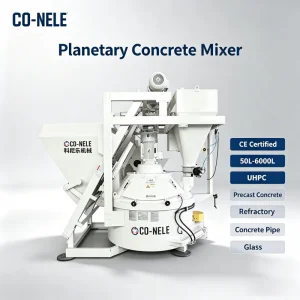
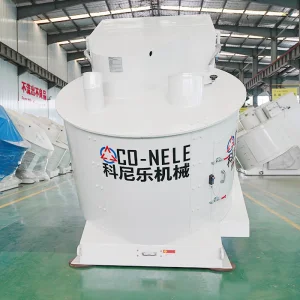
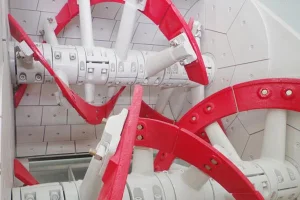
Operating on a vertical shaft system, planetary mixing arms rotate on their own axis while revolving around a central point. This dual-motion trajectory covers every square millimeter of the mixing pan floor without dead zones.
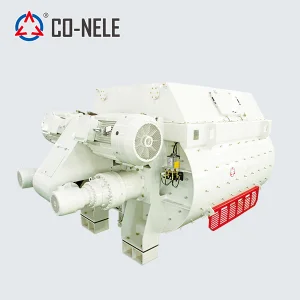
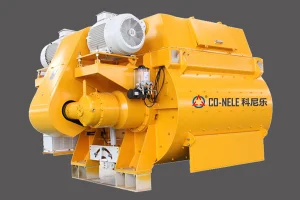
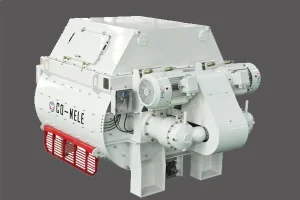
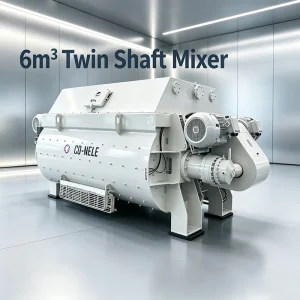
Featuring synchronized horizontal counter-rotating twin shafts equipped with overlapping mixing paddles. Aggregate particles are thrown into a weightless turbulent mixing zone at the center of the drum.
Customizing plant specifications to overcome regional climatic challenges, local raw material profiles, and jobsite logistics.
In regions like Vietnam, Thailand, and Indonesia, concrete plants face intense ambient humidity and fine sand variations. CO-NELE supplies planetary mixing stations integrated with core vibration pipe machines and automated paver lines, guaranteeing weather-resistant concrete blocks with zero efflorescence.
Projects in Saudi Arabia and the UAE require strict control over concrete discharge temperatures. CO-NELE designs plants with insulated aggregate silos, ice-dosing screw conveyors, water cooling chillers, and heavy-duty dust suppression systems built for 50°C+ ambient operation.
Export configurations for Western markets include CE-marked electrical cabinets, SIL2-rated safety interlocks on mixer doors, low-noise pneumatic vibrators, and secondary recycling plants for zero-slurry-waste concrete washwater management.
Ensuring international buyers receive seamless commissioning, localized spare-parts availability, and structural safety guarantees.
Every CO-NELE mixing plant undergoes full dry-run operational testing at our Qingdao production bases prior to shipment. Manufacturing follows strict quality control procedures under ISO9001, CE, and EAC certification standards.
To minimize downtime, CO-NELE maintains standard interchangeable spare parts for every model built since 2004. Export buyers receive comprehensive 3D foundation CAD drawings, electrical schematics, and options for remote IoT troubleshooting or resident engineer installation.
Pioneering green concrete formulations, AI-driven aggregate moisture compensation, and zero-foundation modular deployment.
Real-time microwave moisture sensors installed inside sand aggregate bins stream data directly into the PLC system. The batching algorithm instantly recalculates water-to-cement ratios per batch, eliminating manual slump variance.
As global green building codes penalize high-CO2 Portland cement, CO-NELE intensive mixers are optimized to shear high-viscosity alkali-activated fly ash and slag geopolymers without clumping.
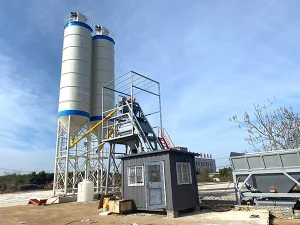
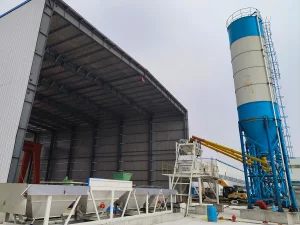
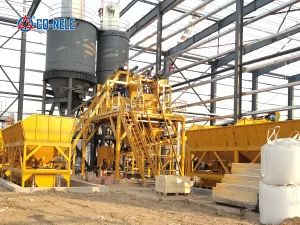
Eliminating expensive civil concrete foundations, modern batching stations use heavy structural steel skid frames. Plants can be erected on levelled ground within 3 to 5 days, drastically cutting jobsite setup costs.
Expert technical insights provided by CO-NELE process engineers to guide your machinery investment decisions.
Beyond the machine FOB quote, buyers must calculate international ocean freight (flat-rack vs. standard OT containers), local import tariffs, port handling fees, site foundation civil works, crane rental during installation, and local electrical transformers (e.g., adapting 380V 50Hz to local 440V 60Hz grid standards). CO-NELE provides detailed container loading plans to optimize ocean freight costs.
Select a planetary counter-current mixer if your production focuses on precast elements, pavers, block making, UHPC, GFRC, or dry cast formulas requiring uniform color and tight consistency (CV < 5%). Select a twin shaft compulsory mixer for high-volume commercial ready-mix concrete above 60 m³/h where speed, larger aggregate sizes (up to 80mm+), and lower cost per cubic meter are the primary goals.
With standard high-chrome alloy wear parts (Cr26), CO-NELE mixing liners and blades typically last between 90,000 to 150,000 batches on normal concrete recipes. For extreme abrasive applications such as refractory castables or quartz-heavy UHPC, expected lifespans range between 40,000 and 60,000 batches. All wear components are bolt-on and easily replaceable in the field.
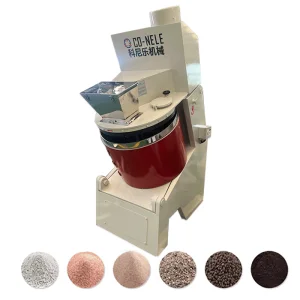
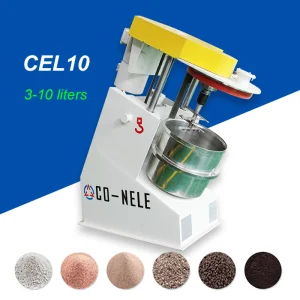
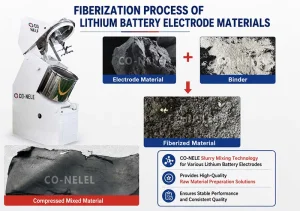
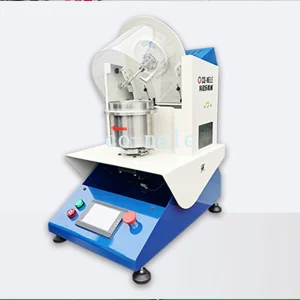
Yes. CO-NELE operates an advanced material testing laboratory in Qingdao equipped with 5L to 75L lab-scale intensive mixers and granulators. Clients can send 10-20 kg samples of raw powders, aggregates, or binders. Our engineers will run test batches and provide a scientific trial report covering mixing homogeneity, granule sphericity, density, and recommended industrial scale-up models.
All mixing plants are built to your specific site electrical requirements (e.g., 220V, 380V, 415V, 440V, 480V at 50Hz or 60Hz). Control panels can be equipped with Schneider contactors, Siemens PLCs, and multi-language HMI interfaces (English, Spanish, French, Russian, Arabic) with full CE or UL compliance documentation.
Explore specialized equipment solutions for precast concrete, refractory mixing, lab scaling, and powder granulation.