CO-NELEMixing & Granulation
In modern civil engineering, infrastructure mega-projects, and commercial concrete manufacturing, the quality of concrete depends heavily on mixing efficiency. The China Twin Shaft Concrete Mixer has become a vital piece of machinery in commercial ready-mix plants, precast concrete yards, dam construction, and highway infrastructure projects around the world. As global infrastructure investments grow and concrete formulations require higher performance (such as SCC, RCC, and fibre-reinforced concrete), demand has shifted from simple gravity mixers to compulsory twin shaft mixing systems.
China's equipment manufacturing sector has undergone a major transformation over the past twenty years. China is no longer just a high-volume assembly hub; it is now an engineering center for high-torque planetary and twin-shaft mixers. Advanced domestic machinery builders, such as CO-NELE (Qingdao CO-NELE Machinery Co., Ltd.), have advanced horizontal twin-shaft technology by combining heavy-duty mechanical engineering, automated shaft sealing, and wear-resistant alloy metallurgy. This combination offers high volumetric mixing efficiency, consistent batch quality, and low lifetime operating costs.
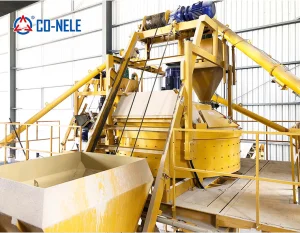
Traditional tilting drum mixers rely on gravity to cascade materials down, which often results in aggregate segregation and long cycle times (90 to 180 seconds). Single-shaft mixers create spiral currents along one axis, but they struggle with dead zones near the shaft ends when handling dry-hard or stiff mixes. In contrast, horizontal twin shaft compulsory mixers use counter-rotating dual axes fitted with overlapping, angled mixing paddles. This configuration creates a 3D turbulent mixing zone, ensuring rapid dispersion of cementitious binders, fine aggregates, coarse aggregates, water, and chemical admixtures in as little as 30 seconds.
The performance of a China Twin Shaft Concrete Mixer comes down to mechanical design, fluid dynamics, and metallurgy. Below is an engineering analysis of the key structural components that make Chinese twin shaft mixers reliable for global construction projects:
Two parallel horizontal shafts revolve in opposite directions at synchronized speeds (typically 24 to 32 RPM). The mixing arms are set at specific spatial angles (45° or 60° relative to the shaft axis), pushing material both radially and axially. This creates a turbulent mixing zone in the center of the pan, thoroughly dispersing cement particles into the water film and preventing unmixed material from collecting at the tub edges.
Shaft-end slurry leakage can cause bearing failure in horizontal mixers. Modern Chinese twin shaft mixers use a multi-layer sealing system. This includes floating labyrinth seals, mechanical face seals, rubber oil seals, and high-pressure automatic grease injection pumps. The system maintains continuous positive pressure at the shaft ends, keeping abrasive cement grout out of the bearings.
The mixing trough is lined with replaceable, high-chromium cast iron tiles (Ni-Hard / Cr26 alloy) with a hardness rating of ≥60-65 HRC. The mixing arms and blades are cast from ductile iron treated for high impact resistance and toughness. This allows the mixer to handle harsh aggregates such as crushed granite, quartz, and recycled concrete aggregate without excessive wear.
| Model Series | Charging Capacity (L) | Discharging Volume (L) | Mixing Motor Power (kW) | Max Aggregate Size (mm) | Discharge Gate Control |
|---|---|---|---|---|---|
| CHS 750 / JS750 | 1200 L | 750 L (0.75 m³) | 2 × 15 kW | 60 / 80 mm | Hydraulic / Pneumatic Dual Step |
| CHS 1000 / JS1000 | 1600 L | 1000 L (1.0 m³) | 2 × 18.5 kW | 60 / 80 mm | Hydraulic Manual Adjust Option |
| CHS 1500 / JS1500 | 2400 L | 1500 L (1.5 m³) | 2 × 30 kW | 80 / 100 mm | High-Pressure Hydraulic Gate |
| CHS 2000 / JS2000 | 3200 L | 2000 L (2.0 m³) | 2 × 37 kW | 80 / 100 mm | Proportional Hydraulic Cylinder |
| CHS 3000 / JS3000 | 4800 L | 3000 L (3.0 m³) | 2 × 55 kW | 100 / 120 mm | Multi-Position Hydraulic Gate |
| CHS 4500 / JS4500 | 7200 L | 4500 L (4.5 m³) | 2 × 90 kW | 120 / 150 mm | Heavy Duty Dual Hydraulic Rams |
Looking ahead, the development of Chinese twin shaft mixing technology focuses on three main areas:
International buyers often ask how leading Chinese OEMs maintain high manufacturing quality while offering competitive pricing. The answer lies in China's industrial machinery clusters, especially in Shandong Province and the Qingdao port district:
Manufacturers like CO-NELE source structural steel, high-chrome wear plates, gear castings, and electric motors locally. Being near major steel mills and specialized foundries reduces raw material lead times and avoids international freight surcharges on heavy components.
Modern factory lines feature robotic welding systems, large gantry CNC boring mills, and automated heat-treatment furnaces. Machining the twin shaft bearing seats on a single-pass gantry mill ensures precise shaft alignment, preventing premature bearing wear.
Rather than relying on outsourced commercial speed reducers, top manufacturers build, assemble, and test their gearboxes in-house. Every batch unit undergoes a 4-hour no-load test run and dynamic torque load test before painting and shipping.
The versatility of the China Twin Shaft Concrete Mixer is demonstrated across diverse regional environments and specialized industrial sectors worldwide:
In urban readymix batch plants (e.g., HZS90, HZS120, HZS180), CHS twin shaft mixers process standard C25 to C60 strength concrete with discharge times under 45 seconds. Their fast cycle time allows concrete truck fleets to load efficiently during peak morning delivery windows.
For precast bridge girders, culverts, railway sleepers, and tunnel segments, concrete requires high early strength and zero air-void defects. Twin shaft mixers ensure thorough dispersion of micro-silica and admixtures, producing dense mixes that meet strict structural standards.
Dam construction requires large volumes of zero-slump Roller Compacted Concrete mixed with coarse aggregate sizes (up to 120-150 mm). Twin shaft mixers feature reinforced mixing arms and high-torque drives designed to process aggregate-heavy mixes without stalling.
From high-temperature, dusty job sites in Saudi Arabia to cold alpine projects in Scandinavia, Chinese twin shaft mixers are fitted with specialized regional options: thermal jacket heating for low-temperature batching, dust-sealed motor enclosures, and tropical cooling systems for hydraulic power units.
Buying machinery internationally requires clear guarantees around safety standards, electrical compatibility, and post-installation support. Leading manufacturers back their exports with structural certifications and comprehensive service programs:
A horizontal twin shaft mixer uses two parallel horizontal counter-rotating shafts suited for high-volume ready-mix concrete and large batch production (1.0 m³ to 6.0 m³ per batch) with fast discharge times (30–45 seconds). A vertical-shaft planetary mixer uses star-paddles that rotate around a central axis while spinning on their own axes. Planetary mixers excel at handling dry-hard mixes, UHPC, glass fiber concrete, and precast products that require micro-homogeneity (<2% CV) and zero aggregate clump formation.
Shaft seal durability relies on two factors: multi-stage physical labyrinth seals combined with an automated grease injection system. The automated pump feeds clean lubrication grease under positive pressure into the seal chambers every time the mixer operates. This creates a grease barrier that prevents abrasive cement slurry from contacting the internal shaft seals and main bearings.
With standard river sand and crushed limestone aggregates, high-chromium wear liners (≥60 HRC) typically last between 80,000 and 150,000 batch cycles. If mixing highly abrasive aggregates like quartz sand, granite spalls, or crushed iron ore, lifespan may decrease to 40,000–60,000 batches. All liners feature bolt-on designs for quick replacement on site.
Yes. When configured for RCC or dry-cast concrete, the mixer is equipped with reinforced mixing arms, higher motor power ratings (e.g., dual 55kW or 75kW motors), and high-torque planetary reduction gearboxes. The overlapping paddle arrangement delivers the force needed to shear and homogenize stiff, zero-slump mixes without jamming.
Every machine is custom-built to match the customer's local site power supply (e.g., 220V/60Hz 3-phase for parts of the Americas, 380V/50Hz for China/Europe, 415V/50Hz for UK/Australia, 460V/60Hz for USA). Control panels feature dual-language English/Spanish/French/Arabic Siemens HMI touchscreens with thermal overload protection and isolation transformers.
Daily maintenance includes checking the automatic lubrication pump reservoir and washing out concrete residue at the end of each shift. Weekly tasks include checking V-belt tension, inspecting mixer paddle clearances (adjusting blade-to-liner gap to 3–5 mm), and checking gearbox oil levels. Monthly tasks involve inspecting shaft seal grease ports and checking bolt tightness on liner plates.
Selecting the right mixing equipment is essential for plant productivity, concrete strength, and operating profitability. Whether you are building a commercial ready-mix plant, upgrading a precast production line, or sourcing lab-scale granulators, CO-NELE offers over two decades of mixing engineering experience. Contact our technical team today to discuss your material requirements, request detailed CAD foundation layouts, or arrange raw material testing at our Qingdao laboratory.