CO-NELEMixing & Granulation
Precision-engineered mixing equipment certified for global infrastructure, precast, and refractory projects.
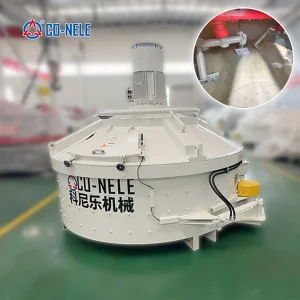
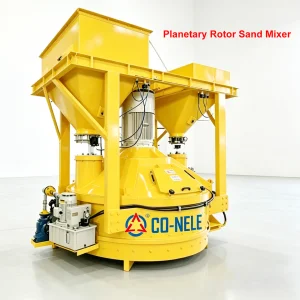
In modern civil engineering, precast concrete manufacturing, refractories, and chemical material synthesis, the mechanical mixing phase dictates the structural integrity, surface aesthetic, and durability of the finished material. Global procurement directors and plant engineers evaluating China Planetary Mixers For Sale are transitioning away from traditional pan and gravity mixers toward vertical-shaft counter-current planetary mixers.
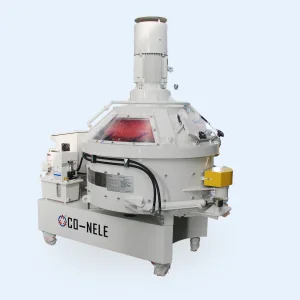
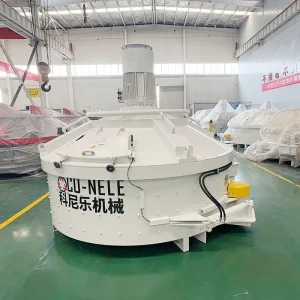
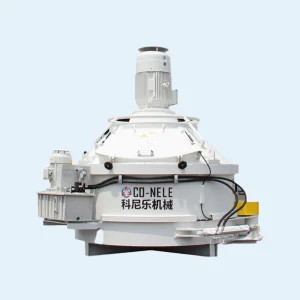
Unlike horizontal twin-shaft or gravity drum mixers—which rely primarily on shear forces generated along horizontal axes or simple gravitational cascade—the planetary counter-current mixing mechanism drives mixing star arms that rotate around their own vertical axis while simultaneously orbiting a central axis within the mixing pan. This dual-kinematic rotation trajectory creates complex, intersecting velocity vectors across every square millimeter of the batch volume, ensuring zero material segregation and achieving micro-homogeneity with a Coefficient of Variation (CV) under 5% within standard cycle times.
To assist industrial procurement teams in making data-driven machinery investments, the following technical matrix details the mechanical distinctions between vertical-shaft planetary mixers, intensive mixing granulators, and conventional twin-shaft compulsory mixers.
| Performance Dimension | Planetary Counter-Current Mixer | Intensive Mixer & Granulator | Horizontal Twin-Shaft Mixer |
|---|---|---|---|
| Primary Kinematic Vector | Dual vertical-axis planetary & orbital counter-current trajectory | High-speed rotor combined with inclined rotating mixing vessel | Dual horizontal parallel shafts with overlapping paddle arms |
| Target Material Viscosity | Zero-slump concrete, dry-cast, UHPC, GFRC, refractory castables | Ultra-fine powders, technical ceramics, metallic slurries, granules | High-slump ready-mix, mass concrete, large-aggregate dams/roads |
| Mixing Homogeneity (CV) | < 3.5% - 5.0% (Micro-homogeneous level) | < 1.5% - 3.0% (Chemical/Nanoscale level) | < 7.0% - 10.0% (Macro-homogeneous level) |
| Fiber & Pigment Dispersion | 100% uniform dispersion, zero clumping or fiber balling | Complete agglomeration control & spherical granulating option | Moderate fiber dispersion; prone to balling at high fiber ratios |
| Energy Consumption / m³ | Optimized high-efficiency planetary gearbox (Low kW/m³) | High energy shear input tailored for rapid chemical reaction | Standard industrial power consumption for high-volume flow |
| Typical Batch Cycle | 60 – 90 seconds (including discharge) | 45 – 120 seconds (customizable granulation curves) | 30 – 45 seconds (high volume throughput priority) |
The geometric disposition of the planetary star arms produces dynamic shear stress across the slurry matrix, rapidly shearing gel agglomerates and accelerating pozzolanic reactions.
Side scraper blades continuously sweep the periphery and bottom wall of the pan, ensuring 100% of the charged materials are directed into the active mixing zone.
Equipped with multi-position hydraulic discharge doors fitted with proximity sensors, enabling rapid pan emptying without material stratification or residual buildup.
Qingdao, Shandong Province, has established itself as the world's foremost cluster for industrial heavy machinery, casting technology, and planetary gear reducer design. The global competitiveness of China Planetary Mixers For Sale stems directly from full vertical supply chain integration.
The gearbox is the heart of any planetary mixer. CO-NELE utilizes proprietary, heavy-duty vertical planetary reducers engineered specifically to absorb extreme torsional stress and shock loads caused by dry-cast materials and dense aggregates. High-precision gear grinding, carburizing heat treatments, and load testing on automated test benches ensure quiet operation, minimum thermal generation, and an operational lifespan exceeding 15 years under continuous duty cycles.
Operational costs in refractory and concrete production are heavily impacted by wear component longevity. Chinese foundry clusters leverage advanced alloy science to supply high-chromium alloy liners and cast-iron blades (Cr26, Cr28, or Ni-Hard) with surface hardness exceeding HRC 60–65. For extremely abrasive recipes, optional silicon carbide, ceramic tiles, or polyurethane blades are available, delivering up to 150,000 batches per liner replacement set.
Operating from 3 unified production bases covering 30,000 square meters of CNC machining, robotic welding, and automated shot-blasting halls, Qingdao CO-NELE maintains complete control over raw material procurement, gear machining, assembly precision, and final quality inspection protocols (ISO 9001:2015).
International engineering buyers, EPC contractors, and multinational manufacturing enterprises demand equipment that complies seamlessly with local safety standards, electrical codes, and environmental regulations.
All machinery exported by CO-NELE adheres strictly to the EU Machinery Directive 2006/42/EC and EN 12151 standards. Electrical control cabinets utilize IP55/IP65 ingress protection ratings, standard safety door limit interlocks, and emergency stop circuits compliant with global safety standards.
Export units are fully configured to local industrial power grids worldwide: 220V/380V/415V/440V/480V at 50Hz or 60Hz. Electrical components are standardized around global brands (Siemens PLC, Schneider low-voltage components, ABB or SEW drives) for immediate local replacement availability.
Buyers receive comprehensive 3D BIM plant layouts, foundation civil drawings, and wiring diagrams prior to shipping. Optional IoT telemetry modules allow remote diagnostics, PLC software updates, and predictive maintenance alerts directly from Qingdao process engineers.
The versatile mixing dynamics of planetary mixers allow them to serve across a vast spectrum of demanding heavy industrial applications:
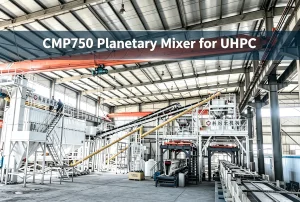
UHPC recipes require high shear input to thoroughly wet silica fume particles (0.1–0.2 microns) and distribute steel micro-fibers (up to 2-3% by volume) without agglomeration. CO-NELE CMP series planetary mixers deliver the high kinetic energy needed to fluidify zero-slump mixtures, enabling compressive strength achievements exceeding 150–200 MPa for bridge deck overlays, offshore wind turbine foundations, and architectural cladding.
In automated block batching lines (paving stones, kerbstones, hollow blocks, retaining walls), color consistency between batches is paramount. Planetary counter-current mixers ensure fast pigment dispersion within 45 seconds, eliminating streaks and reducing scrap rates by up to 85% compared to conventional pan mixers.
High-alumina, silicon carbide, and graphite refractory materials demand intense mechanical force to wet dense powders with minimal liquid binders. Special heavy-duty planetary refractory mixers lined with high-chrome ceramic plates provide heat-resistant and abrasion-resistant performance under aggressive operational conditions.
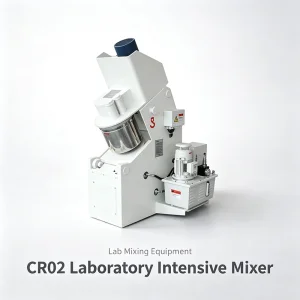
Utilizing specialized intensive mixer granulators (CQM & CR series), chemical plants turn fine powders (alumina, zirconia, iron powder, battery cathode materials) into dust-free spherical granules with precise particle size distribution (0.5 mm to 8 mm) in a single vessel.
As global construction industries accelerate decarbonization targets, mixing technology is evolving rapidly. Key market developments shaping the next decade include:
Increasing reliance on supplementary cementitious materials (SCMs) such as calcined clays, alkali-activated slag, and recycled aggregates demands higher shear energy during mixing to activate latent hydraulic properties—a task perfectly suited for vertical planetary mixers.
Integration of real-time microwave moisture probes located in the mixer floor, communicating directly with PLC batching software to auto-adjust water dosing within ±0.1% accuracy on every cycle.
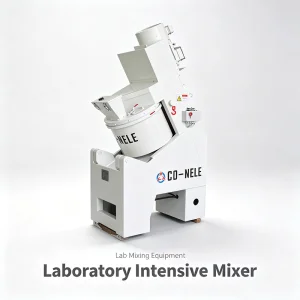
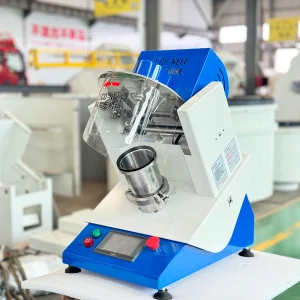
R&D departments utilize 5–75 L laboratory intensive mixers to formulate recipes, transferring identical kinematic scale-up parameters directly to 3000 L industrial production models.
While the initial purchase price (CAPEX) of a planetary concrete mixer is typically 15–20% higher than a standard pan mixer, the Total Cost of Ownership (TCO) over a 5-year period is dramatically lower:
TCO = Purchase CAPEX + Power (kWh/m³) + (Wear Part Cost x Replacement Frequency) - Cement Savings (7-10% hydration gain) - Scrap Reduction
By saving up to 25–35 kg of cement per cubic meter of high-grade concrete while achieving full design strength, high-volume precast plants recover their complete initial machinery investment within 8 to 14 months of continuous operation.
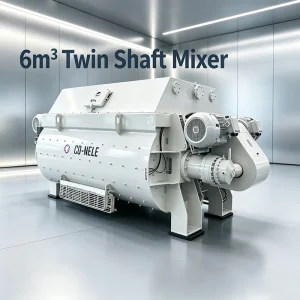
Select a vertical-shaft planetary counter-current mixer when your application requires micro-homogeneity below a 5% coefficient of variation, zero segregation, fast color dispersion, or processing of low-slump, dry-cast, or ultra-high performance concrete (UHPC, GFRC, refractory castables). Planetary mixers excel in precast, pavers, blocks, and technical applications. Choose a twin-shaft mixer for high-throughput ready-mix concrete plants (above 2–6 m³ output per batch) where cycle time (30–45 seconds) and high volume flow are primary priorities over specialized micro-dispersion.
Equipped with standard high-chromium alloy wear liners (HRC ≥ 62), mixing arms and tiles typically achieve 90,000 to 150,000 batches under standard aggregate concrete operations. In highly abrasive applications (e.g., quartz-dense UHPC, refractory castables, or corundum powders), wear life ranges between 40,000 and 60,000 batches. All wear elements are fully bolt-on and modular, allowing quick field replacement. Interchangeable spare parts are maintained in stock for all CO-NELE mixer series produced since 2004.
Yes. CO-NELE operates an advanced process material testing laboratory at our Qingdao headquarters equipped with laboratory intensive mixers and granulators (5 to 75 liters capacity). International clients can ship 10–50 kg of raw powder, aggregate, or slurry. Our process engineers perform trial batches, measuring mixing time, moisture adsorption, bulk density, granule sphericity, and compressive strength, providing a detailed technical test report alongside scale-up machinery recommendations.
Export machinery is built strictly to the buyer's local electrical standards (220V–480V, 50/60 Hz, 3-phase). Delivery packages include complete CE-compliant documentation, 3D BIM models, civil foundation drawings, schematic wiring diagrams, and comprehensive English Operation & Maintenance Manuals. All machines carry a standard 12-month heavy-duty structural and gear drive warranty, backed by 24/48-hour remote technical assistance and worldwide spare parts dispatch via express air freight.
Traditional mixers leave unhydrated cement core clusters due to insufficient shear force. The dynamic counter-current action of planetary mixers breaks down agglomerates down to the micron level, exposing max surface area of cement particles to water molecules. This complete hydration allows concrete formulations to achieve target 28-day compressive strengths with 7% to 10% lower total cement content per cubic meter.
Complete industrial machinery catalog tailored for asphalt, mortar, ceramics, and mobile construction.