
CO-NELEMixing & Granulation
High-efficiency mixing equipment and batching plants engineered in Qingdao, China for refractory, precast, UHPC, and advanced ceramic industries.
How modern planetary counter-current kinematics and high-shear intensive mixing technologies are solving refractory formula segregation, thermal stress failures, and processing inefficiencies.
In thermal processing industries—spanning steelmaking blast furnaces, non-ferrous metallurgy, glass melting kilns, cement rotary kilns, and petrochemical cracking reactors—refractory materials represent the critical line of defense against extreme temperatures, chemical slag corrosion, and mechanical erosion. The performance of shaped refractory bricks (magnesia-carbon, silica, alumina) and unshaped monolithic refractories (castables, ramming mixes, gunning materials) is fundamentally governed by the homogeneity of micro-powder dispersion and binder distribution during the mixing phase.
Historically, refractory producers relied on conventional horizontal ribbon mixers, gravity drum mixers, or standard pan mixers. However, as modern high-performance refractories increasingly incorporate nano-silica fumed additives, steel/organic fibers, metallic powders (silicon/aluminum anti-oxidants), and complex liquid binder systems (sodium silicate, resin, phosphate), traditional equipment fails to overcome agglomeration. Micro-segregation of ultra-fine particles leads to localized density variations, resulting in catastrophic spalling and premature furnace lining breakdown under thermal shock.
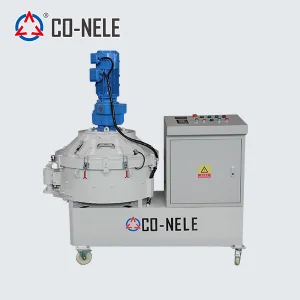
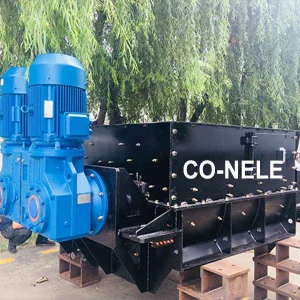
As a leading China Mixer For Refractories Manufacturer, Qingdao CO-NELE Machinery Co., Ltd. has spent over two decades pioneering vertical-shaft planetary counter-current mixers and intensive mixing granulators. By engineering high-shear rotating star-arms and counter-rotational mixing pans, our machinery guarantees a Coefficient of Variation (CV) below 3%, setting a new global benchmark for refractory mixing efficiency and structural longevity.
Micro-fine silica fume and metallic anti-oxidant powders are completely deagglomerated within 60–90 seconds of forced planetary shearing.
Equipped with replaceable high-chrome alloy, tungsten carbide hardfacing, or ceramic wear liners capable of handling extremely abrasivecorundum and SiC materials.
Optimized hydraulic discharge gates allow full pan clearing in under 15 seconds, maximizing batching plant throughput for continuous lining installation.
Understanding the mechanical physics behind forced action mixing for low-moisture and ultra-high-density refractory castables.
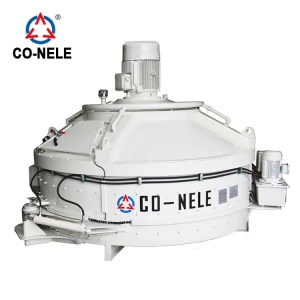
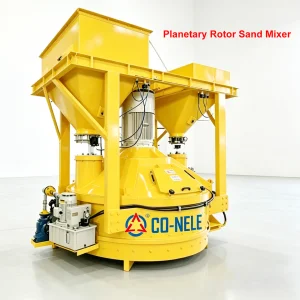
The core innovation of the CO-NELE refractory mixer lies in its patented vertical-shaft planetary gear drive mechanism. Unlike traditional twin-shaft mixers that rely on horizontal parallel paths, planetary counter-current mixing combines revolution and rotation motion vectors:
As the central mixing star revolves around the center axis of the pan, the individual mixing blades rotate simultaneously around their own sub-axes at calculated speed ratios. This dual-kinematic motion ensures that the paths of the mixing blades cover the entire floor and sidewalls of the mixing pan within a single revolution. No material dead zones exist, preventing dry powder pockets or binder pooling near the pan discharge gate.
| Performance Feature | CO-NELE Planetary Counter-Current Mixer | Traditional Twin-Shaft Mixer | Gravity Drum & Ribbon Mixer |
|---|---|---|---|
| Mixing Kinematics | Dual-axis planetary motion (Revolution + High-Speed Rotation) | Horizontal dual-shaft overlapping shear | Single-axis gravity tumbling / spiral pushing |
| Dead Zone Elimination | 100% complete pan sweeping (Zero dead zones) | Occasional buildup at shaft ends and corners | High accumulation along bottom corners |
| Micro-Powder Dispersion | Exceptional (Deagglomerates nano-silica & fibers) | Moderate (Requires extra mixing time) | Poor (High binder lump risk) |
| Moisture Range Handling | Ultra-dry to thixotropic castables (1.5% - 12% moisture) | Wet to medium dry castables | High moisture slurries only |
| Liner Wear Rate | Symmetrical blade path distributes wear evenly | High localized wear on bottom liners & paddle tips | Uneven wear causing wall clearance gaps |
| Energy Efficiency per Tonne | High energy conversion; 20-30% power savings | Standard industrial energy footprint | High energy waste due to internal drag |
Tailored mixing solutions engineered for harsh operating environments in steel, non-ferrous smelting, cement, glass, and chemical facilities.
For Al2O3-SiC-C main trough castables and ladle lining materials, CO-NELE mixers enforce precise dispersion of silicon carbide and pitch binders, preventing oxidation and thermal degradation during molten iron tapping.
High-alumina alkali-resistant castables and preheater calciner linings require rapid field-mixing. Mobile and stationary batching units deliver uniform fiber reinforcement without clumping, preventing lining collapse.
Fused cast AZS (Alumina-Zirconia-Silica) materials demand zero iron contamination. Specialized stainless steel liners and non-contaminating polyurethane blades ensure ultra-pure batch production.
Dense erosion-resistant castables containing metallic needles and dense aggregates are homogenously wetted, ensuring low porosity and high cold crushing strength (CCS) after sintering.
Utilizing high-speed intensive granulating mixers, micro-fine ceramic powders (alumina, zirconia, boron carbide) are processed into highly spherical granules with optimal flowability for press-molding.
Automated moisture control systems accurately dose liquid resin or water-glass binders, producing uniform press-ready granules that minimize density gradient flaws during hydraulic pressing.
Headquartered in the industrial hub of Qingdao, CO-NELE leverages an end-to-end manufacturing ecosystem to deliver unmatched quality and cost-efficiency.
Unlike standard OEM aggregators who purchase third-party gearboxes and assemble modular frames, CO-NELE operates complete vertical integration in Qingdao. We design, cast, machine, heat-treat, and test our proprietary planetary reducers in-house. This ensures that every gear mesh is optimized to handle the extreme torsional shock loads characteristic of refractory dry mixing.
By controlling our component supply chain—including heavy steel plate cutting, CNC machining centers, automated robotic welding, and dynamic balance test benches—CO-NELE reduces production lead times by up to 40% compared to European equipment builders. Furthermore, key wear components (high-chrome liners, mixing blades, discharge seals) are maintained in permanent stock for 24-hour dispatch via Qingdao Port and international air freight logistics.
Pioneering smart mixing systems, real-time rheological telemetry, and eco-efficient power trains for the next decade of thermal material processing.
Integrating high-frequency microwave moisture sensors and optical torque feedback to continuously measure batch viscosity, dynamically adjusting liquid binder addition within ±0.1% precision.
Transitioning from traditional high-chrome alloys to laser-cladded tungsten carbide matrix tiles and sintered diamond-composite scraping arms, extending wear life past 200,000 refractory batches.
Eliminating belt drives and secondary gear reductions in favor of high-torque direct-drive motors, cutting transmission energy losses by 18% and dramatically lowering machine sound levels.
Rigorous international engineering standards backed by localized engineering assistance and customized electrical configurations.
CO-NELE refractory machinery is tailored to regional industrial electrical grid standards across Europe, North America, the Middle East, Southeast Asia, and South America. We support variable power inputs including 220V, 380V, 415V, 440V, and 690V at 50Hz or 60Hz. Controls are equipped with top-tier global components such as Siemens PLC systems, Schneider electrics, and ABB frequency converters.
Explore our complete catalog of specialized machinery for refractory, UHPC, asphalt, granulating, and foundry sand applications.
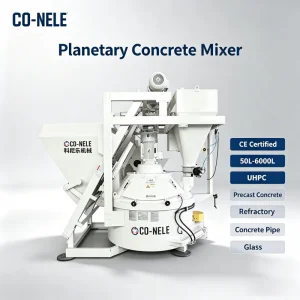
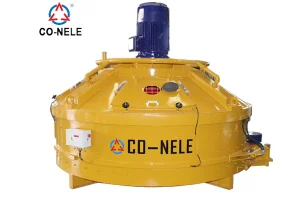
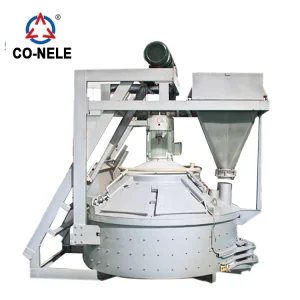
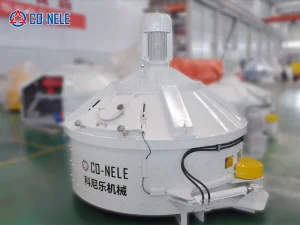
Expert responses compiled by CO-NELE application engineers to address equipment selection, wear part management, and formula optimization.
Refractory mixes—especially unshaped low-cement castables (LCC), ultra-low cement castables (ULCC), and dry ramming mixes—contain abrasive heavy aggregates combined with micro-silica powders. Twin-shaft mixers create horizontal shear zones that can leave unmixed dry pockets near shaft seals. Planetary counter-current mixers utilize a vertical-shaft star-arm system that rotates while revolving around the entire pan floor. This eliminates dead zones, prevents micro-powder agglomeration, and achieves a sub-3% variation coefficient far faster than twin-shaft systems.
CO-NELE offers multiple customizable wear liners depending on raw material abrasiveness. Standard configurations use high-chrome alloy plates with a hardness rating of HB600+. For extreme abrasion, such as processing fused corundum, silicon carbide (SiC), or zirconia, we provide tungsten carbide hardfacing blades, ceramic-tiled pan liners, or non-metallic polyurethane linings to prevent iron contamination in high-purity formulas.
Yes. Every CO-NELE refractory mixer and mixing granulator is engineered for seamless integration into fully automated batching and pressing lines. Our electrical control cabinets feature open PROFINET, Modbus, or Ethernet/IP protocols for direct communication with centralized Siemens or Allen-Bradley PLCs, automated aggregate weighing hoppers, liquid binder dosing pumps, and brick press feed systems.
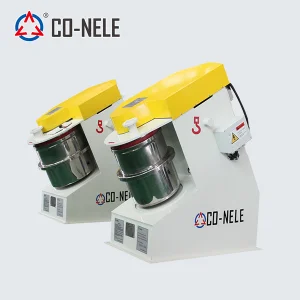
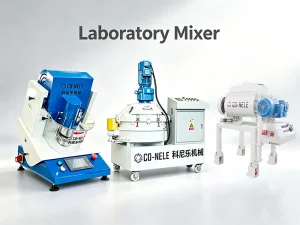
We operate a 1,500 m² state-of-the-art mixing laboratory in Qingdao equipped with CMP50 laboratory planetary mixers and CEL series intensive granulators. Global clients can send 10kg to 50kg samples of their proprietary raw powders. Our chemical and mechanical process engineers will run mixing trials, benchmark dispersion homogeneity, analyze moisture dynamics, and generate a comprehensive technical feasibility report prior to equipment selection.
Consult directly with our Qingdao process engineering team for custom mixer sizing, layout CAD drawings, and laboratory material testing.