
CO-NELEMixing & Granulation
Explore our core engineering equipment engineered for extreme material homogeneity, rapid batching cycles, and zero-dead-zone processing.
Transitioning from Macro-Dispersion to Nano-Level Micro-Homogenization in Modern Material Processing
Across high-tier manufacturing sectors—ranging from Ultra-High Performance Concrete (UHPC) and advanced technical ceramics to lithium-ion battery precursor synthesis—the physical constraints of standard free-fall and low-shear horizontal ribbon mixers have become a primary bottleneck. Traditional mixing technologies rely on gravitational tumbling or gentle convective displacement, which frequently fail to disintegrate micro-agglomerates, resulting in density gradients and localized structural weaknesses.
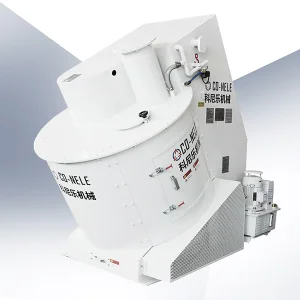
High-Intensity Powder Mixers represent a mechanical leap forward. By decoupling material transport from the energy input mechanism, these machines generate high shear force dynamics inside a controlled mixing chamber. Operating on the principle of forced counter-current kinematics, high-intensity mixing forces micro-particles, fibers, liquid binders, and heavy aggregates into continuous three-dimensional intersection paths, reaching a Coefficient of Variation (CV) under 3% within batch cycles under 90 seconds.
The global industrial ecosystem is demanding higher performance metrics from composite materials. Industrial applications no longer tolerate material variability:
| Performance Parameters | Conventional Ribbon / Pan Mixer | Twin-Shaft Horizontal Mixer | CO-NELE High-Intensity Counter-Current Mixer |
|---|---|---|---|
| Mixing Kinematics | Single-direction low convective shear | Dual-axis overlap flow | Counter-current rotational pan + high-speed rotor vector |
| Mixing Homogeneity (CV) | 8% – 12% (Higher dead zones) | 5% – 8% | < 3.0% (Micro-level distribution) |
| Micro-Agglomerate Dispersal | Poor (Requires pre-grinding) | Moderate | Exceptional (De-agglomeration via high-shear choppers) |
| Energy Density (kW/m³) | 15 – 25 kW/m³ | 30 – 45 kW/m³ | 60 – 120 kW/m³ (Targeted kinematic energy transfer) |
| Granulation Capability | None (Mix only) | None | Dual Capability (Mixing & Wet Granulation in 1 unit) |
Decoupling Material Transport from Mixing Intensity for Optimal Power Utilization
The core innovation of China High Intensity Powder Mixers lies in the functional separation between material circulation and high-shear dispersion. The mixing pan rotates at an inclined or horizontal axis, conveying 100% of the charge upward into the path of high-speed mixing rotors.
This dual-action velocity gradient creates intense collision forces between individual particles rather than pushing materials against stationary vessel walls, eliminating friction-induced thermal degradation.
Handling abrasive powders such as silicon carbide, fused alumina, quartz sand, and metallic ores rapidly degrades inferior alloy contact surfaces. CO-NELE integrates customized tribological protection systems:
Modern industrial processing requires real-time telemetry and closed-loop feedback. CO-NELE high-intensity mixers are equipped with integrated Industry 4.0 control suites:
Tailored Mixing Solutions Designed to Overcome Specific Process Engineering Bottlenecks
In Ultra-High Performance Concrete (UHPC) manufacturing, ultra-fine powders like silica fume tend to clump, preventing uniform water reaction. Standard mixers fail to disperse high percentages of steel fibers without balling.
The CO-NELE Advantage: The high-intensity counter-current rotor instantly shears silica fume agglomerates and evenly distributes micro-steel fibers throughout the matrix within 60 seconds, eliminating structural voids and yielding 180+ MPa compressive strength performance.
Refractory castables require extremely low water additions (under 4.5%) to maximize high-temperature density. Standard mixers cannot coat dry aggregates with such minimal liquid levels without prolonged batch cycles that generate heat.
The CO-NELE Advantage: High energy input per unit volume rapidly forces moisture throughout the binder powders, enabling uniform coating of corundum, bauxite, and silicon carbide grains in under 90 seconds.
Granulating ultra-fine technical powders (alumina, zirconia, metal oxides) prior to dry-pressing requires strict particle sphericity above 90% and high bulk density to prevent die binding and cracking during firing.
The CO-NELE Advantage: Our intensive mixer granulators combine micro-homogenization with binder spray systems in a single vessel, forming dense, spherical granules from 0.2 mm to 2.0 mm without needing expensive spray-drying towers.
Scale Economics, Vertical Integration, and Technical Precision from Qingdao Industrial Hub
Unlike assembly-only plants that outsource critical components, CO-NELE operates three dedicated manufacturing bases spanning over 30,000 m² in Qingdao, China. Every core mechanical subsystem—from heavy structural steel machining to specialized planetary gearboxes—is fabricated in-house.
This vertical integration grants total control over dimensional tolerances, gear teeth hardening, assembly fit-up, and quality assurance. Operating our own gearbox test benches guarantees that every unit shipped delivers quiet operation, high thermal dissipation, and long service life under heavy peak loads.
Leveraging China's comprehensive industrial supply network, CO-NELE pairs domestic cost efficiency with world-class component standards. We integrate premium international brands (Siemens PLCs, Schneider electronics, SKF bearings, SEW drive options) while securing raw steel plate and alloy wear parts directly from top-tier domestic foundries.
The result is an unmatched cost-to-performance ratio. International buyers receive heavy-duty industrial mixing machinery that matches or exceeds European engineering standards at a lower Total Cost of Ownership (TCO).
Ensuring Seamless International Integration, Electrical Adaptability, and Rapid Service SLAs
CO-NELE mixing systems are fully engineered to comply with strict international regulatory standards. Every machine exported carries CE Certification for European mechanical safety, ISO 9001:2015 quality management validation, and can be optioned with ATEX Dust Explosion-Proofing for chemical and powder-metallurgy environments handling flammable dusts.
Whether operating on 220V/380V/415V/440V/480V at 50Hz or 60Hz, every electrical enclosure is customized to match local site power supplies. Wiring runs follow IEC and NEMA color coding, featuring multi-language touchscreen HMI interfaces (English, Spanish, Russian, French, Arabic) for intuitive local operation.
We maintain an extensive, centralized inventory of interchangeable wear parts, mixing blades, scrapers, and seal kits in Qingdao. With direct air and ocean port links, emergency spare parts dispatch within 24 to 48 hours. Remote visual commissioning guidance and field engineer dispatch ensure minimal production downtime.
Comprehensive Insights into Equipment Sizing, Wear Maintenance, and Material Laboratory Testing
Standard planetary mixers utilize a fixed geometric rotation path, which can leave temporary dead zones when handling sticky fine powders or low-moisture recipes. Horizontal twin-shaft mixers rely on high volume displacement suitable for coarse wet concrete, but lack the high shear rates required to break down micro-agglomerates. High Intensity Powder Mixers feature an inclined or horizontal rotating pan paired with independently powered, ultra-high-speed rotor choppers (up to 40 m/s tip speed). This design decouples material transport from energy input, delivering high shear forces without wearing out the pan liner, and achieving a Coefficient of Variation (CV) under 3% in less time.
Wear part service life depends directly on material hardness (Mohs scale), particle shape, velocity, and selected lining options. When handling standard abrasive aggregates or refractories, high-chrome alloy scrapers and wall liners typically operate between 80,000 to 140,000 batch cycles. For extreme abrasion (such as silicon carbide or fused alumina), CO-NELE provides tungsten-carbide-coated rotor blades and ceramic composite tiles. All scrapers and liner plates are bolt-on, allowing rapid field replacement without cutting or welding.
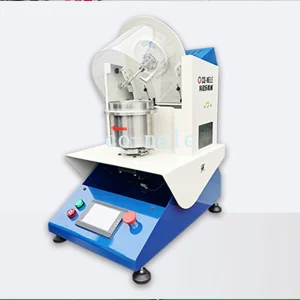
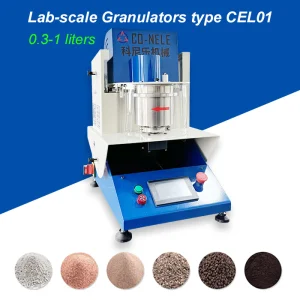
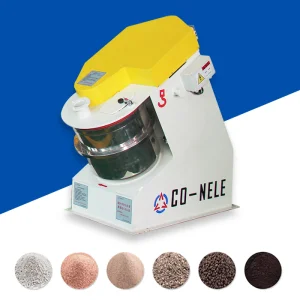
Yes. CO-NELE operates an advanced R&D material testing laboratory at our Qingdao headquarters, equipped with 5L to 75L laboratory-scale intensive mixers. Clients can ship 15kg to 50kg samples of their raw powders or aggregates. Our process engineers will run mixing and granulation trials, measuring batch time, energy consumption, bulk density, granule sphericity, and binder ratio. A detailed trial analysis report will be provided to help select and size the right industrial-scale model.
The dual functionality is achieved by controlling the variable speed settings of the mixing pan and rotor choppers via a VFD interface. In Phase 1 (Dry Homogenization), the rotor runs at high speeds to break micro-agglomerates and uniformly disperse dry ingredients. In Phase 2 (Liquid Injection), binder liquid is introduced via fine misting nozzles while the rotor speed adjusts. In Phase 3 (Granulation), the rotor speed slows to foster controlled snow-balling kinetic energy, rolling fine powders into uniform, dense spherical granules without needing extra equipment.
Every exported unit includes a comprehensive technical dossier containing CE/ISO compliance certificates, full 3D layout drawings, civil foundation foundation templates, wiring schematics, a spare parts manual with OEM part numbers, and an English operation & maintenance manual. Additionally, full factory acceptance test (FAT) videos are provided prior to packing.
Complete Industrial Batching, Granulating, and Specialized Concrete Infrastructure Equipment