CO-NELEMixing & Granulation
Explore China's leading batching and mixing machine configurations engineered for high-homogeneity concrete, refractory, and material granulation processing.
The global construction industry is undergoing a structural paradigm shift driven by urban densification, accelerated transport infrastructure projects, and stringent environmental sustainability targets. Modern EPC (Engineering, Procurement, and Construction) contractors, ready-mix producers, and precast concrete manufacturers face mounting pressures to deliver consistent mix qualities under hyper-tight project timelines.
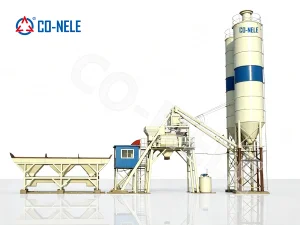
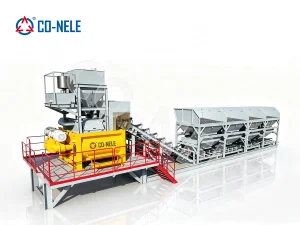
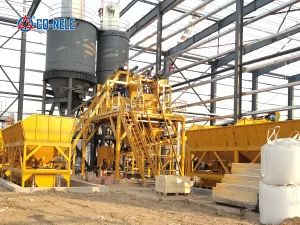
Traditional stationary batching plants, while offering massive volumetric throughputs exceeding 200 m³/h, present severe capital expenditure (CAPEX) inertia, extensive site foundation requirements, long installation windows (often 4 to 8 weeks), and zero operational flexibility once civil works conclude. In response, global procurement strategies are rapidly leaning toward China Compact Concrete Mobile Batch Plant Factory & Machine solutions.
Key Industry Shift: According to global infrastructure procurement benchmarks, over 64% of medium-scale highway, wind farm foundation, and bridge abutment projects now specify foundationless or mobile compact batching systems to eliminate civil foundation costs and reduce site mobilization times by up to 80%.
Chinese OEM machinery manufacturers—led by engineering pioneers like Qingdao CO-NELE Machinery Co., Ltd. (est. 2004)—have redefined the technological landscape. By fusing precision European planetary motion dynamics with modular Chinese manufacturing efficiency, contemporary mobile and compact batch plants provide enterprise-grade reliability, ultra-precise material dosing ($\pm 1\%$ accuracy for cement/water/admixtures), and seamless transportability in standard shipping containers.
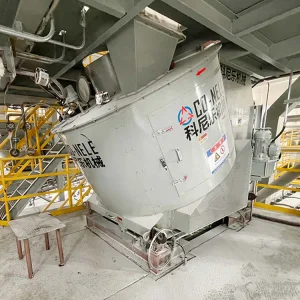
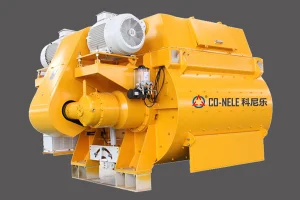
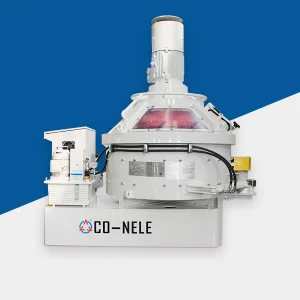
The engineering core of any compact concrete mobile batch plant lies within its forced mixing unit. A critical decision for equipment buyers is specifying between a vertical-shaft planetary counter-current mixer (such as CO-NELE's CMP series) and a horizontal twin-shaft mixer (CHS series).
In high-specification applications such as Ultra-High Performance Concrete (UHPC), Glass Fiber Reinforced Concrete (GFRC), dry-cast block manufacturing, and pigmented architectural precast, standard twin-shaft mixing often leaves dead zones or uneven fiber dispersion. Planetary mixing solves this through multi-dimensional motion vectoring:
The mixing blades rotate on a central sun axis while simultaneously spinning on their own planetary axes in opposite directions. This counter-current action forces aggregate particles through complex intersecting trajectories, achieving full chemical dispersion of cementitious binders, silica fume, micro-admixtures, and fibers within 45 to 90 seconds.
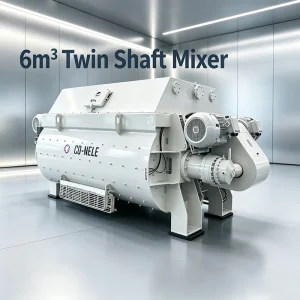
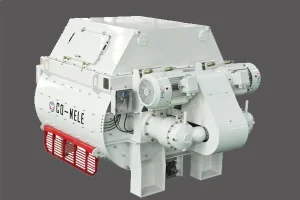
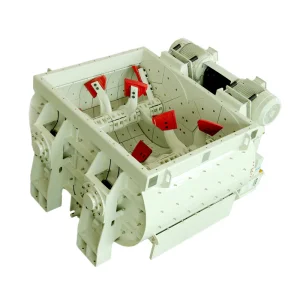
For high-volume commercial ready-mix concrete ($C20$ to $C50$ grades) where batch cycle speed is paramount, horizontal twin-shaft mixers utilize dual counter-rotating shafts equipped with overlapping spiral blades. This creates intense turbulence in the overlapping central region, discharging up to 6 m³ per batch within a 30 to 45-second mixing phase.
| Technical Parameter | Planetary Counter-Current Mixer (CMP) | Twin Shaft Compulsory Mixer (CHS) |
|---|---|---|
| Primary Application | UHPC, Precast, Block, GFRC, Refractory | Ready-Mix Commercial Concrete, Mass Civil Works |
| Homogeneity (Co-efficient of Variation) | $CV < 3\%$ (Micro-Homogeneity) | $CV < 5\%$ (Standard High Homogeneity) |
| Mixing Cycle Time | 60 – 90 Seconds | 30 – 45 Seconds |
| Discharge Speed & Cleanliness | 100% Bottom Scraper Discharge (Zero Residue) | Dual Hydraulic Gate (High Volume Rapid Flow) |
| Wear Resistance Rating | High-Chrome Alloy ($\ge 500 \text{ HBW}$) | Ni-Hard Cast Iron / Manganese Steel Liners |
On-site mobile batch plants eliminate concrete transit delay. Outfitted with precision steam heating systems and chilled water batching, these units maintain slump and hydration control in temperature extremes from $-25^\circ\text{C}$ to $+50^\circ\text{C}$.
Deployable on barges or coastlines, foundationless compact mixing units produce high-density anti-scour grouting and concrete gravity bases, meeting rigid DNV-GL marine environment standards.
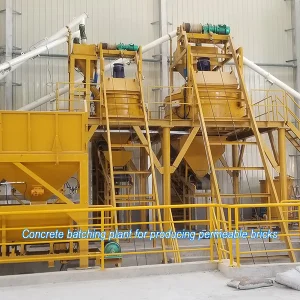
Integrated directly into block machine production lines (e.g., CBP150 series), compact batch plants supply uniform dry-cast mix for pavers, roadside kerbs, and environmental permeable bricks.
Modern concrete production is no longer just about aggregate mixing; it is a digitised batching process governed by microprocessors, IoT telemetry, and low-carbon chemistry.
Aggregate moisture variations represent the single greatest cause of slump instability and strength deviation in concrete. Advanced Chinese mobile batch plants integrate microwave moisture probes inside aggregate discharge gates and mixer pans. The PLC system dynamically adjusts water dosage in real time (within 100 milliseconds), guaranteeing water-cement ratio ($W/C$) precision to $\pm 0.5\%$.
To comply with global net-zero targets, concrete formulations increasingly substitute Portland cement with Supplementary Cementitious Materials (SCMs) such as Ground Granulated Blast-Furnace Slag (GGBS), fly ash, and calcined clays. Chinese compact plants feature multi-silo powder weighing hoppers with fluidised aeration pads and anti-caking pneumatic vibrators, enabling clean dosing of fine, low-carbon binders.
Equipped with 4G/5G telemetry modules, batch plants stream real-time operational telemetry—such as mixer motor current draw, gearbox temperature, hydraulic door pressure, and scale load cell drift—to central engineering dashboards. Operators receive automated alerts before mechanical wear leads to un-scheduled site downtime.
Evaluating a Chinese machinery manufacturer requires analyzing Total Cost of Ownership (TCO), international certification standards, and spare parts supply logistics.
While European batching plants command premium CAPEX investments, top-tier Chinese manufacturers deliver equivalent component longevity (utilizing SEW-Eurodrive reducers, Schneider electricals, and Siemens PLCs) at 35% to 50% lower initial acquisition costs. Furthermore, containerized compact designs reduce international ocean freight expenses by allowing complete 50 m³/h plants to ship inside three standard 40ft High-Cube (HQ) containers.
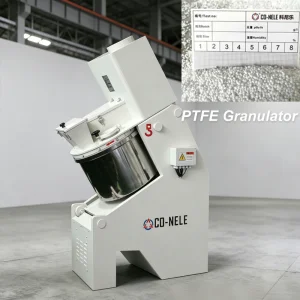
Discover specialized laboratory mixers, asphalt plants, compact batching systems, and intensive granulators engineered for international industry compliance.