CO-NELEMixing & Granulation
Engineered for high-volume duty cycles, intense aggregate abrasion, and precise pigment distribution.
South Africa's construction and civil engineering sector is undergoing a structural transition driven by large-scale public infrastructure initiatives, urban rapid transit expansions, commercial industrial parks, and the ongoing demand for affordable human settlements under the Reconstruction and Development Programme (RDP). Concrete hollow blocks, solid masonry bricks, interlocking paving stones, and retaining wall units form the foundational backbone of this building boom across provinces from Gauteng to the Western Cape.
However, commercial block manufacturers operating in South Africa face severe local challenges: highly variable raw material supplies (ranging from harsh Witwatersrand quartzite aggregates and coastal dune sands to crushed dolerite and crusher dust), fluctuating power grid reliability (Eskom load-shedding), and stringent compliance specifications dictated by the South African Bureau of Standards (SANS 1215 for masonry units and SANS 1058 for concrete paving blocks). Modern block producers can no longer rely on conventional, legacy horizontal twin-shaft mixers or basic gravity batching bins that produce inconsistent compressive strength and high cement wastage.
Compressive strength standards (ranging from 3.5 MPa for partition blocks to over 45 MPa for heavy-duty industrial paving blocks) require a batching system capable of extreme dosing precision (±1% for cement/water) and zero segregation.
Industrial batching plants deployed in South African municipal zones require smart PLC memory save systems, dual-fuel generator interlocks, and low-torque soft-starting planetary gearboxes to prevent mix hardening during unexpected power drops.
Crushed granite, iron ore slag, and quartzite sands typical in Johannesburg and Polokwane rapidly erode standard steel mixing pans. High-chrome alloy wear plates (hardness >60 HRC) are vital for maintaining long service life.
For dry-cast and semi-dry concrete block manufacturing, mixing mechanics dictate the ultimate strength, moisture distribution, and surface aesthetic of the finished unit. Standard twin-shaft concrete mixers—designed primarily for high-slump ready-mix wet concrete—suffer from velocity dead zones when handling low-slump earth-moist block recipes (water-cement ratio between 0.28 and 0.38). This results in cement balling, unequal moisture distribution, and high variation in block height and density.
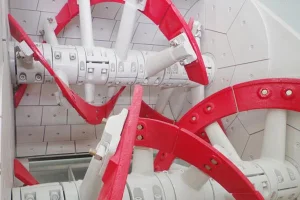
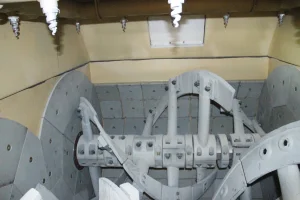
CO-NELE vertical-shaft planetary concrete batching plants utilize counter-current mixing technology. The mixing star arms rotate around a central vertical axis while simultaneously revolving rapidly in the opposite direction. This complex spatial trajectory covers 100% of the mixing pan bottom within 60 to 90 seconds, imparting high shear forces that completely break down agglomerated cement particles and coat every aggregate granule evenly.
Independent laboratory testing on South African aggregate samples demonstrates that CO-NELE planetary counter-current mixing achieves a Coefficient of Variation (CV) below 5%. This superior micro-homogeneity allows block manufacturers to reduce raw cement content by 10% to 18% while achieving higher early-age compressive strength (demoulding strength within 12–24 hours).
| Technical Parameter | CO-NELE Planetary Block Batching Plant | Standard Twin-Shaft Batching Plant | Conventional Pan / Gravity Mixer |
|---|---|---|---|
| Suitable Concrete Slump | Zero-Slump / Earth-Moist (Dry-Cast) | High Slump & Wet Ready-Mix | Medium-High Slump Only |
| Mixing Trajectory & Coverage | 100% Planetary Counter-Current (No Dead Angles) | Parallel Shaft Overlap (Dead Corners at Ends) | Simple Radial Sweep (Center & Edge Dead Zones) |
| Mixing Coefficient of Variation (CV) | < 5% (Ultra-Homogeneous) | 8% - 12% | > 15% (High Instability) |
| Pigment / Colour Dispersion | Instant, Uniform Streak-Free Integration | Poor (Requires Long Cycle Times) | Streaking & Spotting Common |
| Wear Resistance Rating | High-Chrome Cast Alloy (150,000+ Batches) | Standard Hardox / Ni-Hard (60,000 Batches) | Mild Steel Liner (20,000 Batches) |
| Cement Savings Potential | 12% - 18% Reduction per m³ | Baseline Standard | Requires 5-10% Excess Cement |
As an established OEM manufacturer operating three high-tech production bases spanning 30,000 m² in Qingdao, China, QINGDAO CO-NELE MACHINERY CO., LTD. represents two decades of specialized mixing research. Unlike middle-man trading houses or localized equipment refurbishers, CO-NELE engineers, casts, machines, and tests every core component—including our proprietary heavy-duty planetary reducers—in-house.
For South African plant owners, importing directly from a top-tier Chinese manufacturer delivers unprecedented capital cost efficiency (CAPEX optimization) without sacrificing European-grade engineering standards. Our factory features state-of-the-art CNC machining centers, automated robotic welding, and dynamic gearbox testing benches to ensure every plant leaving our factory operates reliably under tough African ambient conditions.
Designed specifically for harsh dry-cast block shock loading. Features dual-stage hardened planetary gear sets, oil-submerged lubrication, and dynamic seal rings to eliminate aggregate powder contamination.
Batching plant modules are pre-assembled and wire-tested at our Qingdao facility before flat-pack breakdown, fitting seamlessly into 40ft High Cube containers for low-cost ocean freight to Durban or Cape Town ports.
Equipped with globally accessible electronics, touch-screen PLC controllers, multi-language interfaces (English, Portuguese, French), and real-time cloud remote diagnostics for fast technical support across Africa.
South Africa's diverse geography presents distinct environmental and material challenges for concrete production. CO-NELE tailors concrete block batching plants to match specific regional demands:
Application: High-density hollow masonry blocks (M4, M6 units) and commercial retaining wall blocks for high-rise developments.
Engineering Adaptation: Integrated high-capacity 4-bin aggregate batcher optimized for crusher dust and fine quartzite sand blending with rapid cycle times.
Application: Saline-resistant coastal interlocking pavers (SANS 1058 45+ MPa) and decorative architectural bricks.
Engineering Adaptation: Dual-discharge planetary mixer layout with microwave moisture sensors for exact water-cement ratio control under variable humidity.
Application: Heavy-duty port logistics paving blocks, drainage channel blocks, and permeable eco-bricks.
Engineering Adaptation: Anti-corrosive marine paint coating on batching plant structure, stainless steel additive dosing lines, and sealed dust filtration systems.
CO-NELE does not sell one-size-fits-all machinery. We configure comprehensive concrete block batching plants tailored precisely to your land footprint, block machine capacity (e.g., Zenith, REHAU, Masa, or Chinese automatic block machines), and electrical grid infrastructure.
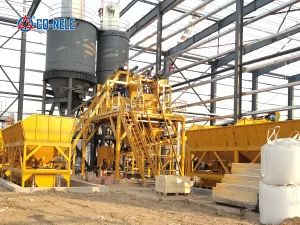
Designed for fast site establishment without extensive civil foundation works. Steel skid structures allow quick installation on flat concrete slabs within 3 days. Ideal for leased industrial sites or expanding regional block producers in Mpumalanga and Limpopo.
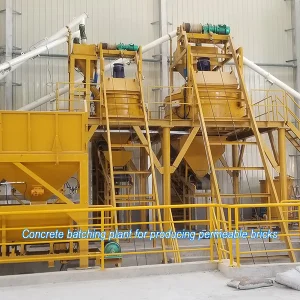
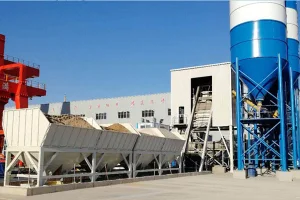
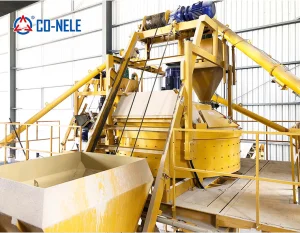
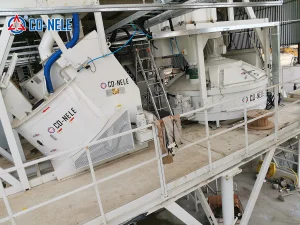
High-capacity central batching stations featuring overhead aggregate storage hoppers (up to 4 x 50 m³), automated skip-hoist or belt feeding, high-speed planetary mixing (CMP750 to CMP2000), and integrated cement screw conveyors. Fully integrated with automated block machine lines.
Specialized batching plants designed for producing high-margin 2-layer paving stones (coarse base mix + ultra-fine colored face mix). Configured with one large base mixer and a dedicated smaller planetary face mixer for instant, vibrant pigment distribution.
When evaluating a concrete block batching plant purchase, smart procurement managers look beyond initial purchase price (CAPEX) to examine total life-cycle operational costs (OPEX). Key financial drivers for South African operations include:
Talk directly with CO-NELE mixing process engineers. Receive layout blueprints, ROI calculations, and custom equipment proposals tailored to your local raw materials.
Send Inquiry NowExpert answers from CO-NELE technical team regarding export logistics, installation, electrical compatibility, and maintenance.
Dry-cast concrete blocks require low water-cement ratios (zero slump). Twin-shaft mixers rely on liquid concrete flow to achieve mixing, creating dry spots and cement balling in low-slump mixes. CO-NELE vertical-shaft planetary mixers use forced counter-current mechanical shear, ensuring 100% micro-homogeneity (CV < 5%), uniform moisture, and flawless pigment integration required for high-density SANS-compliant blocks.
Yes. All electrical systems, motors, and PLC control cabinets exported to South Africa are custom-built to local grid specifications: 400V / 525V, 3-Phase, 50 Hz. Components feature CE and ISO certifications with Schneider breakers and Siemens PLCs for effortless maintenance and local spare part sourcing across South Africa.
CO-NELE provides end-to-end containerized shipping to key South African ports including Durban, Cape Town, and Port Elizabeth (Gqeberha). Equipment arrives pre-wired and modularly assembled. We provide comprehensive civil foundation drawings, 3D assembly models, English instruction manuals, and can dispatch commissioning engineers or oversee remote video commissioning.
CO-NELE mixing pans are equipped with high-chromium alloy liner plates (thickness 12–15 mm, hardness >60 HRC) and cast alloy mixing blades. For extreme abrasion environments (such as gold mine tailing bricks or quartzite crusher dust), optional tungsten carbide coated blades and ceramic liner tiles are available.
Yes. CO-NELE offers automated liquid, powder, and granular oxide pigment dosing systems integrated directly into the Siemens PLC control system. Dosing accuracy is maintained within ±0.5%, guaranteeing batch-to-batch color repeatability for premium architectural pavers.
Factory-direct industrial mixing solutions exported worldwide with guaranteed spare parts availability.
Get in touch with CO-NELE engineering specialists for factory pricing, technical catalogs, and customized batching layout drawings for South Africa.