
CO-NELEMixing & Granulation
Engineered to handle harsh recycled aggregates, GGBS/fly-ash binders, and zero-slump dry-cast formulations with sub-3% coefficient of variation (CV).
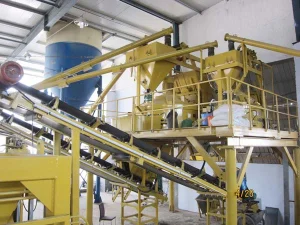
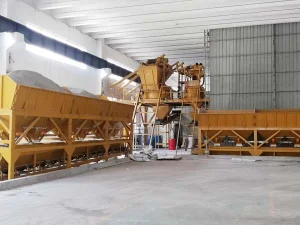
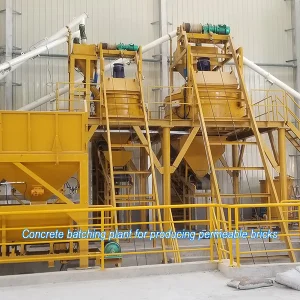
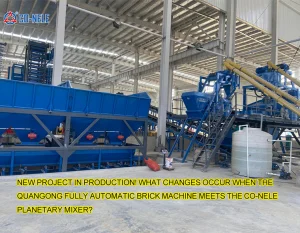
The construction sector in the Netherlands is undergoing one of the most radical transformations in Western Europe. Driven by the Dutch government's mandate to achieve a fully 100% Circular Economy by 2050 (with a 50% reduction in primary raw material use by 2030), concrete block manufacturers, paving brick producers, and structural precast plants are forced to re-engineer their core production methodologies. Operating within the Randstad urban agglomeration and regional hubs like Rotterdam, Amsterdam, Eindhoven, and Groningen, Dutch concrete producers face rigorous environmental, structural, and spatial constraints that directly impact machinery selection.
Dutch public procurement managed by Rijkswaterstaat heavily relies on the Environmental Cost Indicator (Milieukostenindicator - MKI). Concrete block batching plants must deliver absolute consistency when dosing alternative binders such as blast-furnace slag (GGBS) and calcined clays to lower CO2 footprints.
With sand and gravel extraction heavily restricted in the Low Countries, Dutch plants utilize up to 50%+ Betongranulaat (Recycled Concrete Aggregate - RCA). Mixing RCA requires intensive counter-current planetary force to ensure complete binder coating without crushing friable particles.
Every block, paver, and retaining element sold in the Benelux region must comply with NEN-EN 206-1 and national KOMO quality standards. Batching tolerance errors must remain under ±1% for cement/water and ±2% for aggregates.
In standard ready-mix applications, horizontal twin-shaft mixers deliver acceptable throughput. However, when manufacturing dry-cast (aardvochtige) concrete blocks, interlocking pavers, permeable eco-bricks, and hollow-core wall units, twin-shaft kinematics generate dead zones and unequal shear distribution. Zero-slump mixes exhibit extreme internal friction. Standard mixers result in micro-clumping, pigment streaks, uneven compaction during block pressing, and elevated rejection rates at the curing chamber.
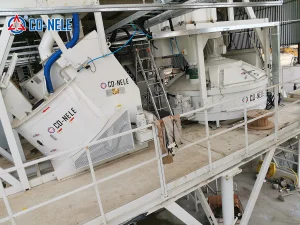
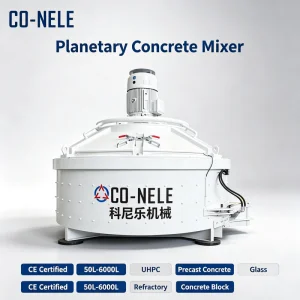
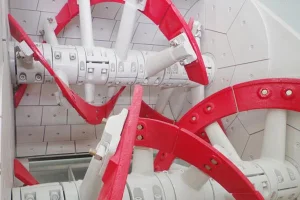
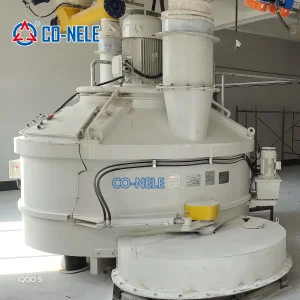
CO-NELE vertical-shaft Planetary Counter-Current Mixers solve this systemic issue. By synchronizing the rotation of mixing stars around a central axis with reverse-direction pan rotation, the mixing blades cover every square millimeter of the mixing pan every 4 seconds. This intense, multidirectional kinetic energy breaks up fine binder agglomerates, disperses micro-silica evenly, and guarantees homogenous moisture coating over porous recycled concrete aggregates.
Quantitative comparison of concrete mixing technologies for high-density block and paver manufacturing lines.
| Performance Metrics | CO-NELE Planetary Counter-Current Mixer | Conventional Twin-Shaft Mixer | Standard Ring Pan Mixer |
|---|---|---|---|
| Dry-Cast (Aardvochtig) Homogeneity | Superior (<3% Variation) | Moderate (Clumping Risk) | Poor (Rim Accumulation) |
| Pigment & Facing Dispersion | Instantaneous Multi-Axis Shear | Uneven Color Streaking | Slow Mixing Cycle Required |
| Recycled Aggregate (RCA) Handling | Zero Particle Breakdown / High Coat | High Blade & Liner Wear | Severe Segregation |
| Energy Consumption per m³ | Optimized Gearbox (15% Savings) | High Drag Resistance | Moderate |
| Wear Liner Service Life (Batches) | 120,000 – 150,000 | 60,000 – 80,000 | 50,000 – 70,000 |
Integrated Engineering: From Raw Aggregate Storage to Integrated Block Machine Feeding.
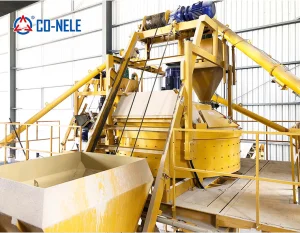
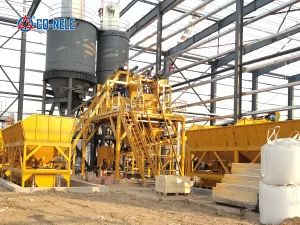
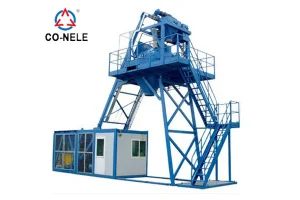
A high-performance concrete block plant is only as strong as its weakest sub-system. CO-NELE engineers fully integrated, modular batching plants designed for fast assembly on Dutch industrial soils where heavy foundation piling is costly. Our modular plants feature elevated aggregate storage bins, high-precision belt conveyors, loss-in-weight binder dosing, and SCADA-driven batching software configured in Dutch and English.
For Dutch paving block manufacturers producing high-value architectural pavers (such as washed-aggregate paving blocks and multi-color marbled face mixes), precise pigment batching is critical. Our plants integrate automated liquid, powder, and slurry pigment dosing systems linked directly to the main PLC. Dosing accuracy is held to within ±0.5%, eliminating batch-to-batch color shifts across multi-thousand-square-meter urban paving projects.
Moisture fluctuation in aggregate bins—caused by the typical maritime Dutch climate—can derail water-cement ratios instantly. CO-NELE batching plants incorporate high-frequency online microwave moisture probes (installed in both the aggregate discharge gates and inside the planetary mixer pan). The control system dynamically calculates moisture content every 100 milliseconds and adjusts added batch water automatically before discharge.
Industrial land leasing costs in locations such as Schiphol Logistics Park or Havenbuurt Rotterdam demand efficient spatial layouts. Our compact HZS and CBP series concrete block batching plants feature self-supporting steel structures. They can be installed directly onto a reinforced concrete slab without deep foundation excavations, reducing installation timelines from months to days.
Proven across 80+ countries: Modular batching plants, mobile mixing stations, high-performance mixers, and specialized industry batching systems.
Seamless Integration into European Manufacturing Standards & Electrical Networks.
Deploying heavy machinery into the Netherlands requires strict adherence to European Union directives and local Dutch industrial regulations. CO-NELE machinery exported to Benelux clients is fully customized prior to shipment to ensure zero compliance friction during site commissioning.
All structural steelwork, safety guards, interlocks, and emergency stop circuits comply with European safety standards. Complete Technical Construction Files (TCF) are provided with every plant delivery.
Control cabinets are built using premium Siemens or Schneider components, configured for 400V 50Hz 3-Phase power supply with NEN 3140 electrical safety compliance and IP65 dust-tight enclosures.
Equipped with secure industrial VPN routers, our engineers in Qingdao perform real-time PLC diagnostics, software updates, and process tuning online. Standard wear parts ship from stock within 24 hours.
In the Dutch energy market, where power costs directly affect per-block profitability, CO-NELE mixers utilize proprietary, heavy-duty parallel helical gearboxes designed specifically for high-torque start-ups under full load. By optimizing blade angle geometry and reducing cycle times from 90 seconds down to 60 seconds, our plants deliver up to 18% reduction in kilowatt-hours per cubic meter of finished concrete compared to traditional pan mixers.
In-depth technical answers addressing buyer search intent in the Benelux region.
Concrete block production uses dry-cast (zero-slump) mix designs. A vertical-shaft planetary counter-current mixer forces the mixing blades through every part of the pan without leaving dead zones. This guarantees complete dispersion of moisture, micro-silica, and pigments in 60 seconds, whereas twin-shaft mixers often leave unmixed clumps in dry-cast formulas.
Yes. To meet Dutch Circulair Bouwen requirements, our plants are equipped with wear-resistant high-chrome alloy liners (HB600+) and planetary arms that thoroughly coat porous recycled concrete aggregates with cement paste without degrading the aggregate grading curve.
Our plants feature integrated micro-dosing systems for liquid or dry powder pigments with ±0.5% dosing accuracy. Combined with real-time microwave moisture sensors in the mixer, water-cement ratios remain constant, eliminating batch-to-batch color variations.
Because CO-NELE plants feature modular, foundationless steel chassis design, pre-wired electrical harnesses, and quick-connect pneumatic lines, on-site assembly typically takes only 7 to 10 days on a pre-leveled concrete slab.
Yes. The automated Siemens PLC weighing and control system maintains batching tolerances well within NEN-EN 206 requirements: ±1% for cement, water, and additives, and ±2% for aggregates, complete with printable batch logs for KOMO audit compliance.
All CO-NELE equipment comes with a 12-month standard warranty on drive assemblies and gearboxes. Wear components (blades, scrapers, liners) are bolt-on for fast field replacement, and spare parts ship directly from stock with 24/48-hour dispatch windows.