
CO-NELEMixing & Granulation
Direct from Qingdao manufacturing base: Field-proven mixers and batching plants engineered to meet the stringent shear and durability demands of Chilean mega-projects.
Analyzing the macro-economic and structural engineering drivers creating unprecedented demand for high-shear planetary concrete mixers across Chile's mining and civil infrastructure sectors.
Chile is the world's premier copper producer and a key supplier of lithium. Copper processing plants in Antofagasta, Calama, and Atacama endure extreme abrasive wear. Traditional concrete fails under harsh mineral slurry impact. UHPC elements—produced with CO-NELE planetary mixers—deliver compressive strengths exceeding 160 MPa and unparalleled impact resistance, drastically reducing plant downtime in chute linings and underground mining tunnel supports.
Situated along the Pacific Ring of Fire, Chile enforces some of the world's most rigorous seismic design codes (NCh433 and NCh170). Structural precast elements require exceptional ductility, micro-cracking control, and energy dissipation. UHPC reinforced with steel micro-fibers eliminates brittle failure modes. Achieving homogenous fiber distribution without clump formation mandates the high-shear counter-current mixing technology pioneered by CO-NELE.
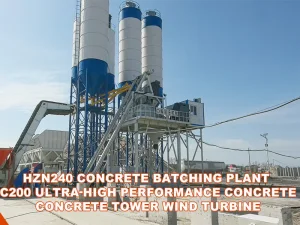
As Chile aggressively expands its green energy footprint in the Atacama Desert and southern Patagonia, infrastructure developers require ultra-durable precast wind turbine towers, transformer foundations, and coastal port anti-scour structures. CO-NELE UHPC batching plants provide precise water-cement ratio control (w/b < 0.18) suited for aggressive hyper-saline desert and marine environments.
Standard concrete mixers fail when processing UHPC formulations due to high matrix viscosity and low water-binder ratios (0.14 - 0.18). In regions like northern Chile, high solar radiation and extreme thermal fluctuations accelerate hydration rates. CO-NELE’s planetary mixers utilize optimized shear dynamics to fully de-agglomerate silica fume particles (0.1–0.5 µm) and distribute steel micro-fibers uniformly, ensuring maximum packing density without thermal micro-cracking.
How Chinese industrial mixing engineering is setting global benchmarks for low-carbon, high-density cementitious material preparation.
Global cement decarbonization trends require replacing clinker with high volumes of Supplementary Cementitious Materials (SCMs)—including copper slag, calcined clay, and ultra-fine silica powder. CO-NELE’s intensive mixing technology imparts intense kinetic energy to break agglomerated fines, enabling up to 50% clinker substitution without sacrificing early compressive strength.
Modern UHPC mixing relies on real-time feedback. Integrated microwave moisture probes and electric torque load sensors continuously measure slurry viscosity. The Siemens PLC automated dosing system calculates exact water adjustments within millisecond cycles, preventing batch segregation and guaranteeing consistency across 100+ daily cycles.
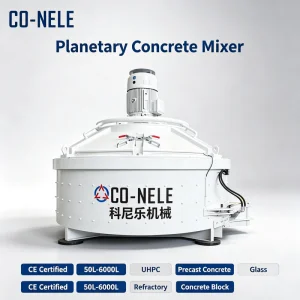
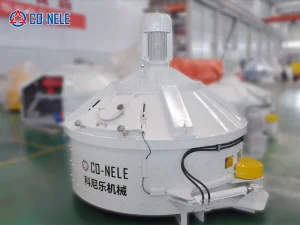
Unlike twin-shaft mixers that suffer from material compaction near shaft seals, vertical-shaft planetary mixers drive mixing blades along complex, non-overlapping trajectories. Every square centimeter of the mixing pan is swept within 6 seconds, ensuring 100% homogenous dispersion of steel fibers without balling or strand distortion.
Mixing hard basalt, quartz sand, and steel fibers creates high wear rates on pan liners. CO-NELE equips UHPC mixers with high-chrome cast iron liners (hardness ≥ HRC 62) and tungsten carbide coated scraper blades, extending operational lifespan beyond 120,000 batches even under abrasive Chilean quartz conditions.
Why conventional drum and twin-shaft mixers fail UHPC standards and how CO-NELE planetary geometry solves the challenge.
Ultra-High-Performance Concrete (UHPC) is not simply "strong concrete"—it is a dense composite material engineered at the micro-scale. Achieving tensile strengths of 10-15 MPa and compressive strengths exceeding 150 MPa requires overcoming extreme fluid resistance during the initial wetting phase. The table below highlights the operational differences when processing UHPC mixtures:
Custom-engineered plant configurations designed to address regional logistics, seismic requirements, and harsh climate conditions in Chile.
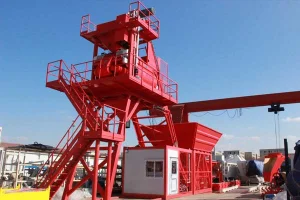
For remote Chilean mining sites in the Andes or Atacama desert, foundationless mobile batching plants eliminate civil engineering costs. Containerized designs permit rapid assembly within 48 hours, providing independent high-shear mixing capacity directly at the mine portal.
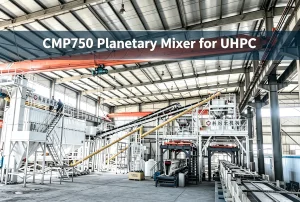
Specifically matched for manufacturing precast bridge girders, pier caps, and tunnel vault segments complying with Chilean highway concession specifications. Integrates precise steam heating and automated batch dosing for maximum throughput.
Coastal applications in Valparaíso, Antofagasta, and Puerto Montt demand salt-spray resistant concrete formulations. CO-NELE mixers feature fully sealed dust covers, stainless steel fluid injection manifolds, and heavy-duty IP65 electrical systems.
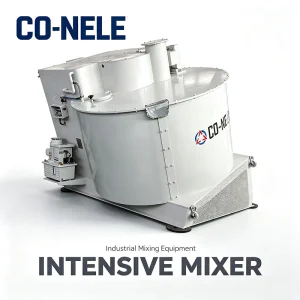
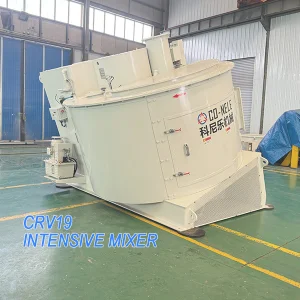
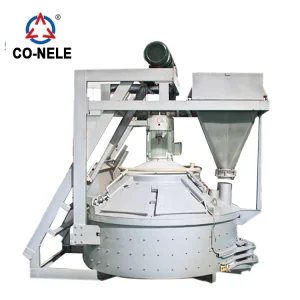
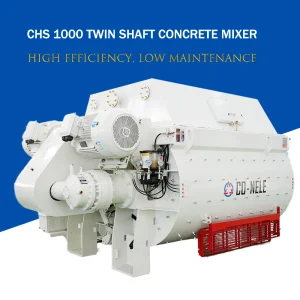
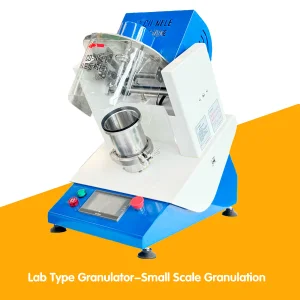
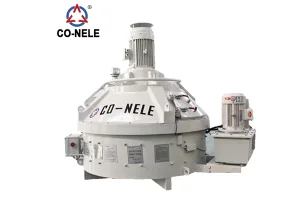
Explore our full line of industrial counter-current planetary mixers, intensive granulators, and heavy-duty concrete machinery.
Expert answers addressing electrical standards, logistics to Chilean ports, steel fiber mixing protocols, and wear life management.
Yes, absolutely. Standard industrial power in Chile operates at 380V and 50Hz (3-Phase). All CO-NELE machinery destined for Chile—including motor drives, frequency converters, soft starters, and Siemens PLC automation panels—are custom-wired and certified to operate flawlessly on 380V/50Hz local power grid parameters, preventing voltage fluctuations and motor overheating.
Fiber balling is primarily caused by low shear zones and improper loading sequences. CO-NELE’s planetary counter-current mixer uses dual-spinning star arms revolving on an offset axis. Combined with high-speed shear rotors and staged PLC dosing protocols (powders first, water/admixture second, micro-fibers third), steel fibers are dispersed single-strand throughout the matrix within 90 seconds.
We regularly ship directly from Qingdao Port (one of China's largest maritime hubs) to principal Chilean ports such as Valparaíso, San Antonio, and Antofagasta. Typical ocean transit times range between 28 to 35 days. Machinery is fully dismantle-packed in standard 40ft HQ container frames with seaworthy anti-corrosion VCI barrier wrappings.
For high-abrasion applications, CO-NELE supplies modular, bolt-on high-chrome cast alloy liners (HRC ≥ 62) and tungsten carbide coated mixing scrapers. Liners are standardized and individually replaceable. We supply a 2-year wear parts package with the initial shipment, ensuring continuous operation without waiting for overseas replacements.
Yes. CO-NELE operates an advanced mixing and granulation testing laboratory in Qingdao. Chilean clients can send 20-50 kg samples of local cement, silica fume, aggregates, or mining powders. Our process engineers execute test runs, analyze rheology curves, measure compressive strength growth, and provide a full engineering feasibility report prior to equipment order confirmation.
Partner with China’s leading industrial mixer manufacturer. Request a custom technical proposal, plant layout design, or equipment quotation tailored to Chilean industrial standards.