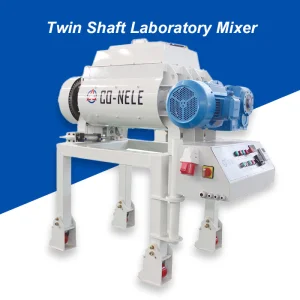

CO-NELEMixing & Granulation
Engineered for high-volume ready-mix, structural precast, and stringent civil engineering standards across Klang Valley.
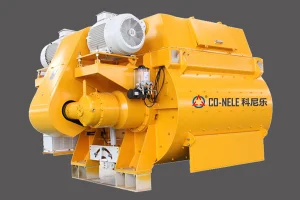
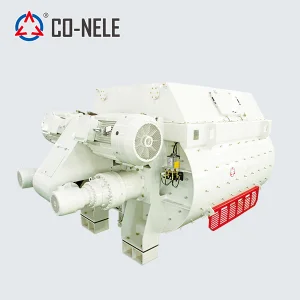
The Greater Kuala Lumpur metropolitan area and the wider Klang Valley region represent one of Southeast Asia's most intensive civil construction zones. Driven by landmark mega-infrastructure projects—such as the Mass Rapid Transit Line 3 (MRT3 Circle Line), East Coast Rail Link (ECRL) connection terminals, Subang Airport Regeneration Plan (SARP), and ongoing high-density commercial developments surrounding Tun Razak Exchange (TRX) and Merdeka 118—the local ready-mix concrete (RMC) sector operates under rigorous structural and environmental constraints.
Operating concrete batching plants in tropical conditions requires overcoming specific regional challenges: rapid cement hydration caused by ambient temperatures ranging between 30°C to 36°C, high relative humidity, and stringent Malaysian Standard specifications (MS EN 206 and JKR standards). Batching plants serving the Kuala Lumpur market require forced compulsory mixing technology capable of processing high-volume mineral admixtures, including Pulverized Fuel Ash (PFA), Ground Granulated Blast-furnace Slag (GGBS), and ultra-fine silica sand sourced from Selangor and Perak deposits.
Why Chinese Twin Shaft Compulsory Mixing Technology Outperforms Conventional Single-Shaft & Tilting Drum Systems in Tropical Civil Construction
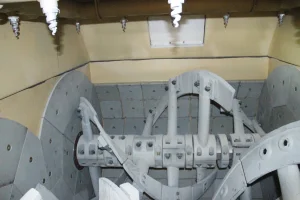
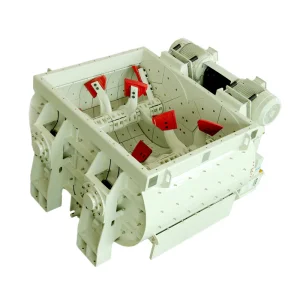
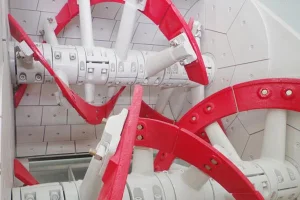
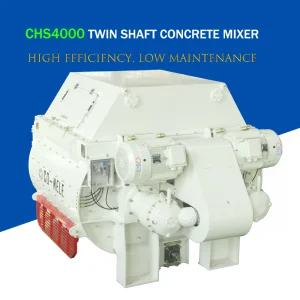
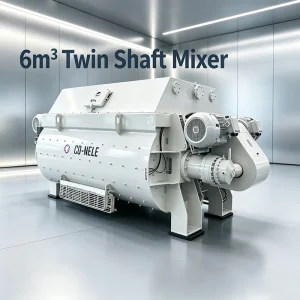
Dual counter-rotating shafts equipped with staggered 60-degree mixing arms generate intersecting three-dimensional turbulent vortices. Aggregate, cement, water, and plasticizers achieve micro-scale dispersion within 30 seconds, eliminating dead zones near pan edges.
Utilizes a multi-stage labyrinth seal system backed by floating seal rings and an automated high-pressure grease injection pump. This creates a positive hydraulic barrier preventing caustic slurry intrusion, extending bearing life past 500,000 cycles.
Driven by an independent hydraulic power pack with manual emergency release override. Three-position discharge door positioning provides precise control for transit mixer charging while minimizing material segregation.
| Performance Metric | CO-NELE CHS Twin Shaft Series | Standard Single Shaft Mixer | Conventional Planetary Mixer |
|---|---|---|---|
| Mixing Homogeneity (CV) | < 3% (In 30-45 Seconds) | < 7% (In 60-90 Seconds) | < 5% (In 60-75 Seconds) |
| Max Aggregate Size (Crushed) | Up to 120 mm (Mass Concrete) | Up to 60 mm | Up to 40 mm |
| Liner Plate Wear Rating (HRC) | High-Chrome Alloy (≥ 62 HRC) | Manganese Steel (45-50 HRC) | Chilled Cast Iron (52-55 HRC) |
| Energy Consumption (kWh/m³) | 1.0 - 1.25 kWh/m³ | 1.6 - 1.9 kWh/m³ | 1.4 - 1.7 kWh/m³ |
| Hydraulic Discharge Speed | 3.5 Seconds (Fully Open) | 8 - 12 Seconds | 6 - 10 Seconds |
Procuring industrial machinery for Malaysian project sites requires adherence to strict legal and operational benchmarks. Mixers manufactured in our Qingdao export facility for deployment in Kuala Lumpur, Shah Alam, Klang, and Cyberjaya are engineered to comply directly with CIDB (Construction Industry Development Board) Malaysia site standards and JKR (Jabatan Kerja Raya) infrastructure guidelines.
Electrical panels feature IP65-rated enclosures fitted with dual Schneider/Siemens switchgear, tropicalized cooling fans, and surge protection modules designed for Malaysia’s high lightning index climate. Motors are configured standard for 415V, 50Hz, 3-Phase power grids, fully certified to ISO9001 and CE international electrical codes.
Comparing capital expenditure (CAPEX) vs. long-term operational expenditure (OPEX) reveals why Chinese manufactured twin shaft mixers dominate the Malaysian market:
Deployment of twin CTS 3000/2000 compulsory twin shaft mixers delivering 240 m³/h continuous output. The dual hydraulic discharge mechanism maintained batching cycle consistency over a continuous 48-hour continuous raft foundation pour, achieving zero unmixed binder pockets.
Integration of CHS series twin shaft concrete mixers into a automated precast girder production line. Attained strict compressive strength tolerances (>60 MPa at 28 days) with a slump deviation within ±10 mm across 12-hour operational shifts.
Integrating Industrial Internet of Things (IIoT), AI-Assisted Hydration Tracking, and Low-Carbon Concrete Processing
Incorporating microwave moisture sensors embedded directly into the mixer floor tiles, connected via RS485/Modbus to an AI dosing controller. The system dynamically adjusts added batch water within 5 seconds of aggregate charge to maintain target water-cement ratios automatically.
Next-generation CHS series mixers feature multi-axis vibration telemetry on primary gearboxes and drive motors. Real-time predictive maintenance alerts notify plant supervisors in KL of micro-bearing wear or shaft seal pressure degradation before catastrophic failure occurs.
As Malaysia moves toward net-zero carbon goals, concrete recipes increasingly replace OPC with alkali-activated slag and calcined clay. Our specialized high-shear paddle geometries are optimized for viscous geopolymer mixing without thermal overheating.
In-depth engineering answers covering procurement, shipping, maintenance, and technical operation.
Explore our full spectrum of twin shaft, double spiral, planetary, and specialty granulation systems.
Request customized engineering drawings, local Malaysian project reference lists, and factory-direct pricing for your Kuala Lumpur concrete plant deployment.
Send Inquiry Now