CO-NELEMixing & Granulation
Explore our foundational line of laboratory scale mixers, heavy-duty twin shafts, and specialized production units engineered for extreme particle homogeneity.
Overcoming micro-segregation, cohesive forces, and particle attrition through deterministic counter-current agitation and fluid shear modeling.
Sub-micron powders, fumed silica, and active pharmaceutical ingredients (APIs) tend to form cohesive clusters due to strong van der Waals attraction. Standard tumble and ribbon blenders fail to inject sufficient specific energy. Our counter-current planetary laboratory mixers generate controlled high-shear zones that fracture agglomerates down to primary particle distribution without inducing localized thermal degradation.
A persistent risk in laboratory powder processing is non-linear scale-up: formulations that pass quality control at 5 liters often experience unblended dead-zones and phase stratification at 3,000 liters. By calibrating laboratory geometry, rotational velocity vectors, and Froude numbers against full-scale industrial variants, our equipment guarantees scalable thermodynamic and rheological continuity across every recipe stage.
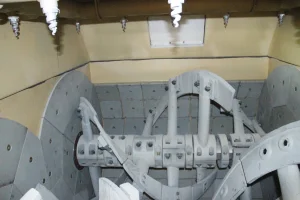
Processing advanced technical ceramics (silicon carbide, zirconia, boron nitride) and battery-grade lithium transition metal oxides demands ultra-low cross-contamination. Our factory engineers wear linings in tungsten carbide overlays, high-chrome white iron castings (up to 65 HRC), and sintered ceramic tile matrices that insulate pure formulations from metallic contamination.
How direct Tier-1 engineering integration from Qingdao bridges the gap between premium performance and total cost of ownership (TCO).
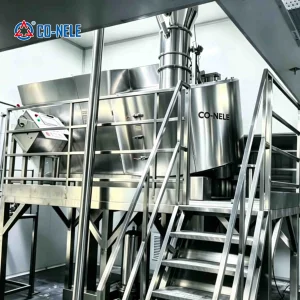
Unlike trading entities that assemble off-the-shelf third-party components, our three Qingdao production bases encompass 30,000 m² of specialized manufacturing. We cast, machine, and heat-treat our proprietary planetary gearboxes and precision mixing tools. This direct control ensures complete part traceability, reliable delivery timelines, and dynamic customization for high-stakes pilot facilities.
Western European capital equipment typically incurs substantial brand premiums and prolonged supply cycles for replacement parts. As a certified Chinese manufacturer, we deliver equal or superior metallurgy and CE-compliant automation at a 40–55% lower capital expenditure threshold, complemented by stock availability of spare components dating back across our 20+ years of operation.
Our engineering division contributed directly to the formulation of national mixing equipment standards in China. Over 80 authorized design and utility patents validate our proprietary innovations in multi-stage seal arrangements, oil-bath planetary gearboxes, and multi-dimensional counter-current kinematic arms.
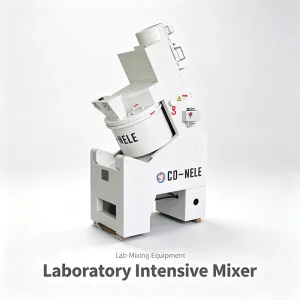
Technical baseline for laboratory scale configurations across planetary counter-current, intensive high-shear, and twin-shaft pilot configurations.
| Kinematic Mechanism | Effective Volume (L) | Drive Capacity (kW) | Linear Rotor Tip Velocity | Primary Process Applications |
|---|---|---|---|---|
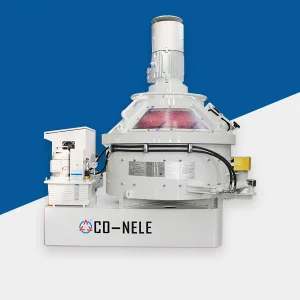
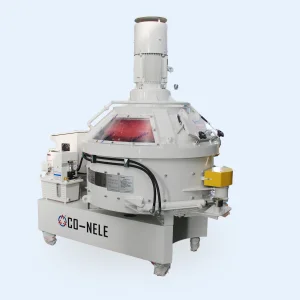
| Planetary Counter-Current | 10 L – 75 L | 2.2 – 7.5 kW | 1.5 – 3.2 m/s | UHPC, Refractory castables, Diamond/CBN micro-matrix, Ceramic masterbatches |
| High-Shear Intensive (Inclined) | 5 L – 50 L | 3.0 – 11.0 kW | Up to 30 m/s (Adjustable) | Battery cathode slimes, Rare-earth metal powders, Binder micro-granulation |
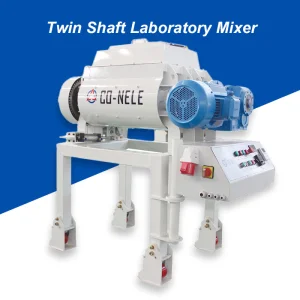
| Pilot Twin-Shaft Compulsory | 20 L – 100 L | 4.0 – 9.0 kW | 1.2 – 2.0 m/s | Ready-mix cementitious pilot formulations, Structural mortars, Fly-ash activation |
| Horizontal Double-Spiral | 15 L – 60 L | 1.5 – 4.0 kW | 0.8 – 1.6 m/s | Dry adhesive mortars, Polymer powder dispersion, Thermal insulation dry-mix |
Configured specifically to process complex multi-component matrices across demanding operational domains.
Laboratory validation of water-to-binder ratios below 0.18. Requires micro-scale dispersion of silica fume, quartz flour, and homogeneous spatial orientation of high-tensile steel or basalt fibers without bird-nesting or matrix voids.
High-shear blending of sub-micron alumina, zirconia, and silicon carbide formulations with zero cross-contamination. Produces granulates with >90% sphericity for direct automated isostatic cold pressing operations.
Processing reactive micro-silica, calcined bauxite, and spinel matrices. Precise torque absorption protects drive assemblies during the high-resistance shear peaks common to dry-to-semi-dry hydration phase transitions.
Rapid wetting, polymer binder coating, and carbon-black conductive networks dispersion over active cathode/anode particles. Sealed atmospheric purging options are available for moisture-sensitive formulations.
Built for seamless worldwide commissioning with strict adherence to CE, UL, and ATEX industrial operating frameworks.
Every laboratory mixer is fully engineered according to EU Machinery Directive 2006/42/EC and Low Voltage Directive 2014/35/EU. Standard configurations feature redundant dual-channel safety limit switches on access ports, quick-reaction mechanical brakes, and emergency stopping circuits conforming to ISO 13849-1 (PL-d) protocols.
Direct export configurations support worldwide power parameters without intermediate transformers: 220V/380V/415V/440V/480V at 50Hz or 60Hz. Automation architectures employ Siemens or Schneider PLC modules with standardized IP65 enclosures, UL508A-certified internal layouts on request, and multilingual operator HMIs.
Our Qingdao headquarters houses a fully operational test laboratory. Clients submit 10–20 kg powder samples to verify batch bulk density, shear curves, and specific granule sphericity before signing production contracts. All wear elements, scraper arms, and seals are backed by direct warehouse inventory available for dispatch within 24–48 hours.
The transition from scheduled batch processing toward real-time rheological feedback, digital twin simulation, and closed-loop speed adaptation.
By measuring high-frequency motor current fluctuations, micro-vibrations, and dynamic gear resistance, next-generation laboratory models automatically identify the exact instant of capillary wetting, dispersion saturation, and peak matrix micro-homogeneity, preventing over-shearing and reducing unnecessary electrical draw.
Every blade profile and star-arm angle is evaluated through coupled CFD-DEM simulations prior to factory casting. Kinematic simulations model millions of individual particle trajectories, minimizing power consumption and pan liner wear while optimizing turnover rates for abrasive batches.
Integrated vibration transmitters and optical temperature probes track bearing stress, gearbox heat, and liner wear in real time. Maintenance alerts and operational analytics help international teams prevent unexpected mechanical downtime.
Direct engineering responses to key application, integration, and operational questions from international buyers.
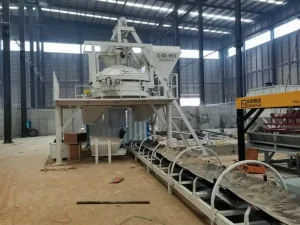
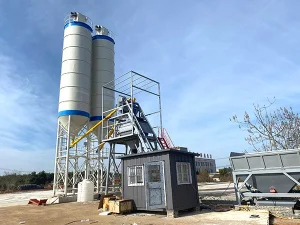
Industrial planetary concrete units, specialized asphalt mixers, advanced pelletizers, and complete batching infrastructures manufactured at our Qingdao works.