CO-NELEMixing & Granulation
Explore our core equipment portfolio engineered for rapid deployment, high mixing homogeneity, and industrial durability across global job sites.
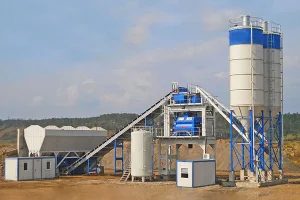
The global construction ecosystem is undergoing a structural transition driven by large-scale linear infrastructure builds, rapid urbanization in emerging economies, and the urgent need to rehabilitate aging transportation corridors in developed markets. Projects such as high-speed rail networks, remote highway expansions, dam construction, and offshore wind farm foundations demand continuous, high-volume, and uncompromisingly precise concrete production. In this environment, the traditional reliance on centralized, permanent ready-mix concrete batching plants presents significant operational vulnerabilities, including prolonged material transit times, risk of premature hydration, increased transit mixer fuel consumption, and heightened logistics costs.
To mitigate these spatial and operational inefficiencies, global engineering procurement, construction (EPC) conglomerates, and specialized concrete producers are increasingly standardizing on high-capacity, mobile concrete batching plants manufactured in China. Modern Chinese mobile concrete batching technology—typified by advanced engineering clusters in Qingdao—has evolved beyond simple portable setups into fully integrated, high-precision industrial mixing powerhouses. Integrating automated dosing, dynamic moisture compensation, dual-shaft compulsory mixing, and modular wheel-mounted chassis, these systems deliver stationary-grade concrete quality with unmatched deployment agility.
Complete mechanical and electrical pre-assembly on a integrated trailing chassis reduces site foundation civil work by up to 85% and enables operational commissioning within 48 to 72 hours of arrival.
Compulsory twin-shaft and planetary vertical-shaft mixer options achieve mixing homogeneity coefficients of variation (CV) < 5%, fulfilling strict nuclear, bridge, and precast standards.
Delivers up to 40% reduction in total capital expenditure compared to European equivalents while significantly cutting fuel burn, haulage logistics, and labor overheads.
Quantifiable operational metrics demonstrated by Chinese mobile batching technology across global civil engineering contracts.
When enterprise procurement directors, chief technical officers, and site logistics managers evaluate a China Mobile Concrete Plant For Sale, their intent extends far beyond acquiring a standalone mechanical unit. They are procuring an end-to-end operational capability designed to resolve complex site constraints. Understanding these multi-layered decision vectors is critical for establishing a resilient equipment fleet.
In linear projects such as highway paving or railway embankment construction, the plant must move frequently along the construction alignment. Procurement teams evaluate the Time-to-Relocate (TTR) index. High-performance mobile plants feature integrated kingpin towing mechanisms, foldable aggregate bin hoppers, and pre-wired plug-and-play electrical harnesses. This eliminates the need for disassembling complex cable trays or executing major structural steel welding on site, transforming a three-week site relocation into a two-day procedure.
Modern infrastructure contracts frequently demand varying concrete mix designs from the same production station. A single project may require mass foundation concrete (large aggregate size), high-strength bridge deck concrete, ultra-high-performance concrete (UHPC) containing dense steel fiber loadings, or low-slump dry-cast concrete for road curbing. Equipment selection hinges on the batch plant’s ability to swap dosing parameters seamlessly via industrial PLC interface and provide dynamic shear adjustments without inducing mechanical resonance in the mixing chassis.
Experienced buyers scrutinize the long-term wear kinetics of mixing paddles, liner plates, and aggregate conveyor belts. Mixers exposed to abrasive aggregates (such as granite or quartz-dense sand) experience rapid degradation if fitted with standard cast iron components. Enterprise procurement standards mandate high-chrome alloy liners (minimum HB600 hardness rating), cobalt-treated wear tips, and standardized bolt-on geometry that guarantees interchangeability across international spare-part depots.
| Evaluation Parameter | Standard Mobile Plant (MBP Series) | High-Precision Precast Mobile Plant | Heavy Infrastructure Twin-Shaft Plant |
|---|---|---|---|
| Target Capacity Range | 25 m³/h – 60 m³/h | 35 m³/h – 90 m³/h | 90 m³/h – 150 m³/h |
| Mixer Kinematics | Planetary / Single Twin-Shaft | Planetary Counter-Current | Compulsory Twin-Shaft (Dual-Drive) |
| Dosing Accuracy (Aggregates) | ± 2.0% Cumulative | ± 1.0% Individual Scale | ± 1.0% Dynamic Belt Scale |
| Foundation Requirement | Zero Concrete (Steel Pad Base) | Minimal Compacted Subgrade | Levelled Concrete Slab Pad |
| Typical Application | Culverts, Roads, Rural Infrastructure | Pavers, Blocks, GFRC, Bridge Beams | Airports, Dams, High-Volume Ready Mix |
| Primary Transport Form Factor | Standard Towable Trailer / Flatbed | Containerized Frame Assemblies | Modular Multi-Trailer Segmented Chassis |
The technical superiority of modern Chinese mobile batching plants rests on three core engineering pillars: structural chassis mobility, compulsory mixing fluid dynamics, and closed-loop electronic batching control. Understanding these technical layers enables site engineers to maximize equipment uptime and output homogeneity.
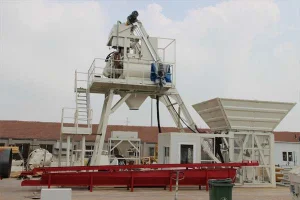
Unlike modular stationary plants that require extensive crane lifts and bolted structural columns, a true mobile plant integrates the aggregate batching bin, weighing conveyor belt, mixing platform, water/admixture scales, and control cabin onto a single heavy-duty structural steel chassis. Equipped with heavy-duty air-suspension axles, dual-line pneumatic braking systems, and standard kingpin hitches, the plant complies with international road transit codes. Upon arrival at the job site, hydraulic outriggers extend to elevate the chassis, establishing a stable, self-supporting foundation without requiring concrete pours.
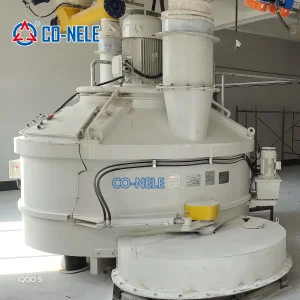
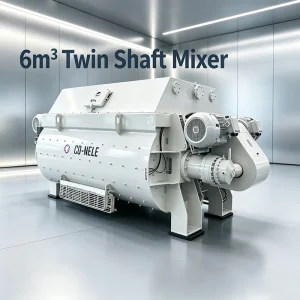
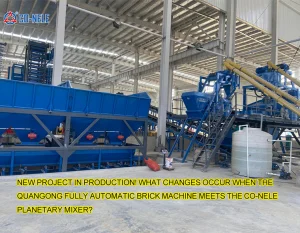
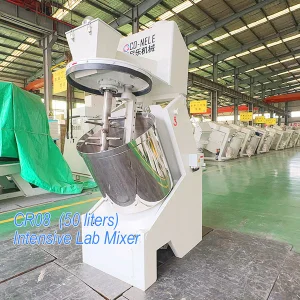
The heart of the plant is the compulsory mixing mechanism. For ready-mix applications, horizontal twin-shaft mixers utilize counter-rotating arms set at a 45-degree helix angle. This creates a intense 3D turbulence zone where aggregate particles, cementitious binders, and water molecules collide under high shear forces, achieving complete cement hydration within 30 to 45 seconds. For specialized applications requiring micro-homogeneity (e.g., UHPC or colored concrete bricks), vertical-shaft planetary mixers are deployed, eliminating dead zones through complex planetary gear trajectories.
Multi-compartment bins feed aggregates via pneumatic gates onto load-cell-suspended weigh belts, performing continuous dynamic measurement.
Screw conveyors transfer cement, fly ash, and silica fume into sealed suspension scales; water and chemical admixtures are metered via high-precision flow sensors.
Materials drop into the compulsory mixer. Moisture microwave sensors detect real-time batch moisture and trigger fine water compensation within milliseconds.
Hydraulically operated rotary discharge doors feed mixed concrete cleanly into transit mixers or concrete pumps without segregation.
Deploying heavy construction machinery across international borders introduces severe regulatory, environmental, and operational risks. Global procurement managers must verify that equipment manufactured in China aligns completely with local statutory mandates and electrical codes.
Global project sites operate under diverse voltage frequencies (380V 50Hz, 440V 60Hz, 220V 60Hz). Leading Chinese plants utilize modular control panels housing Siemens PLC hardware, Schneider electrical switchgear, and ABB variable frequency drives (VFDs) that conform to CE Directive 2006/42/EC and UL/CSA certification requirements. Emergency stop circuits, safety-interlocked maintenance doors, and IP65-rated control enclosures are mandatory baseline features.
Urban and environmentally sensitive project sites enforce tight particulate emissions limits (often < 20 mg/Nm³). Mobile plants incorporate pulse-jet reverse-air dust collectors mounted directly on cement weighing hoppers and silos. Fully enclosed aggregate belts, rubber skirt seals, and noise-dampening mixer housing liners allow operations near populated residential areas without violating regional environmental protection codes.
From the freezing tundra of Northern Europe to the arid desert conditions of the Middle East, mobile plants require regional weatherization packages. Cold-climate variants feature insulated sandwich-panel enclosures, steam-injection piping for aggregate bins, and oil-heater circuits for mixer gearboxes. Hot-climate editions incorporate high-capacity cooling radiators, tropicalized motor insulation, and chilled water integration ports.
The next decade of mobile concrete batching technology will be defined by three convergence trends: AI-driven autonomous process optimization, zero-carbon electric drive architectures, and seamless integration with building information modeling (BIM) networks.
Next-generation batching systems utilize cloud-connected machine learning models to analyze load-cell vibration signatures, motor current draws, and moisture fluctuations. By dynamically adjusting mixing cycle times and additive dosing on a millisecond scale, AI systems guarantee target slump and compressive strength while reducing cement overuse by 3-5% per batch.
As construction sites face strict carbon neutral mandates, battery-electric and hybrid-diesel power modules are replacing legacy diesel generator setups. Integrated solar-harvesting awnings and regenerative braking trailer axles lower field energy consumption, paving the way for zero-carbon site certification.
Real-time IoT telemetry interfaces broadcast batch-by-batch data directly into project BIM dashboards. EPC project managers can trace the exact water-cement ratio, ambient aggregate temperature, and curing trajectory of concrete placed in every structural column, providing immutable digital records for structural audits.
For a standard wheel-mounted mobile batching plant (such as the MBP40 or MBP60 series), setup takes between 48 and 72 hours under normal field conditions. Because the aggregate bins, belt conveyor, weighing systems, and mixer are pre-commissioned and wired onto the main trailing chassis, no heavy concrete foundation slab is needed. The site crew simply compacts the subgrade ground, extends the hydraulic outrigger legs, pins the steel pad foundations into position, unfolds the aggregate bin walls, elevates the control cabin, and connects the quick-connect electrical harnesses to a power source or diesel generator.
Horizontal compulsory twin-shaft mixers utilize two counter-rotating shafts equipped with synchronized mixing paddles. They excel at high-volume output (ready-mix, road bases, civil infrastructure) with fast cycle times (30 to 45 seconds). Vertical planetary mixers feature star-arm agitation systems that rotate around a central axis while spinning on their own axes. This complex planetary trajectory ensures absolute micro-homogeneity with zero dead zones, making planetary mixers the preferred choice for precast elements, dry-cast paving blocks, high-pigment concrete, and ultra-high-performance concrete (UHPC).
Advanced mobile plants integrate high-frequency microwave moisture sensors inside the aggregate batching bin discharge gates and inside the mixing pan itself. The sensors measure the dielectric constant of the aggregates in real time as they drop into the weigh belt. The central Siemens PLC automatically calculates the precise surface water contained within the sand and coarse gravel, subtracts that moisture weight from the target water batch allowance, and adds it to the aggregate batch target. This keeps the effective water-cement ratio perfectly constant regardless of rainfall or atmospheric changes.
To preserve complete site mobility, specialized mobile cement silos (horizontal/bolted or telescopic vertical silos mounted on dedicated trailing chassis) are paired with the batching plant. Horizontal mobile silos require no foundation cranes and use internal arch-breaking aeration pads and heavy-duty screw conveyors to feed cement directly into the plant's weighing hopper. Where high cement storage volume is required (e.g., 100t to 200t), modular bolted vertical silos are transported inside standard 40ft High-Cube shipping containers and erected alongside the plant frame using quick-connect flange pins.
Under standard limestone aggregate mixing conditions, high-chrome cast iron liner plates (HB600+) and mixing blades typically yield between 100,000 to 150,000 batch cycles before requiring replacement. When processing highly abrasive aggregates like quartz sand, river granite, or basalt, wear life typically ranges between 50,000 and 80,000 cycles. All wear components in CO-NELE and top-tier Chinese plants feature modular bolt-on designs, enabling two maintenance technicians to execute a complete liner swap within a single 8-hour shift.
Export machinery ships complete with full international documentation packages. This includes the CE Certificate of Conformity (Machinery Directive 2006/42/EC and Low Voltage Directive 2014/35/EU), ISO 9001 quality management certificates, complete mechanical assembly drawings, electrical single-line schematics in English, Foundation Reaction Force diagrams for civil engineers, comprehensive Operation & Maintenance Manuals, and a recommended 2-year operational spare parts manifest.
Explore our complete range of specialized intensive mixers, foundationless plants, lab-scale R&D granulators, and asphalt mixing equipment.