CO-NELEMixing & Granulation
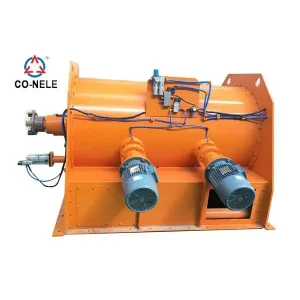
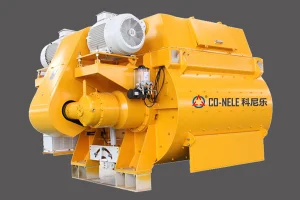
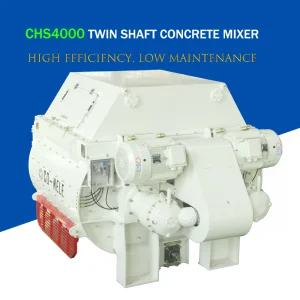
Precision-engineered mixing systems optimized for high binder contents, silica fume dispersion, and heavy steel fiber inclusion in demanding Algerian climatic conditions.
Algeria, as the largest sovereign nation in Africa and a major economic hub of the Mediterranean basin, is undergoing an unprecedented structural transformation. Driven by the national Vision 2030 modernization agenda and extensive public investment programs supervised by the Ministère de l'Équipement et des Infrastructures de Base, the country is executing landmark infrastructure projects. These range from the complex expansion of the Algiers Metro and deep-water port facilities in El Hamdania to the structural retrofitting of major bridges along the East-West Highway (Autoroute Est-Ouest) and massive solar energy substructures in the Sahara Desert (e.g., Hassi R'Mel region).
Traditional structural concrete (C25/30 to C40/50) faces severe long-term degradation in North Africa due to unique environmental stress factors. In coastal zones such as Algiers, Oran, and Bejaia, marine chloride ingress causes rapid rebar corrosion. In the Southern Saharan territories, severe thermal cycling—where ambient temperatures fluctuate by over 35°C within 12 hours—triggers intense thermal cracking and micro-structural spalling. Furthermore, local aggregates in desert regions often carry high concentrations of reactive silica, leading to destructive Alkali-Silica Reactions (ASR).
To meet the stringent requirements of key national projects—such as joint maintenance on the Djamaa el Djazaïr (Great Mosque of Algiers) complex and precast segmental bridges for the Trans-Saharan Highway—Algerian engineering contractors are actively seeking direct partnerships with tier-1 Chinese equipment manufacturers. China’s advanced machinery industry provides the perfect balance of robust mechanical reliability, cutting-edge planetary mixing technology, and unmatched cost-efficiency.
Mixing Ultra-High Performance Concrete is fundamentally different from preparing standard readymix concrete. UHPC formulations involve dense particle packing systems based on modified Apollonian packing models, incorporating ultra-fine silica fume (d50 < 0.5 µm), micro-ground quartz flour, highly active slag, and high concentrations of high-tensile steel fibers (typically 2% to 4% by volume, or 157–314 kg/m³).
Standard twin-shaft mixers suffer from severe dynamic limitations when handling UHPC pastes. Due to the high plastic viscosity and intense yield stress of low-water formulations, twin-shaft paddles create parallel flow channels, leading to dead zones where silica fume agglomerates remain unhydrated. Even worse, high steel fiber volume fractions cause fiber balling (clumping) in horizontal shaft mixers, creating structural weak points inside the cured element.
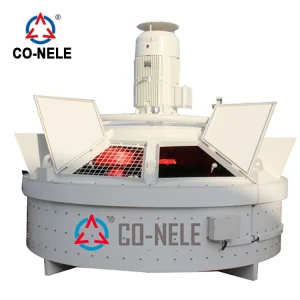
The mixing blades rotate on their own axes while simultaneously revolving around the central pan axis. This complex kinematic trajectory ensures 100% pan coverage within 45 seconds, eliminating all unmixed dead zones.
Custom-designed high-speed rotor blades exert extreme hydraulic shear forces on the binder matrix, rupturing the electrostatic bonds of dry silica fume clusters and instantly coating every aggregate grain.
The specialized vertical clearance and angled blade surface prevent steel fiber crushing or deformation. Steel fibers are evenly distributed in three dimensions without balling or segregation.
Our planetary UHPC mixers, specifically customized for Algerian manufacturing facilities, utilize an integrated heavy-duty planetary reducer designed to withstand torque spikes exceeding 45,000 Nm. The dynamic relationship between shear rate, energy input, and paste temperature rise is managed via smart PLC algorithms, guaranteeing consistent micro-homogeneity with a coefficient of variation (CV) of less than 2.5% per batch.
| Mixing Parameter / Metric | Standard Twin-Shaft Mixer | Traditional Gravity Pan Mixer | China Counter-Current Planetary UHPC Mixer |
|---|---|---|---|
| Silica Fume Dispersion Efficiency | Moderate (Cluster residual > 8%) | Poor (Cluster residual > 15%) | Exceptional (< 0.5% cluster residual) |
| Steel Fiber Homogeneity (3% Vol) | High risk of fiber balling | Severe segregation & settling | Uniform 3D structural alignment |
| Batch Cycle Time (UHPC Recipe) | 6 to 9 minutes | 8 to 12 minutes | 2.5 to 4 minutes |
| Liner & Blade Wear Life (Abrasive Quartz) | ~15,000 batches | ~8,000 batches | 45,000 - 65,000 batches (Cr26 Alloy) |
| Coefficient of Variation (CV) | > 6.5% | > 9.0% | < 2.5% (Micro-homogeneous) |
Choosing a reliable equipment manufacturer is as important as selecting the right mixing technology. As a premier Chinese manufacturer of industrial concrete mixing systems, our manufacturing bases in Qingdao integrate Industry 4.0 smart plant standards. Every stage—from raw steel plate laser cutting and robotic welding to five-axis CNC machining of planetary gearbox housings—is controlled under ISO 9001 and CE quality frameworks.
Our strategic manufacturing capabilities provide concrete producers and contractors in Algeria with major operational advantages:
Contact our senior process engineers today to receive a complete UHPC mixing plant engineering proposal, foundation drawings, and delivered pricing tailored to your jobsite in Algeria.
Send Inquiry NowOur UHPC mixers and batching plants are engineered to solve specific engineering challenges across various industrial sectors in Algeria:
Demanding ultra-high strength joint grouting and segmental tower casting for renewable energy installations in southern provinces such as Adrar and Tamanghasset.
Providing rapid-setting, zero-shrinkage UHPC overlay mixes for the rehabilitation of aged bridge decks along the Chiffa gorge and the East-West Highway network.
Enabling custom color pigments and micro-fine detail replication for architectural cladding panels used in government complexes, airports, and luxury high-rises in Oran and Algiers.
Formulating ultra-dense, impermeable UHPC concrete blocks and grouts resistant to seawater sulfate attack and high-impact wave erosion in Mediterranean ports.
Operating industrial machinery in North Africa requires complete alignment with local electrical standards, regulatory compliance, and operational languages. We provide a fully localized support ecosystem for every machine delivered to Algeria:
Our batching and weighing control systems strictly comply with Algerian NA standards, EN 206-1, and NF P 18-451 (French UHPC standards), ensuring seamless acceptance by national inspection authorities like CNERIB and CTC.
The Siemens PLC touchscreen interface is programmed in French, Arabic, and English. Operational staff in Algiers or Constantine can easily manage batch recipes, adjust moisture sensors, and monitor diagnostic alarms.
For operations in hot desert climates, we equip our mixers with double-jacketed temperature regulation channels, chilled water injection ports, and high-temp electrical wiring rated for ambient temperatures up to +55°C.
We deploy senior field service engineers directly to your site in Algeria for foundation verification, mechanical installation, electrical commissioning, and local operator training. Consumable wear parts are stocked locally for fast delivery.
Explore our complete machinery line—from laboratory R&D mixers to high-throughput commercial batching plants installed across North Africa.
For international procurement directors, project managers, and plant owners evaluating concrete mixing plant investments for Algerian contracts, capital expenditure (CAPEX) is only part of the equation. Operating expenditure (OPEX), energy consumption per cubic meter mixed, wear-part replacement frequency, and equipment resale value define true Return on Investment (ROI).
Our planetary UHPC mixing systems provide a compelling financial ROI profile compared to traditional European alternatives:
Direct factory procurement from our Qingdao manufacturing hub eliminates middleman markups, delivering European-grade planetary mixing performance at roughly 60% of the CAPEX of German or Italian alternatives.
Optimized hydrodynamic blade geometry and direct-coupled planetary gearboxes minimize mechanical friction losses. Energy consumption per batch is reduced by up to 25% compared to belt-driven pan mixers.
High-chromium cast iron (Cr26) liners and tungsten carbide blade facings extend service life up to 60,000+ batches even when mixing highly abrasive quartz aggregates, dramatically lowering per-cubic-meter wear costs.
Pre-wired modular sub-assemblies reduce on-site civil installation time in Algeria by up to 50%, enabling contractors to begin commercial UHPC production weeks ahead of schedule.
Detailed technical responses to common questions raised by engineering consultants, lab directors, and contractors operating in North Africa.
UHPC recipes feature extremely low water-binder ratios (<0.18) and dense mineral powder matrices (silica fume, quartz flour). Twin-shaft mixers tend to create high-viscosity parallel flow zones where unhydrated silica fume agglomerates remain intact. Furthermore, high steel fiber volume fractions (2-4%) cause severe fiber balling between horizontal shafts. Counter-current planetary mixers rotate blades on dual axes, creating intense vertical and radial shear forces that completely break down powder agglomerates and evenly disperse steel fibers in 3D without balling.
High ambient temperatures in regions like Hassi Messaoud or Biskra accelerate early hydration, leading to rapid loss of workability in UHPC. Our mixers engineered for North Africa can be outfitted with double-jacketed pan walls for chilled water circulation, automated ice-flake batch dosing ports, and temperature sensors integrated directly into the mixing pan floor. The Siemens PLC continuously monitors paste thermal curves during the mixing cycle.
When processing abrasive quartz-rich aggregates, standard St37 or Hardox 400 steel liners wear out within 10,000 to 15,000 batches. Our UHPC mixers utilize high-chrome alloy liners (Cr26) with a hardness rating of ≥62 HRC, combined with tungsten carbide tungsten-coated mixing arms. Under standard operating conditions in Algerian precast facilities, wear life regularly exceeds 45,000 to 65,000 batches. All liners are segmented and bolt-assembled for quick field replacement.
Equipment supplied to Algeria is configured to the local industrial power grid standard: 380V/415V, 50Hz, 3-Phase. All electrical switchgear incorporates Schneider and Siemens components with CE marking and ISO certification. Documentation includes complete foundation CAD drawings, electrical schematics, operating manuals in French and English, and certificate of origin documentation required by Algerian customs authorities.
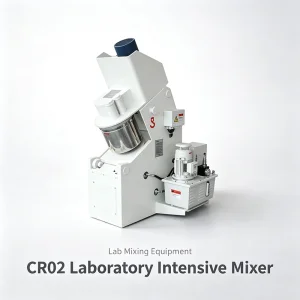
Yes. We encourage Algerian clients to ship sample quantities (20–50 kg) of their target local sand, cement, silica fume, and superplasticizer to our central R&D laboratory in Qingdao. Our process engineers will run mixing rheology trials on our CR-series lab mixers, optimize the mixing time curve, test compressive strength development, and provide a full lab report alongside guaranteed scale-up metrics for your production line.
Partner with China’s leading high-shear UHPC mixer manufacturer. Request technical catalogs, layout blueprints, and competitive FOB/CIF delivered pricing today.
Send Inquiry Now