CO-NELEMixing & Granulation
Heavy-duty planetary mixing technology optimized for high-viscosity mixes, silica fume reaction, and cold-weather concrete durability across Ontario.
The Greater Toronto Area (GTA) is undergoing the largest civil infrastructure expansion in its modern history. Major multi-billion-dollar initiatives—such as the Metrolinx Ontario Line, the Gardiner Expressway Strategic Rehabilitation Plan, Waterfront Toronto’s Flood Protection infrastructure, and massive bridge rehabilitations along Highways 401, 400, and 427—demand unprecedented structural resilience.
Traditional concrete recipes often fall short when subjected to Ontario’s harsh freeze-thaw cycles, aggressive deicing salts (sodium chloride and calcium chloride), and heavy transportation loads. Consequently, the Ministry of Transportation Ontario (MTO) and the City of Toronto have increasingly specified Ultra-High-Performance Concrete (UHPC). Exhibiting compressive strengths exceeding 150 MPa (21,700 psi), exceptional flexural ductility, and near-zero water permeability, UHPC has transitioned from a specialty laboratory mix to a core industrial requirement.
Key Engineering Challenge in Toronto: Standard twin-shaft concrete mixers cannot generate the intensive mechanical shear needed to break down silica fume agglomerates or uniformly disperse steel micro-fibers (13-20mm length, 0.2mm diameter) without creating destructive "fiber balls." This leads to catastrophic material failure under CSA A23.1/A23.2 testing protocol.
Procuring UHPC mixing plants from European manufacturers often involves exorbitant lead times (8–12 months) and premium capital expenditure. As a top-tier Chinese equipment manufacturer, CO-NELE delivers industrial planetary mixers and batching systems designed for North American power standards (575V 60Hz for Ontario) at a 35–50% cost advantage, without sacrificing engineering precision.
UHPC formulation requires mixing extremely dense dry powders (cement, silica fume, quartz flour, fine aggregates) with minimal water and high dosages of polycarboxylate ether (PCE) superplasticizers. Below is an engineering comparison of mixing regimes.
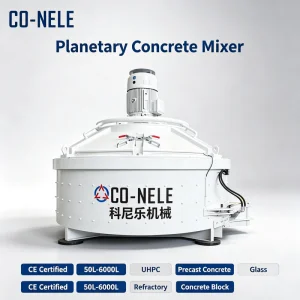
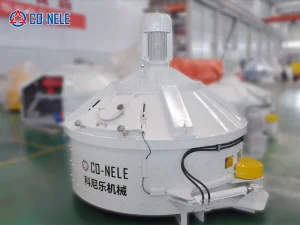
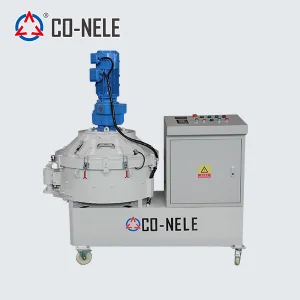
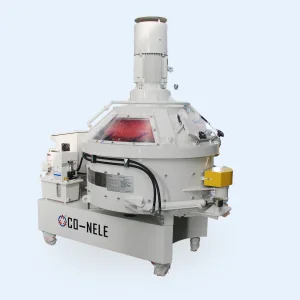
CO-NELE vertical-shaft planetary mixers utilize a dual-star rotating arm configuration. As the mixing stars rotate on their own axes while revolving around the central pan, they generate high-velocity cross-current velocity gradients that shred agglomerates in under 90 seconds.
Dispersing straight steel micro-fibers (up to 3.5% by volume) demands zero dead zones. Our counter-current planetary trajectory forces fibers through continuous high-shear zones, ensuring absolute 3D isotropic orientation without fiber clustering.
Intensive mixing generates friction heat, which can prematurely trigger PCE plasticizer reaction. CO-NELE mixing pans feature optional chilled-water jackets and temperature sensor probes embedded directly into the wear plate floor for real-time monitoring.
| Performance Parameter | Standard Twin-Shaft Mixer | Ribbon Batch Mixer | CO-NELE Planetary UHPC Mixer (CMP Series) |
|---|---|---|---|
| Micro-Homogeneity (CV) | 8% - 14% (Poor for UHPC) | > 15% (Unusable) | < 3% - 5% (Superior Precision) |
| Steel Fiber Balling Risk | High (Dead zone accumulation) | Extreme | Zero (High shear star-arm path) |
| Mixing Cycle Time (UHPC) | 6 - 10 Minutes | 12+ Minutes | 2.5 - 4.0 Minutes |
| Wear Liner Material | Standard Hardox 400 | Cast Iron | High-Chrome Alloy (>60 HRC) / Ceramic Tiles |
| Energy Per Tonne (kWh/m³) | High (Frictional drag) | Moderate | Optimized (30% energy reduction via planetary gearing) |
As a national high-tech enterprise headquartered in Qingdao, China, CO-NELE operates three specialized manufacturing bases spanning over 30,000 square meters. We do not simply assemble off-the-shelf components; we engineer the entire mechanical drivetrain in-house.
The heart of any UHPC mixer is its gearbox. Standard gear reducers collapse under the high torque required during the stiff, viscous phase of UHPC mixing. CO-NELE designs and machines its own patented planetary gearboxes. Built with case-hardened alloy steels and precision-ground gears, our reducers withstand high torsional shock loads and deliver uninterrupted torque transfer.
UHPC ingredients—especially quartz powder and steel fibers—are severely abrasive. CO-NELE mixers are equipped with replaceable bolt-on floor and wall liners crafted from high-chromium cast alloy (hardness > 65 HRC) or optional sintered alumina ceramic linings, extending operational lifespan up to 150,000 batches before maintenance.
From heavy civil engineering to architectural precast, CO-NELE mixers are tailored for diverse high-demand production scenarios.
Extending the service life of Toronto’s aging elevated bridges (e.g., Gardiner Expressway). Thin-bonded UHPC overlays created in CO-NELE mobile mixing stations provide impermeable barriers against chloride penetration and heavy traffic loading.
Toronto high-rise developments demand lightweight, exceptionally strong exterior cladding. CO-NELE CMP mixers allow precast yards to produce self-consolidating architectural UHPC panels down to 15mm thickness without rebar reinforcement.
Heavy transit projects like the Scarborough Subway Extension require dense, high-durability precast segment lining blocks. Our planetary mixers ensure batch-to-batch repeatability and zero air-void entrapment.
Ontario wind farm developments require high-fatigue precast tower elements. CO-NELE high-capacity UHPC plants yield 120+ MPa mixes with high elastic modulus capable of enduring dynamic structural oscillations.
Structural strengthening of columns, marine piers in Lake Ontario, and industrial floors. Mixers deliver highly thixotropic, non-shrink grouts engineered for high bond strength with existing substrate.
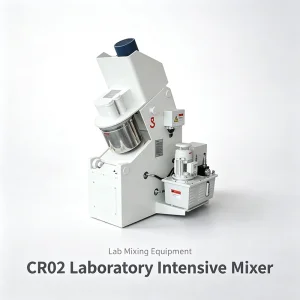
Compact lab-scale CMP50 models enable materials researchers at institutions across Ontario to develop custom mix designs with local aggregates before scaling up to industrial plants.
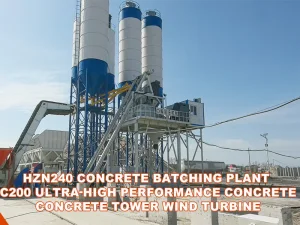
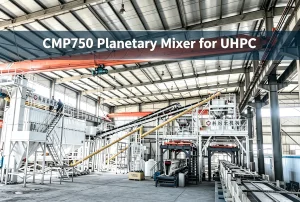
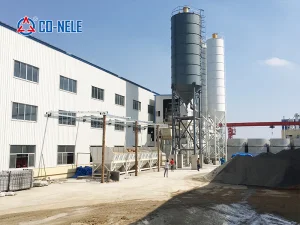
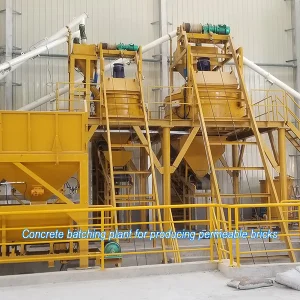
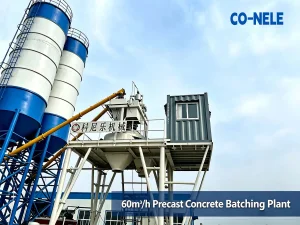
A standalone mixer requires a synchronized dosing, weighing, and control environment to produce consistent UHPC batches. CO-NELE manufactures fully integrated modular batching plants.
Micro-silica and quartz flour tend to bridge and clump in standard hoppers. Our turnkey plants feature fluidizing aeration pads, loss-in-weight screw feeders, and high-accuracy load cells (accuracy ±0.5%) to ensure exact stoichiometric binder ratios.
Fibers are fed into the mixer via magnetic bulk elevators and vibrating comb disentanglers. This guarantees that fibers drop into the pan as individual strands rather than tightly packed bundles.
Aggregate moisture variations ruin UHPC water-binder precision. High-frequency microwave probes installed in aggregate bins and mixer floors continuously adjust batching water in real time.
The entire mixing sequence—dry loading, high-shear plasticizing, fiber addition, and hydraulic gate discharge—is managed through an intuitive multi-language touchscreen SCADA interface.
Explore our expanded series of planetary mixers, granulators, dry mortar systems, and precast batching plants configured for North American and global operations.
Critical technical insights for Canadian concrete producers, bridge contractors, and engineering consultants evaluating Chinese UHPC mixing machinery.
UHPC has an extremely low water-to-binder ratio (typically 0.14 to 0.18) and high silica fume concentration. Twin-shaft mixers rely primarily on gravity and linear parallel motion, which fails to generate sufficient localized shear to break micro-silica agglomerates. This results in unhydrated powder pockets and non-uniform steel fiber dispersion. CO-NELE counter-current planetary mixers feature mixing arms that move in opposing complex geometrical paths, generating high energy shear force that achieves micro-homogeneity with a coefficient of variation (CV) under 3–5% within 3 minutes.
Ontario electrical codes require equipment to comply with CSA C22.1 standards. We supply custom electrical control panels equipped with 575V / 3-Phase / 60Hz industrial motors, Siemens or Allen-Bradley PLCs, and Schneider electrical components. Panels can be pre-certified or built to SPE-1000 field evaluation requirements prior to shipment, ensuring fast inspection and approval by ESA (Electrical Safety Authority) upon arrival in Toronto.
Steel micro-fibers act as an abrasive medium against the mixer floor and blades. Standard cast iron or mild steel wears out rapidly. CO-NELE installs high-chromium alloy liner plates with a Rockwell hardness exceeding 60–65 HRC. Under continuous UHPC production (containing up to 3% steel fibers), our liner plates routinely exceed 40,000 to 60,000 batches, while standard precast concrete production reaches 120,000+ batches before requiring bolt-on replacement.
Standard machine fabrication takes 30 to 45 calendar days. Ocean freight from Qingdao Port to the Port of Montreal or Halifax, followed by rail transport to Toronto CP/CN intermodal terminals, typically takes 28 to 35 days. The entire procurement timeline from contract signing to job-site delivery in the Greater Toronto Area averages 65 to 80 days.
Yes. We operate an advanced industrial material testing lab in Qingdao. Toronto clients can ship a 20kg sample of their local raw aggregates, cementitious powders, and targeted fibers. Our process engineers will conduct trial mixes in our CMP laboratory units, generate slump flow, rheology, and fiber dispersion curve reports, and provide a video audit showing exact mixing dynamics before equipment commitment.
Get in touch with our engineering team today for technical consultations, customized plant CAD drawings, and direct factory quotation pricing for Toronto & Ontario projects.