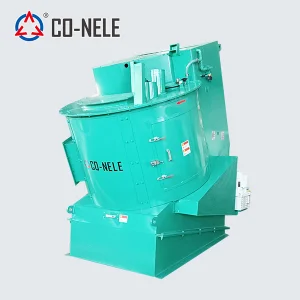
CO-NELEMixing & Granulation
Engineered for high homogeneity, reduced binder consumption, and maximum operational uptime across global concrete production plants.
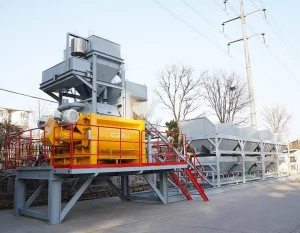
Analyzing procurement requirements, total cost of ownership (TCO), and technical specifications for industrial block manufacturing plants worldwide.
The global concrete block and paving industry is undergoing a structural transition. Accelerated urbanization, expanding infrastructure projects across developing markets, and stringent carbon-footprint regulations in developed economies have fundamentally shifted how engineering procurement managers evaluate mixing technology. Modern concrete block manufacturing is no longer merely a high-volume aggregate consolidation process; it is a high-precision chemical and physical engineering operation that demands absolute batch repeatability, minimal water-cement ratios ($w/c$), and optimal binder activation.
Leading international buyers—ranging from multi-national construction material conglomerates to specialized precast block producers—increasingly prioritize equipment suppliers capable of delivering verifiable Information Gain and operational efficiencies. In dry-cast concrete applications (such as architectural block, interlocking pavers, retaining walls, and hollow blocks), the quality of the mixing process directly dictates the compressive strength ($f'c$), water absorption rate, density variation, and visual surface finish of the finalized block.
Traditional horizontal twin-shaft or ribbon mixers often yield a Coefficient of Variation ($CV$) between 8% and 12% in low-slump or semi-dry concrete recipes. Advanced Chinese counter-current planetary concrete mixers consistently achieve a $CV < 3\%$, reducing cement consumption by 5% to 8% while maintaining identical structural load-bearing ratings.
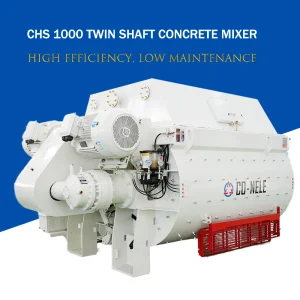
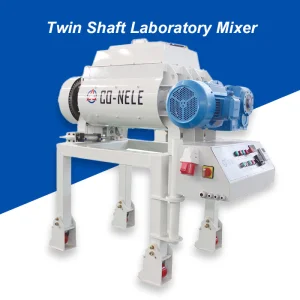
A rigorous comparative analysis of planetary counter-current mixing versus twin-shaft and horizontal pan mixing kinematics.
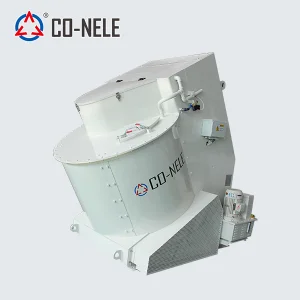
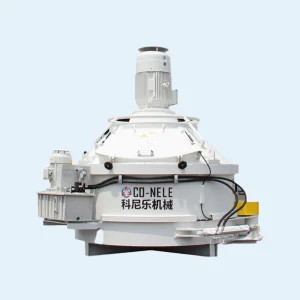
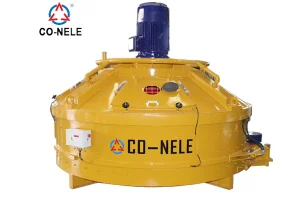
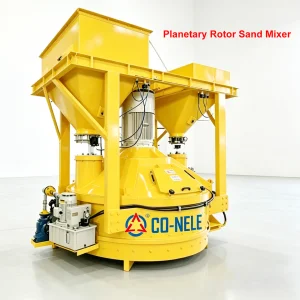
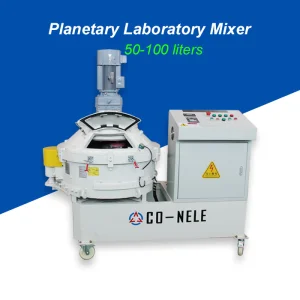
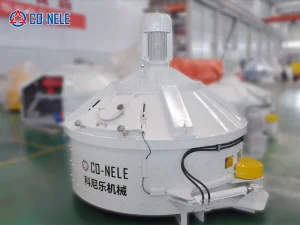
The mixing blades rotate on a central vertical axis while simultaneously revolving around the pan at calculated planetary ratios. This complex trajectory eliminates shadow zones, ensuring 100% material displacement per full revolution cycle.
Specifically tuned for zero-slump and dry-cast block formulations. The counter-current shearing forces tear apart cement particle clusters and evenly coat fine and coarse aggregate matrices without breaking lightweight aggregate structures.
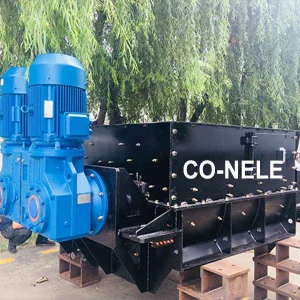
Equipped with customized, heavy-duty planetary gearboxes designed specifically for high-torque start-ups under full batch capacity. Power transmission efficiency exceeds 94% with low thermal dissipation and minimal maintenance.
Selecting the optimal mixing engine for a concrete block production line requires comparing mechanical dynamics, wear mechanics, and power draw across primary machine categories:
| Performance Parameter | Planetary Counter-Current Mixer | Twin-Shaft Compulsory Mixer | Conventional Pan Mixer |
|---|---|---|---|
| Primary Target Application | Dry-cast blocks, pavers, UHPC, precast | Ready-mix wet concrete, mass pouring | Basic masonry blocks, non-structural precast |
| Mixing Homogeneity ($CV$) | < 3.0% (Micro-level distribution) | 4.5% – 7.0% (Macro-level distribution) | 8.0% – 12.0% (Variable density zones) |
| Dry Mix Batch Time | 45 – 75 Seconds | 60 – 90 Seconds | 90 – 140 Seconds |
| Cement Utilization Efficiency | Highest (+5% to +8% strength yield) | Moderate | Baseline |
| Wear Part Material Class | Ni-Hard / High-Chrome (Cr26) / Carbide | High-Chrome Cast Iron (Cr15/Cr20) | Standard Manganese Steel |
| Discharge Gate Mechanics | Hydraulic / Pneumatic Circular Arc Gate | Hydraulic Full-Length Rotary Gate | Manual / Pneumatic Trapdoor |
| Color Pigment Dispersion | Instantaneous streak-free blending | Moderate (Prone to pigment streaking) | Poor (Requires extra mixing time) |
Strategic integration of smart automation, low-carbon formulations, and modular plant architecture for sustainable block manufacturing.
Seamless mechanical and electrical interfacing with high-speed automated block machines. Features synchronized skip-hoist feed mechanisms, aggregate moisture auto-compensation, and dual-face mix batching lines for layered paver production.
Specifically engineered blade geometries capable of thoroughly homogenizing high-volume supplementary cementitious materials (SCMs), construction demolition waste (CDW) aggregates, crushed slag, and alkali-activated geopolymers.
Integration of real-time motor torque curve telemetry, predictive vibration analysis on gearboxes, automatic moisture adjustment via high-frequency microwave probes, and cloud-based batch tracing systems.
The concrete block manufacturing industry is evolving rapidly toward complete zero-carbon production and autonomous factory operations. Future technical roadmaps focus on three critical innovation axes:
Ensuring full compliance with international safety directives, electrical standards, and structural build specifications.
Full compliance with European CE Directives (2006/42/EC Machinery Directive, 2014/35/EU Low Voltage Directive), ISO 9001 quality certification, and North American UL/CSA electrical cabinet wiring options.
Custom motor power configurations supporting 220V, 380V, 415V, 440V, 480V, and 600V at 50Hz or 60Hz. Integrated dual-frequency VFD systems allow seamless operation in any global power grid environment.
Standardized, off-the-shelf wear components, emergency spare part kits shipped via air express, remote telemetry diagnostics, and resident engineer commissioning options across over 80 export countries.
Explore our complete industrial series designed for technical concrete, refractories, powder metallurgy, ceramics, and R&D testing.
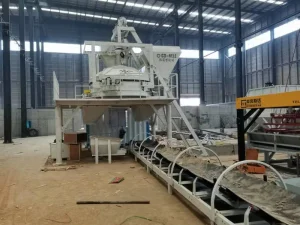
Comprehensive technical guidance formulated by industrial mixing engineers for factory directors, procurement managers, and plant designers.