
CO-NELEMixing & Granulation
Engineered for maximum homogeinity, rapid discharge cycle times, and strict compliance with European precast standards.
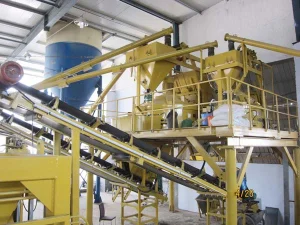
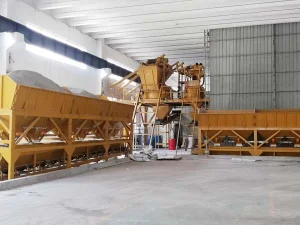
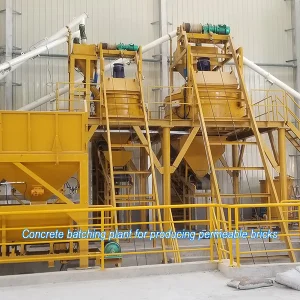
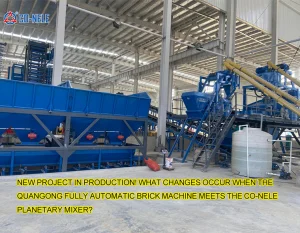
Analyzing the macro-economic shifts, structural demands, and strict quality criteria governing the Metropolitan Region of Hamburg.
The Free and Hanseatic City of Hamburg represents one of Europe's most rigorous and technologically demanding markets for concrete block production and building material manufacturing. Driven by massive urban regeneration frameworks such as the expanding HafenCity project, extensive climate adaptation initiatives along the Elbe River, and continuous port infrastructure modernization by the Hamburg Port Authority (HPA), the demand for high-strength, frost-resistant, and low-carbon concrete blocks has reached an unprecedented peak.
For Chinese mixing technology manufacturers exporting to Northern Germany, competing purely on price is no longer a viable strategy. German civil engineers and concrete plant operators demand absolute compliance with DIN EN 206-1 (Concrete Performance, Production and Conformity), DIN 18500 (Concrete Building Blocks and Pavers), and stringent EU CE Mark specifications. The local climate—characterized by high humidity, coastal saline moisture, and freeze-thaw cycles (Exposure Class XF4 & XS3)—requires precast blocks with zero internal voids, ultra-precise pigment dispersion, and precise water-cement ratio ($w/c$) control.
Information Gain Key Insight: Traditional twin-shaft mixers often struggle with semi-dry (earth-moist) concrete mixes required for block machines, leaving aggregate shadow zones and unmixed cement nodules. China's top-tier planetary batching technology solves this by employing counter-current vertical shaft kinematics, securing a Coefficient of Variation ($CV < 3\%$) across all color pigments, silica fume additives, and coarse aggregates.
Why vertical-shaft planetary mixers are essential for zero-slump dry-cast block manufacturing.
In high-volume ready-mix applications, twin-shaft mixers excel due to their rapid discharge speed for wet concrete ($slump > 100 \text{ mm}$). However, concrete block manufacturing—especially for paving stones, hollow building blocks, curb stones, and retaining wall units—utilizes zero-slump or earth-moist mixtures ($w/c \text{ ratio between } 0.28 \text{ and } 0.36$). Under these rheological conditions, twin-shaft blades cut through material without generating sufficient cross-directional shearing action, leading to localized agglomeration.
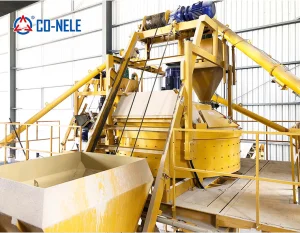
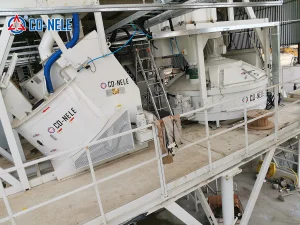
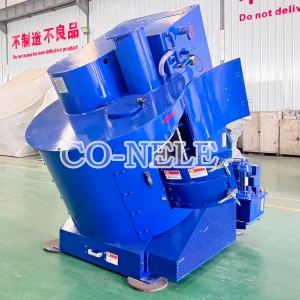
China's advanced CMP Series Planetary Concrete Mixers utilize a specialized counter-current mixing system. The mixing star arms rotate on a central vertical axis while simultaneously orbiting around the pan floor in the opposite direction. This complex geometric movement ensures that every square millimeter of the mixing pan is swept every 4 rotations, leaving zero dead zones.
| Engineering Metric | Planetary Counter-Current Mixer (CMP) | Standard Twin-Shaft Mixer (CHS) | Impact on Hamburg Block Quality |
|---|---|---|---|
| Target Material State | Zero-Slump / Earth-Moist / UHPC / Dry-Cast | Plastic / High-Slump Wet Ready-Mix | Essential for high-density paving blocks & tiles |
| Mixing Uniformity (CV) | < 3.0% (Micro-homogeneous) | 5.0% – 8.0% | Prevents color streaking in architectural pavers |
| Pigment & Additive Dispersion | Instantaneous shear breakdown of oxides | Risk of pigment clustering / streaks | Guarantees exact color matching across batches |
| Power Consumption ($kWh/m^3$) | 12% Lower energy overhead per cycle | Baseline Standard | Directly reduces $CO_2$ footprint per block unit |
| Wear Parts Lifespan | 120,000+ Batches (Ni-Hard / High Chrome) | 70,000 – 90,000 Batches | Dramatically reduces maintenance downtime |
Multi-stage hydraulic door system allows controlled proportional dumping directly into block machine hoppers, preventing material segregation during transfer.
Integrated high-frequency microwave moisture sensors continuously monitor sand moisture at 100 Hz sampling rates, dynamically adjusting water batching in real time.
Equipped with replaceable Rhombus-type wear tiles ($HB \ge 600$) and high-chrome mixing blades ($Brinell \ge 650$), designed for abrasive granite and quartzite aggregates.
Aligning Chinese manufacturing precision with the European Green Deal and German circular economy targets.
The European building sector is undergoing a monumental shift towards decarbonization. Under the EU's Fit for 55 framework and Germany's national Gebäudeenergiegesetz (GEG), concrete block producers in Hamburg are mandated to lower embodied carbon dioxide ($CO_2$) emissions by replacing traditional Portland Cement (CEM I) with supplementary cementitious materials (SCMs) like Blast Furnace Slag (CEM III), Fly Ash, and Calcined Clays (LC3).
Mixing SCM-heavy formulations presents major engineering challenges: these powders feature finer particle sizes and higher water absorption demands. CO-NELE’s industrial planetary batching plants incorporate high-shear fluidization regimes, allowing complete activation of pozzolanic reactions without increasing total water demand. This enables Hamburg precast manufacturers to reduce cement usage by up to 25% while exceeding standard 28-day compressive strength requirements ($C40/50$ to $C60/75$).
Specially designed batching scales and moisture compensation algorithms process recycled crushed concrete demolition waste (DIN EN 12620), supporting Hamburg’s circular construction targets.
Siemens S7-1500 PLC architecture integrated with cloud telemetry gives plant directors real-time tracking of energy per batch, cement consumption tolerances, and predictive wear alert monitoring.
Closed-loop automatic high-pressure washing systems clean the pan interior in under 4 minutes, routing slurry water directly into recycling filter presses for 100% water recovery.
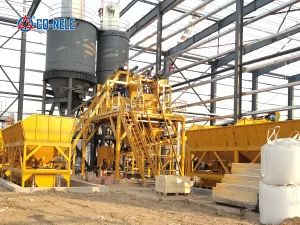
Proven technical configurations tailored for real-world municipal and industrial projects across Northern Germany.
Location Focus: Altenwerder & Waltershof Container Terminals, Port of Hamburg.
Requirement: Interlocking paving blocks capable of sustaining wheel loads from reach stackers ($> 50 \text{ tonnes}$) without surface spalling.
Batching Solution: CBP Series Plant with dual-face mixing system. Planetary batcher delivers dense aggregate base mix plus fine silica face mix for maximum abrasion resistance.
Location Focus: HafenCity Quarter & Hamburg-Mitte Urban Redevelopment.
Requirement: Architectural precast blocks imitating traditional red-brick clinker aesthetics while meeting structural load ratings.
Batching Solution: CMP Planetary Mixer with multi-pigment automatic liquid color dosing. Guarantees absolute batch-to-batch color repeatability across thousands of production cycles.
Location Focus: Lower Elbe River Dykes & Cuxhaven Estuary Protection.
Requirement: Massive interlocking heavy concrete blocks resistant to salt water penetration (XS3) and severe tidal scouring.
Batching Solution: Heavy-duty batching plants equipped with micro-silica dosing and fiber-reinforcement dispension arms for high-durability hydraulic engineering concrete.
Complete peace of mind for German engineering directors through rigorous global certification and rapid local service response.
All structural steelwork, pressure vessels, and control cabinets are certified to European safety norms. Electric switchgear uses premium Siemens, Schneider, and ABB components for easy local sourcing.
Engineered with double-key interlock safety switches on access hatches, automatic emergency stop networks, and heavy dust containment seals meeting strict German emission control laws (TA Luft).
Backed by dedicated technical teams, standardized interchangeable wear parts, and remote VPN diagnostic bridges that allow factory engineers to assist your plant operators instantly in Hamburg.
In-depth answers to common questions asked by plant managers, structural engineers, and procurement directors in Germany.
Earth-moist (zero-slump) concrete requires intense mechanical energy input to distribute low moisture contents uniformly over high surface area fine aggregates and pigments. A twin-shaft mixer relies on fluid movement, which does not happen in dry concrete. Planetary counter-current mixing uses complex star kinematics that force mechanically driven shearing throughout the entire batch volume, avoiding clumps and guaranteeing a homogeneous density prior to block machine compaction.
Our plants feature multi-point suspension load cells manufactured by HBM or Toledo, integrated with high-speed 24-bit digital signal processors. Aggregate batching accuracy is maintained within $\pm 2\%$, while cement, water, and chemical admixtures are controlled to $\pm 1\%$ (exceeding DIN EN 206-1 requirements). Automatic inflight compensation algorithms continuously update feed gate closure points based on real-time material flow dynamics.
When utilizing hard aggregates like crushed granite or quartz sand typical of Northern Germany, standard high-chrome alloy liners ($HB600$) achieve between 100,000 to 150,000 batch cycles. For extreme duty, optional sintered ceramic liner plates ($Al_2O_3$) are available, offering up to 300,000 batches. All wear elements are modular, bolt-on, and easily swappable within 4 hours during scheduled maintenance shifts.
Yes. Our Siemens S7 PLC controls use standardized industrial communication protocols (Profinet, Modbus TCP, Ethernet/IP) to interface with leading European block molding machines. The batching plant signals material readiness to the block machine hopper, controlling intermediate holding hoppers, traveling buckets (flying buckets), and belt conveyors without requiring manual operator intervention.
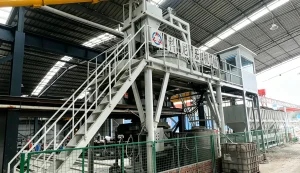
Explore our full lineup of stationary, compact, and high-performance precast batching solutions.
Consult with our senior mixing engineers today to receive tailored plant drawings, mixing trial reports, and detailed ROI calculations for your next project.
Send Inquiry Now