CO-NELEMixing & Granulation
Specially customized for Swedish precast yards, offshore wind turbine foundation projects, and harsh climate civil engineering works.
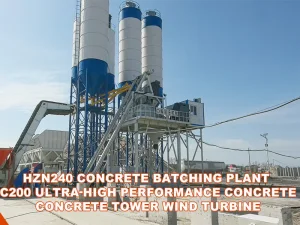
Sweden stands at the absolute global forefront of the green industrial transition. With national targets aiming for net-zero greenhouse gas emissions by 2045 (Fossilfritt Sverige) and the Swedish Transport Administration (Trafikverket) imposing rigorous climate declaration mandates on infrastructure procurement, the Nordic construction sector is undergoing a structural transformation. Conventional C30/37 and C45/55 structural concretes no longer meet the dual challenge of extreme freeze-thaw durability and reduced embodied carbon footprints.
As a result, Ultra-High-Performance Concrete (UHPC)—characterized by compressive strengths exceeding 150 MPa, tensile ductility via micro-steel fiber reinforcement, and exceptionally dense matrix microstructures—has transitioned from a niche laboratory material to a core structural pillar across Scandinavia.
Swedish coastal and northern regions present severe exposure conditions (SS-EN 206 exposure classes XF4 and XS3). High capillary porosity leads to rapid scaling under deicing salts. UHPC’s zero-capillary matrix eliminates water ingress, offering a service life exceeding 100+ years without structural degradation.
UHPC allows Swedish precast concrete manufacturers to reduce element thickness by up to 60–70% compared to standard concrete elements. Less mass means substantially reduced transport emissions across Swedish logistics corridors (e.g., E4/E6 highways) and significantly lower raw material consumption.
With massive offshore wind farms expanding across the Baltic Sea and Bothnian Bay, high-fatigue UHPC grouting compounds are indispensable for anchoring heavy turbine towers to gravity base foundations and jacket structures subjected to extreme dynamic marine wave loads.
Information Gain Insight: Mixing UHPC is not simply an extension of standard concrete mixing—it is an advanced chemical-physical dispersion process. Traditional twin-shaft or gravity tilters fail to break micro-silica agglomerates and frequently suffer from "fiber balling" when steel fibers (13-25mm, high tensile) are introduced into ultra-low water-to-binder (w/b < 0.18) formulations. Specialized high-shear counter-current planetary mixers are an absolute technical prerequisite for achieving SS-EN compliance.
The manufacturing of Ultra-High-Performance Concrete involves extremely low water-binder ratios, micro-silica fume powders (particle size 0.1–0.2 µm), quartz flour, polycarboxylate ether (PCE) superplasticizers, and high volume fractions of steel micro-fibers (typically 1.5% to 3.5% by volume). Under these conditions, the rheology of the mix shifts from Newtonian fluid behavior to high-yield-stress non-Newtonian thixotropic behavior.
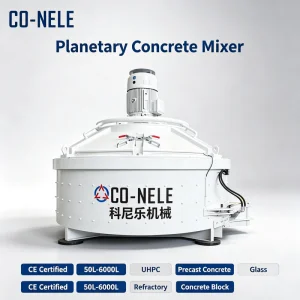
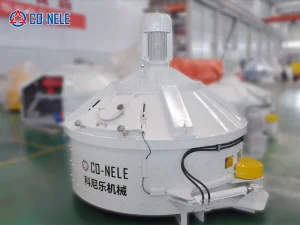
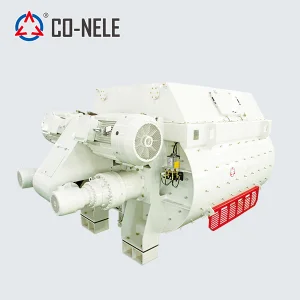
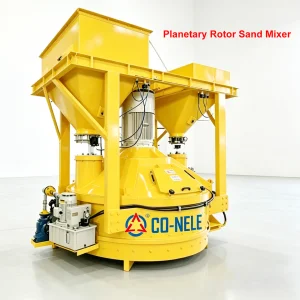
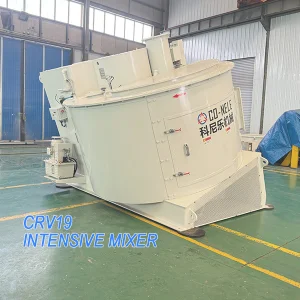
Standard concrete mixers rely primarily on gravity impact or simple linear shear. In contrast, CO-NELE Planetary UHPC Mixers utilize forced-action vertical-shaft counter-current motion. The mixing arms revolve around the central axis of the mixing pan while simultaneously rotating at high speeds around their own axes in opposite directions.
| Kinematic & Operational Parameter | Standard Twin-Shaft Mixer | CO-NELE Planetary High-Shear UHPC Mixer | Impact on Swedish UHPC Quality |
|---|---|---|---|
| Trajectory Density & Coverage | Parallel rotational paths; creates blind spots at vessel margins. | 100% complex planetary trajectory overlap within 30 seconds. | Eliminates unmixed dry powder pockets at pan corners. |
| Steel Fiber Dispersion Efficiency | Low shear rate; prone to fiber clump formation ("bird-nesting"). | High energy density ($kW/m^3$) breaks fiber bundles instantaneously. | Ensures isotropic flexural strength (>25 MPa) in structural elements. |
| Micro-Silica Agglomerate Breakdown | Insufficient shear to overcome Van der Waals forces in dry powders. | Intensive planetary shear forces de-agglomerate sub-micron particles. | Maximizes pozzolanic reaction, achieving dense packing density (>0.82). |
| Coefficient of Variation (CV) | Typical CV: 5.0% - 8.5% | Ultra-low CV: < 2.5% | Exceeds strict Trafikverket quality auditing standards. |
| Temperature Rise Control | Unregulated friction causes rapid thermal spike in low-water mixes. | Optional chilled jacketed pan & amp; calibrated mixing speed profiles. | Prevents premature slump loss during winter mixing operations. |
As demonstrated in empirical batch testing, CO-NELE planetary mixers deliver an optimized power-to-volume ratio ($18 - 25 kW/m^3$ specifically for UHPC matrices, compared to $6 - 10 kW/m^3$ for standard concrete). This mechanical energy input is critical for fully activating PCE molecules across the surface of fine powders, rapidly transitioning dry-mixed ingredients into a fluid, self-consolidating state.
For Swedish contractors, concrete producers, and engineering consultancies, sourcing machinery from a dedicated Chinese OEM manufacturer like CO-NELE provides a compelling combination of technical customization, robust build quality, and unmatched capital expenditure efficiency.
Unlike assemblers who purchase off-the-shelf commercial gearboxes, CO-NELE designs and manufactures its proprietary heavy-duty planetary reducers in-house. Built specifically to handle the extreme shock loads and high torque resistance of UHPC and refractory mixes, our gearboxes ensure decades of uninterrupted service.
All mixing equipment delivered to Sweden is engineered to strict European Economic Area (EEA) requirements. Equipment features full CE Certification, ISO9001 quality management, safety interlocks compliant with EN 12150, and electrical cabinets outfitted with premier global brands (Siemens PLC, Schneider electrics, ABB drives) operating on Swedish 400V 50Hz electrical grids.
Quartz sand, micro-steels, and basalt aggregates common in Swedish concrete production are highly abrasive. Our mixing pans feature field-replaceable high-chrome alloy wear liners (hardness > HRC 62) and specialized composite mixing blades, delivering operational lifespans of up to 150,000+ batches under standard conditions.
Projects along the Swedish coastline (such as offshore installations near Gotland or Skåne) require ultra-dense grout mixtures with high resistance to chloride penetration. CO-NELE mobile and stationary UHPC plants supply uniform, bubble-free grout matrices capable of rapid early strength development (>80 MPa within 24 hours), even in cold marine temperatures.
Trafikverket increasingly specifies thin UHPC overlays (30–50mm) to rehabilitate aging Swedish highway bridges without adding dead weight. Our CMP-series planetary mixers allow jobsite batching plants to maintain precise slump flow (>700mm) while ensuring zero fiber segregation during continuous pours.
Modern Scandinavian architecture emphasizes sleek, lightweight, sustainable building envelopes. CO-NELE intensive mixers deliver flawless color consistency for pigmented UHPC and glass-fiber reinforced concrete (GFRC) panels, completely eliminating surface pinholes and color streaking.
For major Swedish mining complexes in northern Sweden (e.g., Kiruna and Gällivare), high-durability wet-mix shotcrete and UHPC segment liners are critical for deep shaft stability under extreme rock pressure. Our heavy-duty mixers operate continuously in high-dust underground batching environments.
As the global concrete industry moves toward decarbonization, mixer design is evolving rapidly. CO-NELE is at the forefront of incorporating intelligent automation into concrete mixing plants, enabling Swedish operators to comply with upcoming European environmental standards while lowering operational costs.
Integrating microwave moisture sensors with real-time motor torque analysis allows our mixers to automatically dynamically adjust water and PCE dosing. The system detects the exact moment of matrix "phase inversion" (switching from dry powder to liquid flow), optimizing cycle times down to the second.
Swedish cement producers are replacing traditional OPC with calcined clays, granulated blast-furnace slag (GGBS), and volcanic pozzolans. CO-NELE high-shear blades are specially calibrated to thoroughly disperse these fine alternative binders, maintaining 150+ MPa performance while cutting $CO_2$ emissions by up to 50%.
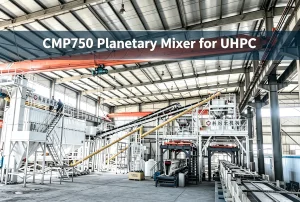
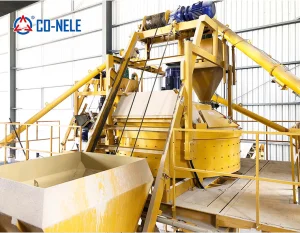
To reduce onsite installation times from months to days, our modern UHPC batching systems are housed within ISO-standard containerized frames. Plug-and-play electrical connectors allow immediate deployment on remote Swedish job sites with zero temporary civil foundation requirement.
Explore our complete machinery catalog engineered for precast yards, laboratory research, refractory production, and heavy construction across Sweden.
Comprehensive technical answers compiled by CO-NELE process engineers for Swedish buyers and EPC contractors.
UHPC recipes feature extremely low water-to-binder ratios (< 0.18) and dense micro-powders (silica fume, quartz flour). A twin-shaft mixer operates on horizontal shearing paths which struggle to break sub-micron powder agglomerates and often cause steel fibers to clump ("bird-nesting"). CO-NELE vertical-shaft planetary mixers use high-shear counter-current motion, covering 100% of the mixing pan floor every 4 rotations. This guarantees homogeneous fiber distribution and complete PCE activation without leaving dead zones.
All export equipment shipped to Sweden is built in compliance with European Machinery Directive 2006/42/EC and carries authentic CE Certification. Control systems operate on standard Swedish voltage (400V, 3-Phase, 50Hz) and are populated with premium European components, including Siemens S7-1200/1500 PLCs, Schneider contactors, and optional ABB variable frequency drives (VFDs). Safety interlocks on inspection doors adhere to EN 12150 standard specifications.
CO-NELE mixing pans are equipped with segmented, field-replaceable high-chrome cast alloy liners with a hardness rating exceeding HRC 62. Mixing blades and scrapers utilize specialized nickel-hardened tungsten carbide coatings. Under intense UHPC production conditions, liner lifespans typically range between 40,000 to 60,000 batches, while standard concrete production lifespans exceed 150,000 batches. All wear components are bolt-on for fast maintenance turnover.
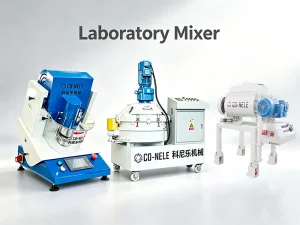
Yes. At our state-of-the-art mixing laboratory in Qingdao, we operate lab-scale intensive and planetary mixers ranging from 5 to 75 liters. Swedish clients can ship sample quantities (10-50 kg) of their local aggregates, cements, micro-silica, and fibers. Our process team will run trials, measure shear rheology, verify fiber dispersion, and provide a full trial report alongside recommended production scale-up parameters.
CO-NELE maintains a comprehensive inventory of interchangeable spare parts for every model manufactured since 2004. Wear parts and critical components can be dispatched via air freight directly to Gothenburg, Stockholm, or Malmö within 3 to 5 business days. Technical support is available 24/7 via remote PLC diagnostics, video guidance, or on-site commissioning engineers upon request.
Whether you are setting up a specialized precast line, upgrading an existing concrete plant, or designing an offshore wind grouting station in Sweden—our engineering team is ready to assist with customized CAD drawings, mixing calculations, and competitive factory-direct quotes.
Send Inquiry Now