
A High Efficiency Glass Mixer blends silica sand, soda ash, limestone, and other approved batch ingredients into a consistent glass-making mixture. Its purpose is practical: distribute materials evenly before they enter the melting process. A well-mixed batch can help reduce composition variation, though it cannot correct every problem in furnace operation or raw-material quality.
Designs vary. Some use rotating drums; others rely on fixed vessels with mechanical paddles or plough-shaped blades. The right choice depends on batch size, ingredient properties, production rate, and cleaning needs. Operators should consider mixing time, discharge consistency, wear parts, dust containment, and access for inspection. These details affect both day-to-day reliability and long-term maintenance.
The label “high efficiency” needs context. It may describe throughput, energy use, mixing uniformity, or a combination of factors, so buyers should request measurable test data rather than rely on a product name. Ask how performance was assessed and whether the test materials match your own batch. Small changes in moisture or particle size can matter. Details matter.
This guide explains the mixer’s main components, typical operation, and practical selection criteria. It also considers limits that are easy to overlook, including cleaning downtime and uneven feeding. No single machine fits every plant. A careful comparison, supported by supplier documentation and operating data, is a more dependable starting point than a headline efficiency claim.
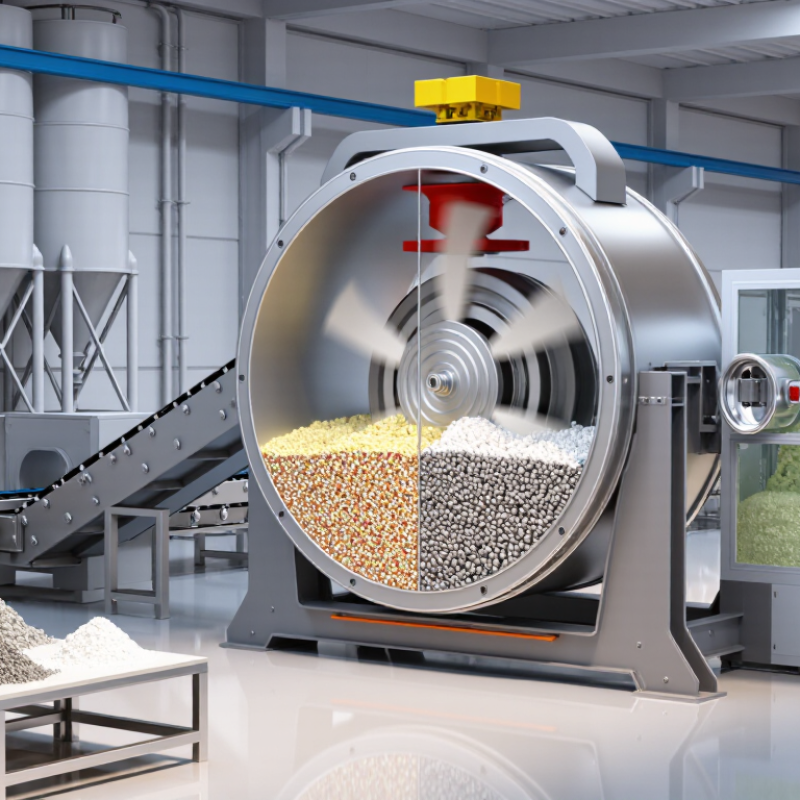
A high-efficiency glass batch mixer blends the measured ingredients used to make glass, including silica sand, soda ash, limestone, and recycled glass. Its purpose is to distribute these materials evenly before they enter the furnace. Consistent blending helps reduce differences in composition from one part of a batch to another.
Small ingredients matter, too. A poorly dispersed additive may affect color or melting behavior.
The operating principle depends on the mixer design. In a rotating drum, the batch tumbles as the vessel turns. In a fixed vessel, paddles or other moving parts circulate and shear the material. Both methods repeatedly lift, separate, and recombine particles.
The goal is a uniform blend without unnecessary breakage or separation. Not simply speed. Operators set batch size, mixing time, and rotation or agitation levels to suit the material.
Moisture and particle size can change how the batch flows, so settings may need adjustment. A mixer can still leave uneven pockets.
That deserves attention. Checking samples from different points in a batch can reveal problems that a clean-looking surface may hide.
A high-efficiency glass mixer combines a well-shaped vessel, suitable blades, a stable drive, and effective dust control. The vessel should hold the batch without dead zones, where powder can collect near corners or beneath the blades. Blade geometry matters: ribbons or paddles must move material through the full vessel, not merely spin it around. That distinction is visible in practice. A clear sample can still hide uneven distribution.
The drive must deliver enough torque for changing batch loads without excessive heat or vibration. A variable-speed setup can help operators adjust mixing as materials change. Dust control is equally important when charging fine silica sand. OSHA’s respirable crystalline silica standard sets an 8-hour permissible exposure limit of 50 micrograms per cubic meter and an action level of 25 micrograms per cubic meter (29 CFR 1910.1053). These limits are exposure benchmarks, not proof that a mixer’s extraction system is adequate. Test airflow and inspect seals under real operating conditions.
Tips: Check blade wear, vessel discharge, and dust-hood capture with a representative batch. Record mixing time and sample several locations; one sample may miss unevenness. No design removes every trade-off. A stronger extraction flow, for instance, may pull useful fines from the process.
What Is a High Efficiency Glass Mixer?
How Mixer Design Promotes Uniform Distribution of Glass-Batch Materials
A high-efficiency glass mixer distributes silica sand, soda ash, limestone, and cullet evenly before the batch reaches the furnace. Its job is not simply to turn material. It must reduce concentration pockets without crushing useful cullet or creating excessive dust. A horizontal paddle mixer can move material through several zones, while carefully positioned blades lift, fold, and redirect the batch. The result is more consistent contact between fine powders and larger particles. Small details matter. Blade clearance, fill level, and mixing time all affect the final blend.
Uniformity also supports predictable melting. The Glass Packaging Institute reports that using 10% more recycled glass can reduce energy use by about 2–3%. That benefit depends on reliable cullet distribution; uneven pockets may melt at different rates and complicate furnace control. Enclosed transfer points and dust extraction help limit segregation after mixing, though they cannot correct a poor batch recipe. Operators often check samples from different mixer locations, rather than trusting one convenient scoop. That takes time. It is also easy to overlook moisture changes or worn blades, and no mixer design can fully compensate for those variables. A good system makes variation easier to detect, not magically disappear.
A high-efficiency glass mixer helps distribute raw materials evenly before they enter the furnace. For typical soda-lime glass, silica makes up about 70–74 wt% of the finished glass, while sodium oxide accounts for roughly 12–16 wt%. These percentages are by weight, not volume. Silica forms the glass network; sodium oxide lowers the temperature needed to melt it. That sounds simple. In practice, the batch also needs stabilizers, commonly calcium oxide, plus smaller amounts of other oxides. Exact recipes vary with the product and process.
The chemistry matters because uneven mixing can leave local differences in composition. A pale streak or an unmelted grain may signal a problem, though furnace conditions also affect the result. Consistent weighing, controlled particle sizes, and checks for batch segregation all support better mixing. Sodium oxide is usually introduced through soda ash, which releases gas as it reacts during melting. Mixing alone cannot remove every bubble or guarantee uniform glass; melting and refining remain important. One detail is easy to underestimate: a well-mixed batch still depends on reliable measurements and careful process control.
Typical soda-lime glass chemistry is dominated by silica, with sodium oxide and other oxides supporting the glass formulation.
The bars show representative composition ranges in weight percent. Formulations vary, and the independent ranges are not intended to add up to exactly 100%.
A high-efficiency glass mixer is not simply a machine that finishes a batch quickly. Its performance depends on mixing time, usable throughput, energy demand, and how evenly material is distributed. For a fair test, keep the recipe, batch size, starting temperature, and loading method consistent. Record the time until the blend meets a defined uniformity target, rather than stopping when it looks ready. Visual checks help, but samples from several points provide stronger evidence. Some variation is inevitable.
Throughput should reflect accepted material per hour, not just total material processed. A fast cycle may create rework, dust, or uneven color, reducing real output. Measure electricity over complete runs, including startup and idle periods, then compare energy per usable kilogram. For batch uniformity, test samples from the top, center, and bottom using an appropriate composition or particle-size check. Repeat trials; one good batch proves little. Even careful measurements have limits: sampling can miss small pockets, and operators may load material differently. Report that uncertainty rather than hiding it.
It distributes silica sand, soda ash, limestone, and recycled glass before furnace processing. The goal is a more consistent blend.
Positioned blades lift, fold, and redirect materials through several mixing zones. This helps fine powders contact larger particles. Small details matter.
Uneven pockets may melt at different rates and complicate furnace control. Reliable distribution helps make melting more predictable, though it cannot guarantee a perfect result.
Blade clearance, mixer fill level, and mixing time all matter. Moisture changes and worn blades can also affect results. They are easy to miss.
Finished glass commonly contains about 70–74% silica and 12–16% sodium oxide by weight. The batch also needs stabilizers, often calcium oxide.
Take samples from different mixer locations, such as the top, center, and bottom. One convenient scoop may miss a concentration pocket.
Track mixing time, accepted throughput, energy use, and batch uniformity. Compare energy per usable kilogram across complete runs, including startup and idle periods.
No. A quick cycle may create uneven color, dust, or rework. Repeat trials; one good batch proves little. Sampling also has limits.
A High Efficiency Glass Mixer is designed to blend the ingredients of a glass batch quickly and evenly before melting. Its operating principle is to move and redistribute materials throughout a mixing vessel so that components with different particle sizes and proportions are less likely to remain separated. A typical mixer includes the vessel, mixing blades, a drive system, and dust-control equipment. Together, these parts support consistent mixing while containing airborne particles generated during material handling.
Mixer geometry, blade arrangement, and operating conditions influence how uniformly the batch is distributed. This matters for soda-lime glass, whose typical composition includes about 70–74 wt% SiO₂ and 12–16 wt% Na₂O, alongside other ingredients. Performance can be evaluated by considering mixing time, throughput, energy use, and batch uniformity. A well-designed system balances these factors to produce a consistent blend without unnecessary processing time or energy consumption.
