
Selecting a Refractory Granulating Mixer is a practical decision, not just a comparison of catalogue specifications. Refractory batches can contain dense minerals, fine powders, and binders that behave differently under changing moisture levels. A mixer must distribute these ingredients evenly while producing granules suited to forming and handling. Small details matter. Look closely at batch capacity, mixing action, discharge design, wear protection, and how easily operators can clean the machine.
This 2026 guide reviews ten manufacturers and the equipment features buyers may want to investigate. It is intended as a starting point, not a substitute for trials with your actual materials. Ask suppliers about comparable installations, spare-part availability, service response, and test results for similar recipes. A polished brochure cannot show every production constraint. Nor can one machine specification guarantee consistent granules.
Taiichi Ohno, the manufacturing engineer associated with the Toyota Production System, said, “Where there is no standard, there can be no kaizen.” That principle offers a useful lens for evaluating mixer manufacturers: dependable results need clear operating standards and measurable checks. For a refractory line, those checks might include moisture variation, granule-size distribution, batch time, and residue after discharge. No comparison is perfect. Some details depend heavily on plant layout and material behavior, and published data may not answer every question. The manufacturers in this guide provide a focused shortlist for further technical review, careful questioning, and—where possible—material testing before purchase.
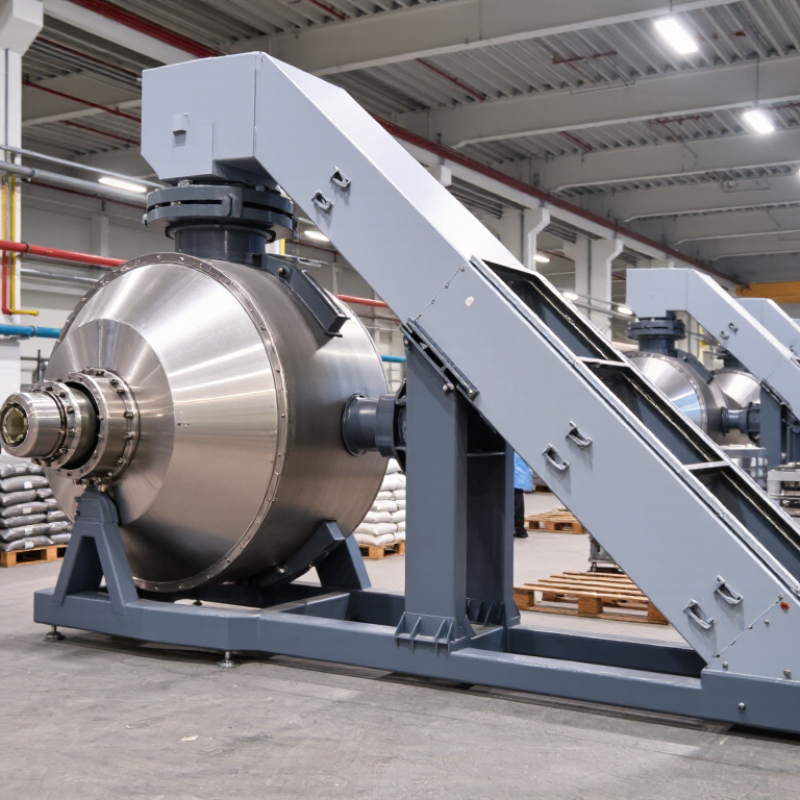
A refractory granulating mixer blends dry mineral powders with measured liquid binders, forming damp granules rather than a smooth paste. The mixer’s blades or paddles distribute moisture through the batch. Operators watch for a consistent texture, often checking whether granules hold together when lightly squeezed. Small adjustments matter.
These mixers are used in manufacturing shaped refractory products, including pressed bricks and other components that need controlled feed material. Granules with suitable moisture and size can flow more evenly into a press, helping reduce uneven filling. In some production lines, granulated mixes also serve as prepared feed for further forming steps. The exact recipe and mixing time depend on the raw materials, binder, and product design.
A practical setup includes dust control, accessible cleaning points, and a way to regulate liquid addition. Too little moisture may leave a dusty, fragile batch; too much can create sticky lumps and slow forming. Not every batch behaves as expected. A uniform-looking mix can still vary inside, especially when powders differ in particle size or absorbency. Sampling granules from several parts of the mixer is a useful check, though it adds time. Operators should validate settings with production trials rather than rely on appearance alone.
The 2026 list compares manufacturers using evidence that buyers can check. Key factors include batch capacity, mixing consistency, wear-resistant construction, dust control, cleanout access, and after-sales support. The World Steel Association’s World Steel in Figures 2025 reports 1,882.6 million tonnes of crude steel production in 2024. This scale highlights why reliable refractory preparation matters across industrial supply chains. It does not, by itself, prove one mixer is better than another. We also consider whether technical documents explain operating limits and maintenance needs. Claims without supporting records receive less weight.
A strong evaluation checks more than headline capacity. Review test methods, parts availability, service response times, and references from comparable production conditions. Where possible, compare documented performance under similar batch sizes and moisture levels. Published specifications can be incomplete, and manufacturer-provided data is not the same as independent verification. Rankings should therefore be read as a structured comparison, not a guarantee of results at every plant.
These ten profiles highlight different strengths without relying on brand claims. One manufacturer specializes in heavy-duty pan mixers for dense, abrasive batches. Another builds continuous granulators for steady production. A third offers compact pilot-scale equipment. One focuses on moisture dosing and spray control. Another designs integrated mixing and conveying lines. A sixth emphasizes replaceable liners and wear-resistant paddles. A seventh adapts equipment to unusual plant layouts. An eighth supports high-capacity production. A ninth concentrates on retrofits for existing mixers. The tenth provides commissioning and operator training.
Small details matter. Refractory mixes can vary in grain size, binder content, and water demand, so equipment performance depends on the actual recipe.
A useful profile should explain working capacity, mixing time, discharge design, and available test data. Ask how the supplier handles abrasive wear and cleaning between batches. Request a trial with representative raw materials when possible. A polished brochure is not proof of consistent granule quality. I would also check service access; it is easy to overlook until a paddle needs replacement.
Tips: Compare usable batch volume, not just rated capacity. Confirm contact materials, spare-part lead times, and local service options. Record granule size and moisture results during trials, then review them with production staff.
A useful comparison of refractory granulating mixers starts with the material, not the catalogue capacity. Dry fines need different action from damp, abrasive mixes. Pan mixers offer visible circulation and convenient discharge; intensive mixers use higher shear for faster granule formation, but can increase wear. Twin-shaft designs handle larger, continuous flows, though they need careful control of feed consistency. No design wins every batch. A small pilot run can reveal dead zones, uneven moisture, or granules that break during discharge.
Capacity figures deserve scrutiny. Ask whether rated output means batch volume, mass per cycle, or hourly throughput, and request test conditions matching your recipe. The Grand View Research Refractory Market report estimated the global market at about USD 27.5 billion in 2023, with projected annual growth of 4.3% through 2030. That market context does not prove mixer performance; it makes application-specific evidence more important. Compare motor power, blade clearance, wear-part life, and cleaning time alongside nominal capacity. Support matters, too. Check whether technicians can review trial data, advise on moisture adjustment, and supply replacement parts promptly. Get response times in writing. One detail is easy to miss: commissioning support may be strong, while later troubleshooting is less clear. Ask for references using similarly abrasive materials and confirm what happens when the first batches fall short.
Anonymous comparison of common supplier and mixer configurations. Capacity figures are indicative equipment ranges, not verified specifications for individual companies or a ranked list. Confirm suitability, throughput, and service coverage directly with suppliers.
| No. | Anonymous supplier profile | Mixer design | Indicative working capacity | Typical refractory application | Granulation and process considerations | Technical support to verify |
|---|---|---|---|---|---|---|
| 01 | Intensive-mixer specialist | Rotating pan with high-speed mixing rotor | About 50–2,000 L per batch | Castables, dry mixes, and granulated refractory feed | Intensive circulation can support rapid wetting and granule formation; recipe trials are important for binder-sensitive mixes. | Ask about trial testing, rotor and pan wear parts, and recipe commissioning. |
| 02 | Twin-shaft paddle mixer supplier | Counter-rotating shafts with mixing paddles | About 100–5,000 L per batch | Refractory batches requiring strong bulk movement | High material turnover may suit short mixing cycles; check paddle clearance and discharge residuals. | Confirm shaft-seal design, paddle replacement procedure, and on-site installation support. |
| 03 | Planetary-mixer supplier | One or more rotating tools moving around a vessel | About 50–2,000 L per batch | Dense, cohesive, or high-solids refractory mixes | Tool paths promote vessel coverage; determine whether the selected tool set can form the required granule size. | Request documented test results, tool-life guidance, and drive-system maintenance details. |
| 04 | Ploughshare-mixer supplier | Horizontal vessel with plough-shaped tools and optional choppers | About 100–5,000 L per batch | Dry blending and liquid-assisted granulation | Choppers can break agglomerates; assess dust control, liquid-addition points, and granule uniformity in trials. | Check availability of wear liners, chopper spares, and process troubleshooting. |
| 05 | Intensive rotor-and-pan supplier | High-energy rotor operating in a stationary or rotating pan | About 50–1,500 L per batch | Small-to-medium batches and controlled granule production | Rotor speed and liquid feed influence granule growth; verify scale-up against the target particle-size distribution. | Ask whether the supplier offers pilot-scale trials and operating-parameter training. |
| 06 | Ribbon-blender supplier | Horizontal trough with inner and outer helical ribbons | About 100–10,000 L per batch | Dry refractory blends and lower-intensity conditioning | Typically used for blending rather than high-energy granulation; confirm that the mixing action meets wetting and granule-strength targets. | Verify discharge performance, cleaning access, and support for ribbon and bearing replacement. |
| 07 | Vertical pan-mixer supplier | Vertical vessel with rotating tools and scraper arms | About 100–3,000 L per batch | Batch mixing of granular and plastic refractory materials | Scrapers can reduce wall build-up; inspect vessel geometry and discharge design for the actual feed material. | Confirm access to wear components, commissioning assistance, and operator instruction. |
| 08 | Continuous-mixer supplier | Continuous paddle or rotor mixer with metered feed | Often specified by throughput, roughly 1–30 t/h depending on design and material | Steady production lines with consistent formulation and feed rates | Requires stable ingredient dosing; validate residence time, moisture control, and start-up or shutdown procedures. | Ask about controls integration, dosing calibration, and remote diagnostics. |
| 09 | Heavy-duty batch-mixer supplier | Robust double-shaft or paddle design with reinforced wear zones | About 500–10,000 L per batch | Large production batches and abrasive raw materials | Wear protection and drive sizing are key selection factors; assess abrasive wear using representative feed. | Check spare-part lead times, wear-part options, and maintenance support near the installation site. |
| 10 | Pilot-to-production mixer supplier | Scalable batch platform with interchangeable tools or vessel sizes | About 10–2,000 L per batch across pilot and production units | Process development followed by production scale-up | Scale-up depends on material behavior and energy input; pilot results do not guarantee identical production granules. | Request a scale-up plan, acceptance-test criteria, and post-installation process support. |
Capacity ranges are broad industry reference ranges and depend on vessel volume, fill ratio, bulk density, formulation, batch time, and machine configuration. They should not be treated as guaranteed output or as company-specific performance data.
Choosing a refractory granulating mixer starts with the material, not the catalogue. World Steel Association’s World Steel in Figures 2025 reports 1,882.6 million tonnes of crude steel production in 2024. That figure does not define mixer capacity, but it highlights the importance of consistent refractory batches in demanding industrial processes. The International Energy Agency’s Iron and Steel Technology Roadmap (2020) estimates that steelmaking accounts for about 8% of global final energy demand. Efficient mixing can support process control, though a mixer alone cannot deliver plant-wide energy savings.
Check the feed’s particle-size range, moisture sensitivity, and binder requirements before comparing machines. Abrasive grains can wear paddles and liners, so ask about material selection and expected maintenance intervals. A variable-speed drive can help operators adjust mixing action for different recipes. Still, maximum capacity is not enough: assess working-volume range, discharge time, and residue left in the vessel. Small tests matter. Compare samples using sieve analysis, moisture checks, and bulk-density measurements.
Request a production-scale trial with your actual raw materials. Observe whether granules form evenly, whether fine dust remains, and whether the batch discharges cleanly. Record cycle time and motor load; these details can reveal problems that a sample photo misses. A perfect lab batch can still fail at production scale. It is worth admitting that supplier claims rarely capture every shift, operator, or material variation. Plan for wear checks and routine calibration, then confirm the mixer fits your real operating conditions.
It blends dry mineral powders with measured liquid binder. The result is damp granules, not smooth paste.
Lightly squeeze a sample. It should hold together without becoming sticky. This quick check helps, but it cannot reveal every variation inside the batch.
Even granules can flow more evenly into a press and help reduce uneven filling. Small differences in size or moisture may still affect production.
Review its working-volume range, discharge time, and leftover residue. A large capacity figure alone says little about daily performance.
Request a production-scale trial using your actual powders and binder. Inspect clumps, dust, coating, and discharge. Photos are not enough.
Check moisture, sieve results, and bulk density. Record cycle time and motor load too. Small tests matter.
Look for accessible cleanout points, controlled liquid addition, and dust control. These details can save time, though cleaning still takes work.
Ask about paddle and liner materials, expected inspection intervals, parts availability, and service response times. Abrasive grains can wear components faster than expected.
No. Efficient mixing may support process control, but a mixer alone cannot deliver plant-wide energy savings. That distinction is easy to overlook.
This article explores the role of the Refractory Granulating Mixer in preparing consistent batches of refractory materials for demanding industrial applications. It explains how these machines support granulation and mixing, and outlines the types of production settings where dependable material consistency, controlled moisture, and efficient processing are important.
The guide also presents a framework for evaluating manufacturers in 2026 and profiles ten suppliers without focusing on brand promotion. It compares mixer designs, processing capacity, and technical support, helping readers understand how equipment options may differ. Finally, it highlights practical selection factors, including production requirements, material characteristics, operating conditions, maintenance needs, and service availability. Together, these topics offer a clear starting point for assessing equipment and identifying a mixer configuration suited to a facility’s process and long-term operational goals.
