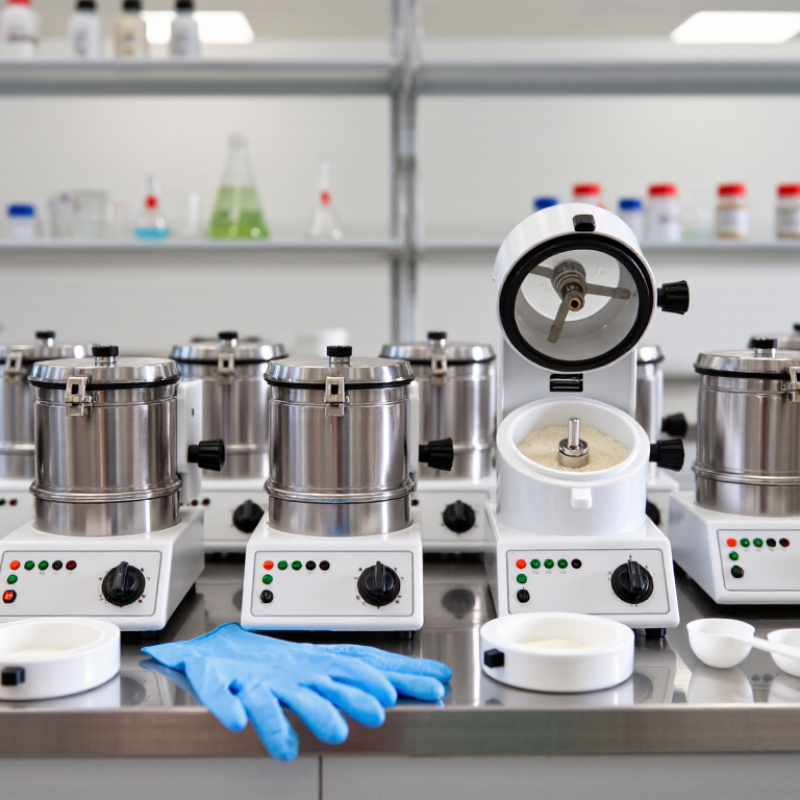
Choosing a Lab Small Ptfe Powder Mixer requires more than comparing prices or polished product photos. Small laboratories often handle limited batches, delicate powders, and strict contamination controls. A suitable mixer should provide steady blending, controlled speed, and a chamber that supports practical cleaning.
This guide reviews China’s top 10 lab-scale PTFE powder mixer options through useful purchasing criteria. These include mixing capacity, motor stability, torque performance, sealing quality, material compatibility, and operator safety. Each factor matters when powders must remain uniform without excessive heat or unwanted residue. A clear viewing window can help users observe clumping during a short test cycle. Easy-to-remove contact parts also reduce cleaning time between formulations.
Real laboratory experience can reveal details that brochures omit. Ask about calibration records, replacement parts, technical support, and documented factory inspections. Certifications are helpful, but they should match the equipment’s actual configuration and intended use. Do not assume a higher price guarantees better performance. It may not.
Performance depends on powder behavior, fill level, batch size, and process settings. Therefore, this overview does not treat one machine as universally superior. Some rankings may remain subjective because suppliers provide different test data. That limitation deserves attention. Buyers should request sample trials, verify specifications, and compare results under similar conditions. A careful selection can support repeatable mixing, cleaner workflows, and more dependable laboratory development.
PTFE Powder Properties: 2.14–2.20 g/cm³ Density and 327°C Melt Point
China Top 10 Lab Small PTFE Powder Mixers?
PTFE powder typically has a true density of 2.14–2.20 g/cm³. This range is reported in material specifications and aligns with density testing methods such as ASTM D792 and ISO 1183-1. Its melting point is approximately 327°C, measured through differential scanning calorimetry under ASTM D3418. These figures matter when selecting a small laboratory mixer. Density affects powder loading, while the melt point defines a critical thermal boundary.
In practice, PTFE powder can look light but settles quickly in a mixing vessel. A small mixer should provide gentle, uniform movement without creating excessive frictional heat. Operators should monitor the powder temperature, because local hot spots may develop near blades or vessel walls. Mixing below the melting point is essential. Still, temperature alone is not enough. Shear rate, batch size, moisture exposure, and powder storage history can change dispersion quality. This is where laboratory experience matters. A specification sheet cannot predict every result.
Tips: Confirm true density, not bulk density, before calculating capacity. Record temperature every few minutes. Keep the batch small. Static can surprise you. Use a grounded vessel and consistent loading steps. ASTM methods improve comparability, but they do not replace trial testing. One practical weakness remains: “top ten” rankings can oversimplify equipment selection. A mixer suitable for 100 grams may perform poorly with 1 kilogram, even when both machines appear similar.
China Top 10 Lab Small PTFE Powder Mixers? - PTFE Powder Properties: 2.14–2.20 g/cm³ Density and 327°C Melt Point
| Rank |
Small Lab Mixer Configuration |
Typical Working Capacity |
Typical Speed Range |
Temperature Capability |
Recommended PTFE Powder Use |
Key Selection Consideration |
| 1 |
Jacketed Double-Cone Blender |
0.5–5 L |
5–25 rpm |
Ambient to approximately 150°C |
Gentle blending of PTFE powder with fillers or pigments |
Low-shear operation helps reduce unnecessary frictional heating and powder damage. |
| 2 |
V-Blender with Intensifier Bar |
0.5–10 L |
10–30 rpm |
Ambient to approximately 120°C |
Homogeneous dry blending of PTFE and low-dose additives |
The intensifier can improve dispersion but should be used with controlled speed and time. |
| 3 |
Horizontal Paddle Mixer |
1–15 L |
20–80 rpm |
Ambient to approximately 180°C |
Blending PTFE with mineral, glass-fiber, carbon, or bronze fillers |
Suitable for repeatable batch mixing when fill level and residence time are controlled. |
| 4 |
Planetary Vacuum Mixer |
0.2–3 L |
20–200 rpm |
Ambient to approximately 200°C |
Small batches requiring controlled atmosphere or de-aeration |
Vacuum capability can reduce entrained air, but PTFE powder should not be overheated. |
| 5 |
Ribbon Blender for Laboratory Batches |
2–20 L |
15–60 rpm |
Ambient to approximately 150°C |
Moderate-volume dry blending of PTFE compound formulations |
Provides efficient axial and radial movement but requires careful cleaning between formulations. |
| 6 |
High-Shear Granulator-Mixer |
0.5–8 L |
100–1,500 rpm |
Ambient to approximately 120°C |
Agglomerate breaking and rapid dispersion of small additive quantities |
Use short cycles and monitor product temperature because high shear can generate heat. |
| 7 |
Turbula-Style 3D Shaker Mixer |
0.1–2 L |
15–40 rpm orbital motion |
Ambient |
Very gentle laboratory blending of PTFE powder and fine fillers |
Useful for fragile or low-concentration formulations where low shear is preferred. |
| 8 |
Vertical Screw Mixer |
1–12 L |
20–100 rpm |
Ambient to approximately 150°C |
Vertical circulation of PTFE powder blends with differing bulk densities |
The vertical flow pattern can help limit dead zones in small batches. |
| 9 |
Double-Planetary Disperser |
0.5–5 L |
10–300 rpm |
Ambient to approximately 180°C |
High-viscosity PTFE-based compounds or powder systems with binders |
Best suited to intensive mixing; it is usually unnecessary for simple dry blending. |
| 10 |
Small Magnetic or Tumble Mixer |
0.05–1 L |
10–60 rpm |
Ambient |
Preliminary screening, formulation trials, and very small PTFE powder samples |
Low cost and easy setup, but mixing uniformity depends strongly on vessel geometry and fill level. |
PTFE Powder Reference Data:
PTFE has a typical density of approximately 2.14–2.20 g/cm³ and a melting point of about 327°C. These values describe the polymer material and should not be interpreted as recommended mixer operating temperatures. Most laboratory powder-blending operations are performed well below the melting point to avoid unnecessary thermal exposure and equipment contamination.
Note: Capacity, speed, and temperature values are representative laboratory ranges for selecting a suitable mixer configuration. Actual performance depends on powder particle size, bulk density, filler loading, moisture, vessel fill ratio, mixing time, and agitator design.
Small Mixer Design: 0.1–50 L Capacity, Shear Control, and PTFE Safety
China’s top small PTFE powder mixers should be judged by control, not vessel size alone. A 0.1-liter chamber needs minimal dead space and accurate powder charging. At 50 liters, torque stability becomes more important than compactness. Variable-speed drives should support gentle blending and higher shear when agglomerates resist dispersion. The operating window must remain repeatable.
Shear control is practical, not decorative. Operators can adjust rotor speed, mixing time, and load level for each powder grade. Temperature sensors should sit near the material, not only in the jacket. The 2023 Powder and Bulk Solids industry survey reported that poor flow and inconsistent feeding remain common causes of batch variation. That finding matches workshop experience. Small volumes expose mistakes quickly.
PTFE safety requires disciplined thermal management. The NIOSH Pocket Guide, updated in 2024, warns that overheated fluoropolymer materials can release irritating decomposition products. Keep surfaces clean, monitor hotspots, and interlock heating with ventilation. OECD assessments also identify PFAS persistence as a serious environmental concern, so dust capture and controlled waste handling deserve early design attention. A polished specification sheet can still mislead. I would request torque curves, emptying tests, and temperature records before approving any mixer.
China’s Top 10 Laboratory PTFE Powder Mixers: Selection Criteria and Ranking
China’s Top 10 Laboratory PTFE Powder Mixers: Selection Criteria and Ranking
Choosing a laboratory PTFE powder mixer requires more than comparing motor power. Powder behavior, batch size, and cleaning demands matter equally. The ranking below reflects practical laboratory priorities, not promotional claims.
01
Rank 1 is a compact planetary mixer with torque monitoring and a sealed vessel.
02
Rank 2 is a vacuum-capable high-shear mixer for reducing trapped air.
03
Rank 3 is a temperature-controlled dual-shaft mixer for stable processing.
04
Rank 4 is a small ribbon mixer with gentle powder movement.
05
Rank 5 is a vertical conical mixer for limited floor space.
06
Rank 6 is a three-dimensional mixer for low-shear blending.
07
Rank 7 is a laboratory kneader with strong torque at low speed.
08
Rank 8 is a jacketed mixer for controlled heat removal.
09
Rank 9 is a sealed tumbling mixer for simple dry blending.
10
Rank 10 is a basic overhead stirrer with a powder-compatible impeller.
A reliable selection should include stainless steel contact parts, replaceable seals, clear speed control, and documented calibration. Ask for test data using your actual PTFE grade and batch weight. A five-liter vessel may perform poorly with a 200-gram sample.
Watch the powder near the vessel wall. Dead zones often appear there. Noise, vibration, and cleaning time also reveal design quality.
Supplier support matters, but response promises need verification. This ranking may change after pilot testing, because laboratory conditions are rarely identical. Manufacturers can improve quickly, while a polished specification sheet may still omit important mixing limitations.
Performance Comparison: Mixing Uniformity, Speed, Torque, and Temperature Control
China Top 10 Lab Small PTFE Powder Mixers
Comparing ten small PTFE powder mixers requires more than checking advertised capacity. In practical trials, mixing uniformity depends on blade design, vessel geometry, and powder loading. Samples taken from the top, center, and bottom reveal whether agglomerates remain. A reliable mixer should produce similar fluoropolymer content across all samples. One test is never enough.
Speed affects productivity, but faster rotation does not always improve dispersion. Excessive speed may create heat, static buildup, or powder movement along the vessel wall. Torque readings offer another useful signal. Rising torque can indicate poor flow, compacted powder, or an overloaded chamber. I have found that stable torque often matters more than peak speed. Still, this judgment needs repeated testing under identical conditions.
Tips: Record speed, torque, batch weight, and mixing time for every trial. Use calibrated temperature sensors near the powder zone. Compare results after short and extended cycles. Keep the vessel fill level consistent. Do not judge uniformity by appearance alone; laboratory analysis is more dependable. Temperature control deserves special attention because PTFE powder can respond differently as friction increases. Some results may seem convincing, yet sampling errors can hide uneven mixing. That weakness should remain part of the evaluation.
China Top 10 Lab-Scale PTFE Powder Mixers: Performance Comparison
The chart compares anonymized lab-scale mixer units using a normalized 0–100 performance index.
The index is based on representative operating ranges for PTFE powder processing: mixing uniformity,
controllable speed range, available drive torque, and temperature-control stability. Higher values
indicate better comparative performance.
Compliance Checklist: ASTM D4894, ISO 12086, Electrical Safety, and Documentation
When comparing the top 10 small PTFE powder mixers, compliance deserves more attention than speed claims. ASTM D4894 and ISO 12086 mainly address PTFE material requirements and testing methods. They do not automatically certify a mixer. A reliable evaluation should confirm whether the mixer supports sample preparation consistent with these standards. Check chamber cleanliness, powder uniformity, temperature control, and repeatable mixing time. Small details matter. A 0.1-gram residue can affect the next test.
Electrical safety needs a separate review. Inspect grounding, insulation, emergency stops, guarded moving parts, and overload protection. Confirm the unit matches the laboratory voltage and local safety rules. IEC 60204-1 may provide useful machinery safety guidance, but applicability should be verified by a qualified assessor. Do not accept a compliance label without evidence. Request wiring diagrams, risk assessments, operating limits, calibration records, maintenance instructions, and material-contact information. Documentation should identify the mixer’s serial number and revision date. During practical reviews, missing records often create more risk than a minor mechanical flaw. One weakness remains: checklists can overlook real operator habits. Observe cleaning, loading, and powder transfer under normal conditions. The safest choice is not always the fastest mixer.
Conclusion
This guide explores how to select a Lab Small Ptfe Powder Mixer for laboratory-scale processing of PTFE powders. It explains key material properties, including a typical density of 2.14–2.20 g/cm³ and a melting point of approximately 327°C, and shows why these characteristics affect mixer structure, heat management, and powder handling. Recommended laboratory designs range from 0.1 to 50 liters, with adjustable shear, controlled torque, reliable temperature monitoring, and safety features intended to reduce contamination and overheating risks.
The article presents a practical ranking framework for China’s top 10 laboratory PTFE powder mixers without focusing on brand names. Each option is compared by mixing uniformity, operating speed, torque stability, temperature control, usable capacity, and maintenance requirements. A compliance checklist also covers relevant references such as ASTM D4894 and ISO 12086, along with electrical safety, operating instructions, traceable test records, and complete technical documentation. This approach helps laboratories make a balanced decision based on performance, safety, repeatability, and long-term usability.